Mellow Protocol
Curated, permissionless vault infrastructure that pivoted from a general DeFi liquidity-management toolkit into the Lido-allied liquid restaking (LRT) layer for Symbiotic, letting third-party curators build risk-tiered restaking products on top of shared vault primitives.
▶ Run interactive simulation animated mechanism with editable parameters
How it works onchain
 Open full-size diagram
Summary
Mellow Protocol launched in late 2021 as general-purpose, permissionless vault infrastructure for "optimal cross-protocol liquidity allocation" on Ethereum — a toolkit for building capital-efficient DeFi strategies, first put through a Code4rena security contest in December 2021. It found little independent traction as a generic vault layer, but repositioned itself decisively in 2024 as the vault backbone for liquid restaking (LRT) built on Symbiotic, the Paradigm- and Lido-founder-backed EigenLayer competitor. Launching alongside Symbiotic on June 11, 2024, Mellow shipped restaking vaults for stETH holders curated by third parties (Steakhouse Financial, P2P.org, Re7 Labs, MEV Capital), gathering over $115M in deposits within 24 hours as part of what Lido called the "Lido Alliance." Mellow has since evolved into "Core Vaults," a more general curated-strategy engine, while remaining closely tied to Lido/Symbiotic restaking flows. As of March 2026 its TVL had grown to roughly $300M amid renewed points-farming activity ahead of a still-unannounced token.
Design (Mechanism)
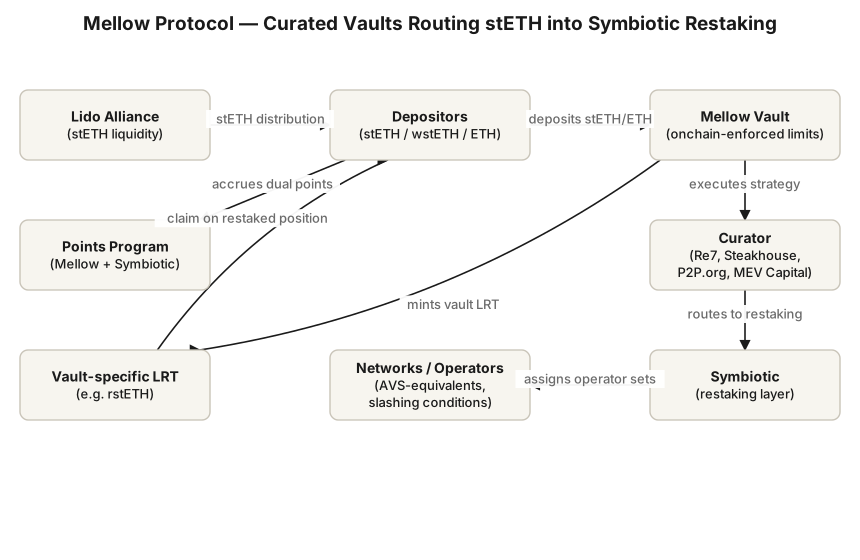
Mellow's core primitive is the curated vault: depositors supply an asset (originally stETH/wstETH/ETH, later broader collateral) into a smart-contract vault whose strategy is executed by a designated third-party "curator" (e.g., Re7 Labs, Steakhouse, P2P.org, MEV Capital) rather than by Mellow itself. Crucially, curators operate within onchain-enforced limits — permitted actions, execution venues, and capital-movement bounds are fixed in the vault's configuration, so a curator "cannot arbitrarily change strategy behavior." This is designed to let sophisticated risk managers differentiate products (different restaking operator sets, different AVS/network exposure, different withdrawal terms) while depositors retain protocol-level guarantees that curators can't rug the vault's mandate.
On the restaking side, Mellow vaults route deposited stETH/ETH into Symbiotic, which — unlike EigenLayer's more restrictive whitelisting — accepts arbitrary ERC-20 collateral and lets networks (AVS-equivalents) define their own operator sets and slashing conditions. Each Mellow vault thus becomes a bespoke liquid restaking token (LRT) with its own risk profile: rstETH (Re7 Labs-curated) was an early flagship product. Depositors receive a vault-specific LRT representing a claim on the underlying restaked position plus (eventually) queued/delayed withdrawals back to the base asset, mirroring liquid-staking mechanics one layer up. Both Mellow and Symbiotic ran parallel points programs, letting depositors farm dual (and via integrations like Ethena, triple) point allocations as an implicit promise of future token value. The protocol later generalized this curated-vault architecture into "Core Vaults," described by the team as an "infinite strategy engine" not limited to restaking, plus supporting products (MultiVault, Interoperable Vaults, Simple LRT, Distributed Validator Vaults/DVV) that have each been independently audited.
Outcome
Ongoing. Mellow's pivot from generic vault tooling to Lido-aligned restaking infrastructure was its inflection point: it launched with Symbiotic in June 2024 to immediate multi-hundred-million-dollar deposits, becoming a visible piece of Lido's defense of its dominant liquid-staking position against the 2024 wave of restaking protocols. TVL has been volatile and closely tracks points-farming sentiment and the broader restaking narrative — surging at launch, cooling through 2025, and rebounding to roughly $300M by March 2026 on renewed airdrop speculation. No MELLOW token has launched as of the last verification date despite roughly two years of points accrual, leaving depositors' implicit token expectations unresolved. No major exploit of Mellow's core contracts has been publicly reported.
Why it worked
- Riding an incumbent's coattails. By becoming the vault layer for Lido's counter-move against EigenLayer-based LRTs, Mellow inherited distribution, trust, and stETH liquidity from the largest liquid-staking protocol rather than having to bootstrap demand alone.
- Curator model outsourced risk-differentiation. Letting named, reputable risk managers (Re7, Steakhouse, P2P, MEV Capital) design and market individual vaults let Mellow scale product variety without the core team owning every strategy decision or reputational risk.
- Points stacking as a growth lever. Compounded Mellow + Symbiotic (+ Ethena, at times) points made deposits attractive purely as an airdrop-farming trade, pulling in capital independent of underlying restaking yield.
- Onchain-enforced curator limits gave depositors a credible reason to trust third-party strategy managers they'd never interacted with before, a prerequisite for the multi-curator model to work at all.
Limitations and criticisms
Mellow's original 2021 vision — permissionless, general-purpose vault infrastructure for any DeFi strategy — never found independent product-market fit and lay largely dormant until repurposed for restaking three years later; the "Mellow Protocol" most users know today is a 2024 pivot, not the original product. Even in its restaking incarnation, growth has been closely coupled to speculative points-farming rather than durable yield demand, producing TVL swings tied to airdrop sentiment cycles rather than steady adoption. The prolonged absence of a MELLOW token (still unlaunched roughly two years after the points program began) risks the same farm-and-dump dynamics and user fatigue seen in other extended points programs, and it ties Mellow's fortunes tightly to Symbiotic's and Lido's own trajectories — a Symbiotic slashing incident or a Lido governance setback elsewhere could hit Mellow hard given its lack of independent brand equity.
Lessons
- A protocol's stated "core mechanism" is not fixed: Mellow's vault-permissioning primitive was general enough to be repurposed wholesale from generic DeFi liquidity management into liquid restaking, showing that flexible infrastructure can survive a failed initial go-to-market by finding a new narrative to attach to.
- Curated, permissioned strategy vaults with onchain-enforced boundaries let a protocol scale product variety (and offload reputational risk to named curators) without centralizing every decision in the core team — a pattern increasingly common across restaking and RWA vault platforms.
- Aligning with a dominant incumbent (Lido) for distribution can produce faster bootstrapping than competing head-on, but it also caps upside and creates correlated downside risk with that incumbent's health.
- Stacked points programs are a powerful but double-edged growth tool: they mobilize capital quickly, but an extended, multi-year points period without a token event risks converting farmers into critics and creates governance pressure to eventually "make good" on years of implicit promises.
Redesign (EDITORIAL — hypothesis, not fact)
This section is editorial speculation. A more resilient Mellow would (1) decouple protocol-level fee revenue from the token-launch overhang by charging curators/vaults a modest, transparent onchain fee from day one, so the protocol has demonstrable cash-flow-based value independent of speculative points; (2) publish a firm points-to-token conversion timeline and formula at program launch rather than leaving it open-ended for years, reducing the farm-and-wait dynamic that erodes trust; (3) require curators to post disclosed, quantified risk parameters (operator concentration, slashing exposure, AVS/network correlation) in a standard machine-readable format so depositors can compare vaults on real risk rather than headline APR or brand name alone; and (4) diversify restaking-network exposure within a single vault (rather than single-curator, single-network defaults) to reduce the correlated-failure risk of depending on one operator set or one underlying restaking protocol like Symbiotic.
Sources
- Mellow Protocol official documentation — primary (docs)
- Code4rena: The Ones in the Arena — Mellow Protocol (Dec 2021 audit contest announcement) — primary (docs)
- The Block: Liquid restaking platform Mellow launches with Symbiotic (news)
- CoinDesk: Lido Introduces 'Restaking Vaults' in Collaboration with Symbiotic, Mellow Finance (news)
- The Defiant: Mellow Finance to Help Lido Hold On to its Place as Largest DeFi Protocol (news)
- p2p.org: rstETH restaking guide on Mellow (docs)
- Crypto Times: What's With Mellow Protocol? TVL Surges Past $300M Amid Airdrop Buzz (March 2026) (news)
- DefiLlama: Mellow Protocol TVL, Fees & Revenue (analysis)
- Mellow Protocol Substack: Core Vaults — The Infinite Strategy Engine (docs)
Related experiments
Last verified: 2026-07-27 · Spot an error? Suggest a correction