Hylo
A Solana protocol that splits a pool of liquid-staking-token collateral into a high-yield stablecoin (hyUSD) and a liquidation-free leveraged SOL token (xSOL), with xSOL absorbing price volatility so hyUSD can stay pegged.
▶ Run interactive simulation animated mechanism with editable parameters
How it works onchain
 Open full-size diagram
Summary
Hylo is a Solana-native DeFi protocol that turns a basket of liquid staking tokens (LSTs — mSOL, JitoSOL, and Hylo's own hyloSOL/hyloSOL+) into two complementary claims on the same collateral pool: hyUSD, a dollar-pegged stablecoin, and xSOL, a leveraged long on SOL that is structurally incapable of being liquidated. The team — pseudonymous builders going by Plish (CEO), Shoom, and Sape — came together in the Lamport DAO Discord during the 2023 bear market, won a Colosseum hackathon, and shipped mainnet around June 2025. Hylo raised a $1.5M seed round in August 2025 (Robot Ventures, Colosseum, Solana Ventures) and grew from roughly $10M to over $100M in TVL within its first several months, weathering an industry-wide October 2025 flash crash before contracting sharply again in early 2026 as SOL fell. As of mid-2026 the protocol is live, ongoing, and has begun expanding the same primitive to other assets (xBTC, and a V2 "xAsset Engine" targeting tokenized leveraged-ETF-like products).
Design (Mechanism)
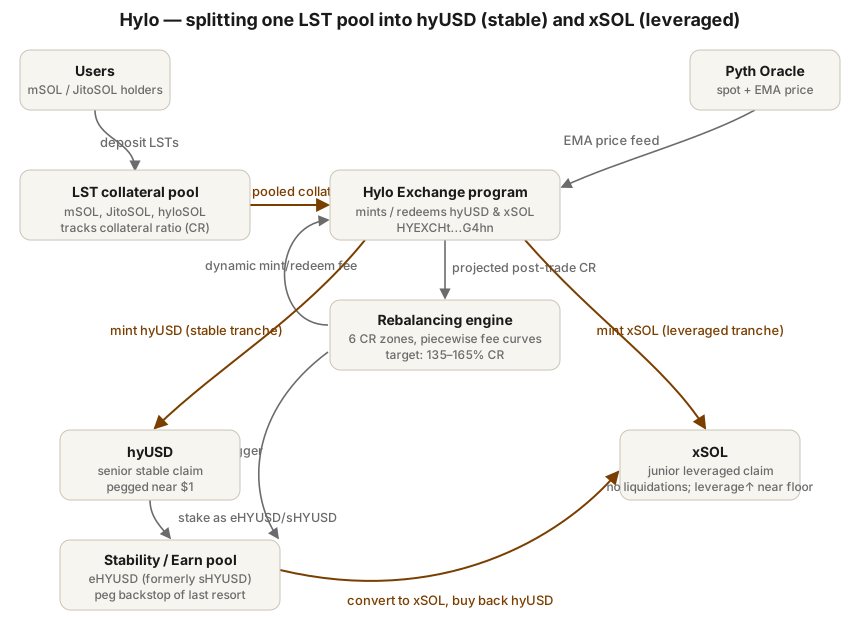
Hylo's core trick is tranching one collateral pool into a senior stable claim and a junior leveraged claim, the same structural idea used by CDO tranches or Ethereum's stETH-vs-ETH volatility splits, applied to LSTs:
- Collateral pools. Users deposit LSTs (or wrap SOL into hyloSOL) into per-asset pools (SOL pool, later BTC pool via cbBTC). Each pool tracks a collateral ratio (CR) = total collateral value ÷ hyUSD liabilities backed by that pool.
- hyUSD, the stable tranche. hyUSD is minted against pooled collateral and is backed "by the combined value of every collateral pool rather than any single asset or issuer." Its NAV is designed to stay at $1 as long as CR stays above 100%.
- xSOL, the leveraged tranche. xSOL holders own the residual/excess value in the pool above what's needed to back hyUSD at $1. Effective leverage = pool TVL ÷ xSOL market cap, so leverage rises automatically as SOL falls (more of the pool value shifts into covering the hyUSD floor) and falls as SOL rises. Because there is no borrowed principal or margin account, there is no liquidation event to trigger — instead, as CR approaches 100%, xSOL's leverage (and thus its exposure to further loss) approaches infinity, which is the protocol's genuine tail risk rather than an eliminated one.
- Six-zone rebalancing engine. The protocol defines CR bands — Destabilized (<100%, minting halts, xSOL NAV→0), Sell Zone 2 (100–120%), Sell Zone 1 (120–135%), Neutral (135–165%, no rebalancing), Buy Zone 1 (165–175%), Buy Zone 2 (>175%) — and applies piecewise-linear mint/redeem fee curves keyed to the projected post-trade CR. Fees fall as an action would move CR back toward the 135–165% target and rise (or block the trade) as an action would push CR further from target, making stabilizing behavior cheap and destabilizing behavior expensive.
- Stability Pool / Earn Pool (eHYUSD, formerly sHYUSD). Users can stake hyUSD for yield sourced from LST staking rewards, protocol fees, and rebalancing premiums. When CR drops into a sell zone, the stability pool is drawn down and converted into xSOL to buy back and support hyUSD — meaning stakers implicitly underwrite the peg and can end up holding leveraged SOL exposure during stress, a trade-off the protocol discloses but that changes the pool's risk profile in real time.
- Pricing. Collateral is marked using Pyth oracles; the OtterSec audit (May 2025) flagged that the Exchange program's reliance on Pyth's EMA price (rather than spot) to value collateral during minting can create an arbitrage window when spot and EMA diverge.
Outcome
Ongoing. Hylo launched mainnet around June 2025, closed a $1.5M seed round in August 2025, and crossed $100M TVL within about four months, weathering the October 10, 2025 crypto-wide ~$19B liquidation event without a reported hyUSD depeg. Growth continued into early 2026 (TVL cited around $52M entering Q1 2026), but Q1 2026 saw TVL fall 58% to $22.8M as SOL dropped roughly 33%, split roughly evenly between price decline and ~$13M of net withdrawals; multiple stability-pool activations deployed a combined $7.9M of hyUSD to defend the peg, temporarily converting sHYUSD/eHYUSD from a pure stablecoin position into a hybrid position with real xSOL exposure. Despite the contraction, sHYUSD posted its strongest quarter on record (52.4% APY) as xSOL recovered from its lows, and quarterly protocol fee revenue (annualized 5.2–7.2% of AUM) held up. Hylo shipped a V2 beta in late March 2026 adding an "xAsset Engine" for tokenized leveraged products beyond SOL (e.g., xBTC), pitched at the much larger leveraged-ETF market.
Why it worked
- Volatility has somewhere to go. By construction, all of the pool's price risk is pushed into xSOL's leverage ratio rather than hedged externally (cf. Ethena's perp shorts) or absorbed by liquidations (cf. Aave/Compound-style lending). This is a closed-system design: no counterparty, no exchange, no margin call — the "liquidation" mechanism is replaced by xSOL's leverage becoming unbounded near the CR floor, which is a real risk but not an operational failure mode that can trigger cascading forced sells.
- Dynamic fees do the stabilizing work ex ante. Rather than relying purely on arbitrageurs or a reserve fund after the fact, mint/redeem fees are priced continuously against projected CR, so the system nudges itself back toward the 135–165% target zone before it becomes distressed.
- Native yield, not synthetic yield. hyUSD's yield comes from real LST staking rewards plus protocol fees — a Solana-native equivalent to Ethena's funding-rate yield, but sourced from staking economics rather than derivatives markets, which behave differently under stress.
- It survived its first real stress test. The October 2025 flash crash, which caused visible dislocation elsewhere in crypto (including a well-documented single-venue USDe mispricing), reportedly left Hylo's hyUSD and xSOL holders unaffected, which likely helped subsequent TVL growth.
Limitations and criticisms
- The stability pool's role can silently change. When CR falls into a sell zone, eHYUSD/sHYUSD depositors' stablecoin position is converted into xSOL exposure to defend the peg — a mechanism that protects hyUSD holders by transferring volatility onto stability-pool depositors, some of whom may not have expected to hold leveraged SOL risk. The Q1 2026 report explicitly attributes part of the quarter's withdrawals to depositor discomfort with this volatility, not just to price decline.
- Concentration and reflexivity risk. With SOL (and its LSTs) as the dominant collateral asset for most of Hylo's life, the protocol's stability is tied to a single asset's volatility regime; a sustained SOL decline compounds through both collateral value and xSOL's rising effective leverage simultaneously.
- Oracle/EMA arbitrage surface. The protocol's own audit identified that using Pyth's EMA price rather than spot price to value collateral during minting can be gamed when the two diverge, a standard but real oracle-design trade-off.
- Team is pseudonymous. Public information about Hylo's founders (Plish, Shoom, Sape) comes from podcast interviews, hackathon/Colosseum profiles, and the team's own social accounts rather than a company registration or verified legal identity, which is common in DeFi but means less independent scrutiny of the team's background than for entities with disclosed corporate structure.
Lessons
- Splitting one collateral pool into a stable tranche and a leveraged tranche can substitute for both overcollateralized CDPs and liquidation-based lending: the leveraged tranche's holders effectively pre-fund the stable tranche's downside, in exchange for amplified (and asymmetrically increasing) upside/risk.
- "No liquidations" does not mean "no tail risk" — it means the tail risk is relocated into an uncapped leverage ratio for the junior tranche as collateralization approaches its floor, which needs to be communicated as clearly as a liquidation price would be.
- A stability pool that dynamically converts between asset classes (stablecoin ↔ leveraged token) under stress is a powerful stabilizer for the protocol as a whole, but it changes the risk contract for depositors mid-stream; disclosure and expectation-setting matter as much as the mechanism's soundness.
- Native-asset yield (staking rewards) can support a high-yield stablecoin design that is less exposed to derivatives-market funding-rate cycles than synthetic-dollar designs, but it inherits the collateral asset's own price-volatility regime instead.
Redesign (EDITORIAL — hypothesis, not fact)
This section is a hypothesis, not fact. A redesigned Hylo could address the stability pool's shifting risk profile by splitting it into two explicit sub-tranches at signup — a "pure hyUSD" tier that is made whole from protocol fee revenue and never converted to xSOL, and a "SOL-backstop" tier that opts in to conversion during sell-zone events in exchange for a visibly higher yield — so depositors self-select their true risk tolerance instead of discovering it during a drawdown. It could also publish a live, on-chain "effective leverage" gauge for xSOL (pool TVL ÷ xSOL market cap) directly in the trading UI, with automatic warnings as CR approaches the Destabilized boundary, making the uncapped-leverage tail risk as visible as a liquidation price is elsewhere in DeFi. Finally, diversifying collateral faster — weighting new deposits toward non-SOL LSTs/assets (BTC, and eventually the V2 xAsset basket) proportionally to existing SOL concentration — would reduce the single-asset reflexivity that made Q1 2026's simultaneous price-and-leverage shock as sharp as it was.
Sources
- Hylo Documentation — Introduction — primary (docs)
- Hylo Documentation — Technical Addendum, Hylo Equations — primary (docs)
- Hylo Documentation — Onchain Addresses — primary (docs)
- Hylo Documentation — Earning Yield with hyUSD — primary (docs)
- OtterSec — Hylo Exchange & Stability Pool Audit (May 2025) — primary (audit)
- Hylo (@hylo_so) — seed round announcement — primary (announcement)
- Solana Compass / Lightspeed — How Hylo Is Accelerating Solana DeFi in 2026 (Plish interview) (analysis)
- SolanaFloor — Hylo Cracks $100M in TVL Weeks After Shrugging Off Flash Crash (news)
- Pine Analytics — Hylo Quarterly Operations Overview Q1 2026 (analysis)
- Colosseum — Hylo project profile (other)
- DefiLlama — Hylo Protocol TVL, Fees & Revenue (data)
Related experiments
Last verified: 2026-07-28 · Spot an error? Suggest a correction