BrightID
A privacy-first, decentralized proof-of-personhood network that uses a pseudonymous social graph and Sybil-resistance algorithms to let people prove they hold only one account, without revealing personal data.
▶ Run interactive simulation animated mechanism with editable parameters
How it works onchain
 Open full-size diagram
Summary
BrightID is one of the earliest and most-referenced proof-of-personhood ("unique humanity") experiments in crypto. Founded by C. Adam Stallard (the mobile app is published under the developer name Christopher Stallard, and the project dates to roughly 2018–2019), it set out to solve the "one account per real person" problem without collecting any personally identifying information. Instead of biometrics or government ID, BrightID builds a giant pseudonymous social graph: users make cryptographically-signed connections to people they actually know via a smartphone app, and a federation of decentralized nodes analyzes the shape of that graph to estimate who is a real, unique human versus a Sybil (fake/duplicate). BrightID became a canonical Sybil-resistance building block for public-goods funding — most famously as a verification method in Gitcoin Grants — and helped popularize the whole proof-of-personhood category alongside Proof of Humanity and, later, Worldcoin.
Design (Mechanism)
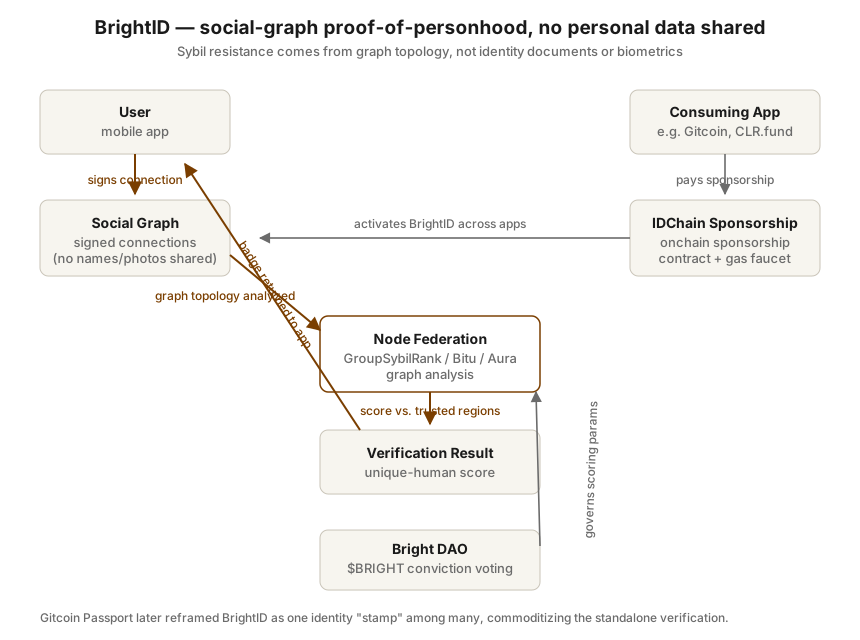
The core primitive is a connection: two people meet (originally in person, later via video) and sign an attestation that they know each other. These connections form an undirected social graph in which no names, photos, or contact data are shared with the applications that consume verifications.
Sybil resistance comes from graph analysis run by independent nodes. BrightID's reference node runs GroupSybilRank, a modification of the SybilRank algorithm, scoring participants by how well-embedded they are relative to trusted regions of the graph. Over time three verification protocols emerged:
- Meets — the original method, where a member connects with a special set of "Hosts" (internally called Seeds) at verification events; strong social ties from seeds propagate trust.
- Bitu — a later graph-analysis method with no fixed seeds: every node in the main dense regions of the graph can act as a seed and verify others, while nodes outside those regions are treated as Sybils.
- Aura — a manual/subjective verification layer where trusted "players" vouch for others, adding a human-judgment tier on top of algorithmic scoring.
Applications integrate by requiring a user to be sponsored — a one-time on-chain sponsorship (funded by an app) that activates a BrightID across the whole ecosystem. To make this affordable and to host the identity/sponsorship contracts, the team launched IDChain, an Ethereum-compatible sidechain that gave verified humans a free lifetime gas supply (the "Eidi" faucet). Sponsorship and subscription smart contracts were maintained for both IDChain and Ethereum mainnet. Governance and funding were run through Bright DAO with a $BRIGHT token using the 1Hive "Gardens" conviction-voting format.
Outcome
BrightID is best characterized as technically successful but commercially/financially unsuccessful. On the technical side it shipped a working mobile app, a live node federation, multiple verification protocols, IDChain, and real integrations. It reportedly contributed 60,000+ verified users into Gitcoin Grants and was integrated by quadratic-funding and UBI/airdrop projects including Gitcoin, CLR.fund, Unitap, and Manna, plus others historically (1Hive, RabbitHole-style tasks, and various DAO airdrops).
However, it never achieved self-sustaining scale or a durable business model. The proof-of-personhood market moved toward Gitcoin Passport (a multi-stamp aggregator in which BrightID became just one stamp among many), and toward biometric approaches like Worldcoin/World ID. The in-person/video connection requirement created serious onboarding friction, and social-graph methods remained vulnerable to collusion and bribery attacks that pure graph topology cannot fully detect. The project remains ongoing at a low level (the iOS app was still being updated into 2025, and founder Adam Stallard remained active, e.g., speaking as "founder of BrightID & Updraft"), but its center of gravity shifted to Stallard's newer public-goods-funding project, Updraft.
Why it worked
- Privacy-preserving by construction. By sharing only graph structure, never PII, it sidestepped the data-honeypot and surveillance problems that plague ID-document and biometric systems.
- Right place, right time. It arrived as quadratic funding (Gitcoin) desperately needed cheap Sybil resistance, giving it a real, recurring use case and distribution.
- Decentralized and open. Open-source code, a federation of independently run nodes, and a DAO gave it credibility with the crypto-native, self-sovereignty-minded audience.
- Composable primitive. The sponsorship model and app SDK let many downstream apps bolt on "is this a unique human?" without building their own identity stack.
Where the design broke
- Onboarding friction. Requiring real social connections (meetups, then verified video calls) is far harder than "scan your face" or "connect a few accounts," capping mainstream growth.
- Graph attacks. Social-graph Sybil scoring is theoretically susceptible to collusion, key-selling, and fabricated cliques; academic reviews repeatedly flagged the limits of subjective/graph approaches.
- Commoditized into a stamp. Gitcoin Passport reframed personhood as one signal among many, eroding BrightID's standalone value proposition and mindshare.
- No revenue engine. Reliance on grants, quadratic-funding rounds, and token incentives never converted into a self-sustaining business, and the broader market's attention moved to better-capitalized biometric competitors.
Lessons
- Sybil resistance is a distribution game, not just an algorithm. BrightID's best years came from being embedded in Gitcoin; when the host abstracted it away, adoption stalled — integration leverage matters more than protocol elegance.
- Privacy and low friction are in tension, and users pick friction losers. A design that protects PII but demands real human vetting will lose share to designs that leak more but onboard in seconds; the winning system has to minimize both.
- Graph-only personhood has a hard ceiling. Topology alone can't distinguish a genuine community from a well-constructed collusion ring, so purely algorithmic social scoring needs an economic or subjective layer (which BrightID eventually added via Aura) to be robust.
- "Canonical" doesn't mean "captured value." Being an influential, widely-cited pioneer of a category is orthogonal to owning the market it created — a recurring pattern in crypto identity.
Redesign (EDITORIAL — hypothesis, not fact)
The following is the researcher's editorial analysis, not established fact.
If rebuilt today, BrightID's most defensible move would be to lean into what only it has — a large, real, privacy-preserving social graph — and stop competing as a standalone "gate." Concretely: (1) ship zero-knowledge personhood proofs so an app receives a verifiable "unique human, score ≥ X" attestation with no on-chain linkage back to the user's graph identity, killing the correlation risk that pushed integrators toward aggregators. (2) Replace the friction-heavy meetup model with continuous, passive graph signal (attested existing relationships imported with consent) plus periodic Aura-style human vouching only for high-stakes tiers, making onboarding seconds-long while reserving expensive vetting for where Sybil cost is highest. (3) Add explicit collusion economics — stake/slashing on vouching so that selling or fabricating identities has a real, forfeitable cost, directly attacking the graph's theoretical weakness. (4) Position as an interoperable stamp and score provider feeding Passport-like aggregators and modern proof-of-personhood standards, rather than fighting them, and monetize via per-verification fees paid by apps rather than grant dependence. The bet: personhood will be a multi-signal, ZK-mediated commodity, and BrightID's edge is a genuine human graph — but only if it hides that graph behind proofs and prices collusion out of existence.
Sources
- BrightID — About (team, mission, social links) — primary (docs)
- BrightID Whitepaper — Universal Proof of Uniqueness — primary (docs)
- BrightID GitBook — Verifications (Meets, Bitu, Aura) — primary (docs)
- BrightID GitBook — Connect to Apps — primary (docs)
- BrightID Sponsorship & Subscriptions smart contracts (idchain / mainnet dirs) — primary (contract)
- Bitu Verification (graph-analysis method) — primary (docs)
- Aura — a new verification for BrightID (forum) — primary (governance)
- BrightID sponsorship use case: Gitcoin (HackMD) (analysis)
- DAOrayaki Research — BrightID: Proof of Digital Uniqueness (analysis)
- BrightID iOS App (developer Christopher Stallard; version history) (archive)
Related experiments
Last verified: 2026-07-26 · Spot an error? Suggest a correction