Idena
A standalone proof-of-person L1 where anonymous humans validate their uniqueness by synchronously solving AI-hard 'flip' puzzles in a global ceremony, earning one-person-one-vote mining and governance rights.
▶ Run interactive simulation animated mechanism with editable parameters
How it works onchain
 Open full-size diagram
Summary
Idena is the first "proof-of-person" blockchain: a standalone L1 in which the Sybil-resistance layer is not stake or hashpower but periodic, synchronized proof that each node is operated by a unique, live human — with no personal data, biometrics, or KYC. Started in October 2018 by an anonymous team of engineers (co-founder Mikhail Nikulin later went public), it launched its testnet in August 2019 and reached "experimental mainnet" status in February 2020. Every validated identity is a full node with an equal chance of mining rewards and equal governance weight, an explicit attempt to build a plutocracy-resistant, one-person-one-vote cryptonetwork. The network grew from 597 identities (Feb 2020) to 8,245 (June 2021), was then quietly captured by hidden "flip farm" pools — by May 2022 roughly 23 entities controlled ~40% of accounts and ~48% of rewards — and pivoted to sublinear identity staking. It still runs today (epoch 216 as of July 2026) but with only ~130 validated identities.
Design (Mechanism)
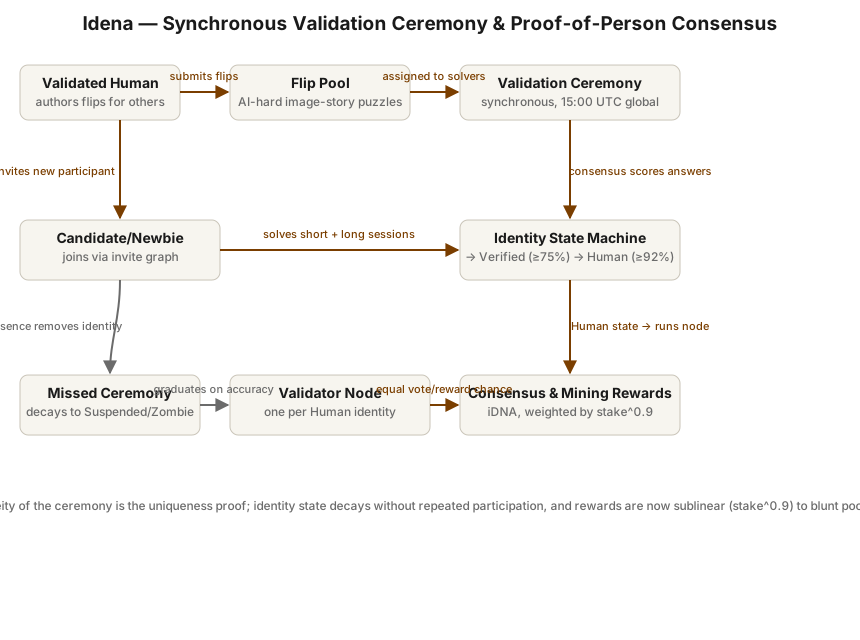
- Flips. A flip is a pair of four-image story sequences built by a validated human around protocol-assigned keyword pairs; one ordering tells a sensible story, the other is scrambled. Solving requires common-sense narrative understanding — designed to be "easy for a human, difficult for a bot." Validated users must create flips for future ceremonies, making the CAPTCHA supply itself decentralized.
- Synchronous validation ceremony. At a protocol-scheduled moment (15:00 UTC on validation day, frequency decreasing as the network matures), every participant worldwide must be online simultaneously: a 2-minute short session (6 flips) proves liveness and humanity; a 30-minute long session (25–30 flips) qualifies answers by consensus. Simultaneity is the uniqueness proof — one person cannot answer for two identities at once (in theory).
- Identity state machine. Identities progress Candidate → Newbie → Verified (≥75% lifetime accuracy) → Human (≥92%), and decay through Suspended/Zombie to killed if they miss ceremonies. Entry requires an invitation from a validated member, throttling Sybil onboarding through a social graph.
- Consensus and rewards. Each validated identity runs a node with equal block-proposal probability and equal vote; minting is capped (51,840 iDNA/day at last documentation, 50% to block mining). After the 2022 crisis, rewards were re-weighted toward identity staking with payouts proportional to stake^0.9 — deliberately sublinear so that splitting stake across many Sybil accounts is penalized less than it is under linear staking but whales earn less per coin than small holders.
Outcome
Partial success, still ongoing. The chain has run continuously since 2019 — as of July 2026 it is at epoch 216 with the next validation scheduled for 2026-07-31 — an unusually long life for a zero-VC, anonymous-founder L1. It pioneered the proof-of-personhood category cited by later projects and academics. But the core promise degraded in two ways. First, capture: the Ohlhaver–Nikulin–Berman paper ("Compressed to 0," 2024) documents that between launch and a May 2022 crisis, hidden pools emerged whose "puppeteers" paid real humans to periodically validate and hand over their keys; ~23 entities (<0.6% of distinct participants) came to control ~40% of accounts and ~48% of rewards — plutocracy re-entering through the back door of a one-person-one-vote system. Second, attrition: from a documented 8,245 identities in mid-2021, the network shrank to ~130 validated identities by epoch 215 (July 2026, per the official indexer: 102 Human, 14 Verified, 14 Newbie). The team itself funded a $25,000 bounty for AI flip-solvers; open-source solvers reached ~71–80% accuracy — above the Verified threshold (75%) but below Human (92%) — and flips are now used as an LLM reasoning benchmark (arXiv 2504.12256). iDNA trades thinly (PancakeSwap, BitMart, ProBit). Funding was bootstrapped: a premint plus small private iDNA raises and recurring Gitcoin grants (e.g., ~$11K total in GR20, 2024).
Why it worked
- Ceremony-as-Sybil-proof was genuinely novel and cheap. Synchronized solving needs no biometrics, no KYC, no hardware orb — just time and attention — so it achieved permissionless, pseudonymous personhood years before competitors, and at global scale (thousands of simultaneous participants at peak).
- Endogenous CAPTCHA supply. Making validated humans author the flips solved the "who makes the puzzles" centralization problem and kept content adversarially fresh.
- Skin-in-the-game identity decay. The Newbie→Human ladder and death-by-absence kept the validated set live rather than a stale registry.
- Intellectual honesty. The team publicly bountied AI attacks on its own CAPTCHA and co-authored the paper documenting its own capture — which enabled the sublinear-staking redesign instead of denial.
Where the design broke
- Uniqueness ≠ independence. The ceremony proves one human per account at validation time, but nothing stops that human from renting their humanity: flip farms paid low-wage participants to validate and surrender keys, converting one-person-one-vote back into capital-weighted control (~48% of rewards to 23 entities by May 2022).
- The AI treadmill. Flip difficulty is bounded by median human patience; ML solvers reached the Verified threshold by the early 2020s, and modern multimodal LLMs make text-image common-sense puzzles a shrinking moat.
- UX and demand. Mandatory synchronous ceremonies at fixed UTC times, invite scarcity, and flip-creation duties imposed heavy recurring friction, while few external applications ever consumed Idena identities ("Sign-in with Idena" saw little adoption) — so once speculative rewards fell, participation collapsed ~98% from peak.
- Isolated L1. Being its own chain (rather than an attestation layer on Ethereum) meant no composability with the ecosystems that actually needed Sybil resistance (airdrops, quadratic funding), despite bridge/relay attempts.
Lessons
- Proof-of-personhood without proof-of-agency is capturable: any system that makes a validated identity yield income creates a market for renting humans, so mechanism designers must price in collusion (sublinear rewards, pool detection), not just bots.
- CAPTCHA-based systems inherit an expiration date from AI progress; the honest design question is what the fallback is when the puzzle falls, and Idena's answer (staking + social graph) arrived only after the crisis.
- Sybil resistance is a feature, not a chain: demand comes from applications (airdrops, QF, governance) that live elsewhere, so personhood layers should ship where the demand is rather than as sovereign L1s.
- Equal rewards attract mercenary participation; equal rights with application-side utility would attract users — reward-led growth inflated the identity count and then deflated it just as fast.
- Radical transparency about failure (self-funded attack bounties, publishing your own capture statistics) is what converts a failed mechanism into a research contribution.
Redesign (EDITORIAL — hypothesis, not fact)
This section is editorial analysis — a hypothesis, not fact. A modern Idena would ship as a personhood attestation protocol, not an L1: ceremony participation would mint a non-transferable, zk-provable credential (Semaphore-style nullifiers) consumable by Ethereum/L2 apps for airdrops, quadratic funding, and DAO voting — importing demand instead of manufacturing it with inflation. To attack key-renting, decouple validation from income: pay nothing (or only reputation) for validating, and let value accrue solely from using the credential in applications where delegation is self-defeating (e.g., per-person governance where a puppeteer's gain is capped by nullifier reuse limits). Replace flips' fixed AI-hardness with an adversarial rotation: each epoch samples tasks from a bounty-audited pool where any task class solvable >X% by publicly submitted models is auto-retired — institutionalizing the AI treadmill Idena ran manually. Keep the two genuinely great ideas — the synchronized global ceremony (liveness + uniqueness in one primitive) and human-authored challenges — but add pairwise-correlation analysis on answer patterns and staking-slash for detected pool coordination, turning the 2022 capture signature (correlated accounts, shared infrastructure) into an automated defense.
Sources
- Idena official site (Proof-of-Person blockchain) — primary (docs)
- Idena Whitepaper — Technology — primary (docs)
- Idena FAQ (validation timing, minting caps, stake^0.9 rewards) — primary (docs)
- Idena community report: Current state and next steps (Feb 2020) — primary (retrospective)
- Idena 2021 community report (growth to 8,245 identities) — primary (retrospective)
- Compressed to 0: The Silent Strings of Proof of Personhood — Ohlhaver, Nikulin, Berman (2024) — primary (analysis)
- Idena blockchain will pay $25,000 for solving AI-hard captchas with AI — primary (retrospective)
- Idena Chronicles, epochs 131–140 (Jul 2024; Gitcoin GR20, Nikulin/Ohlhaver talks) — primary (retrospective)
- idena-network GitHub (idena-go node implementation) — primary (contract)
- Idena indexer API (epoch 215 identity-state counts, Jul 2026) — primary (archive)
- FLIP Reasoning Challenge (arXiv 2504.12256) — flips as an AI benchmark (analysis)
Related experiments
Last verified: 2026-07-26 · Spot an error? Suggest a correction