Nomis
A multichain wallet-reputation protocol that scores addresses 0–100 from 30+ onchain parameters and lets users mint the score as a paid, updatable soulbound token.
▶ Run interactive simulation animated mechanism with editable parameters
How it works onchain
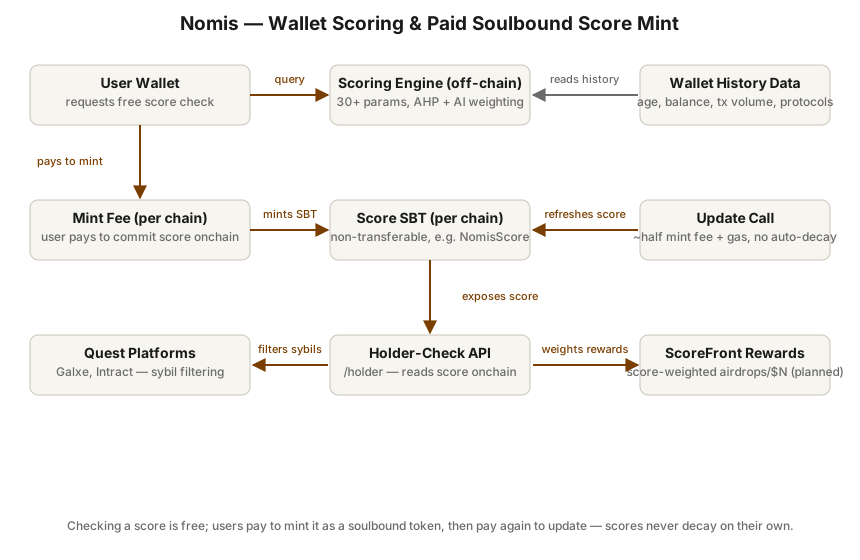 Open full-size diagram
Summary
Nomis is an onchain reputation ("identity") protocol that assigns any wallet a Reputation Score from 0 to 100 by analyzing 30+ parameters of its onchain history — wallet age, balance, transaction volume, protocol interactions, and more — using what the team describes as an analytical hierarchy process, pairwise-comparison weighting, and AI-driven models. The score itself is free to view; the core mechanism is that users pay to mint the score as a non-transferable soulbound token (SBT) bound to their wallet, then pay again (roughly half the mint price plus gas) to update it as their activity improves. Projects consume the scores via API or token-gating integrations for Sybil filtering, score-gated communities, reputation-weighted airdrops, and (aspirationally) undercollateralized DeFi lending.
The project began in 2022 out of a team based in Almaty, Kazakhstan, led by co-founder/CEO Alexander Barabash, bootstrapping through hackathon wins (including a DeFi-category win at Polygon's BUIDL IT Summer 2022 hackathon) and grants rather than a disclosed venture round. It expanded from an initial multichain score covering Ethereum, Polygon, and BNB Chain into per-ecosystem scores for zkSync Era, Linea (attested via Verax), Scroll, Base, Blast, Manta, Lisk, TON, and dozens of others — the site claims 50+ chains, 2M+ wallets scored, 1.3M+ unique score holders, and $8.6M+ in rewards distributed through its "ScoreFront" rewards portal. A native token ($N) airdrop weighted by user scores was announced in mid-2024 but no confirmed token generation event was found as of this writing.
Design (Mechanism)
- Scoring model. Off-chain computation over a wallet's history: 30+ parameters (wallet age, balance, tx volume, counterparties, protocol usage) combined via analytical-hierarchy-process weightings and AI/ML models into a 0–100 score. Parameter weights are customizable per ecosystem, so "zkSync Score" and "Lisk Score" measure ecosystem-specific behavior rather than one global number.
- Soulbound mint. Checking a score is free; committing it onchain costs a mint fee. The result is one non-transferable SBT per wallet per score type (e.g., NomisScore on zkSync Era at 0x00Ba30361E6e0E15da8a0595464bF38E4102797a, per third-party indexer attribution). Because the token is soulbound, reputation cannot be bought secondhand or transferred away from the history that produced it.
- Paid updates, no silent decay. Updating a minted score is a deliberate onchain action costing about half the mint price plus gas; at the protocol level a minted score does not decrease until the holder updates it. This makes the SBT a user-controlled snapshot rather than a live oracle.
- Demand side. A holder-check API (
/api/{slug}/holder) lets projects query whether an address holds a given Score SBT and read its value, enabling Sybil filtering (used by quest platforms such as Galxe and Intract), score-gated Discord roles and communities, and score-weighted reward distribution. Nomis's own ScoreFront/airdrop hub and leaderboard recycle this demand back into minting. - Growth loops. Referral program, quests, and ecosystem co-marketed score launches (each new L2 got its own "mint your X Score" campaign); the announced $N airdrop was to be distributed according to users' scores, explicitly rewarding high scores across many chains.
Outcome
Status: ongoing. Nomis is live in mid-2026 and claims 1.3M+ unique score holders across 50+ chains with $8.6M+ in partner rewards distributed. It survived the 2022–2023 bear market on hackathon prizes (12 wins) and grants (6), and rode the 2023–2024 L2 airdrop-farming wave, when minting an ecosystem score was widely treated as a cheap airdrop-eligibility lottery ticket. Its original headline vision — reputation-based undercollateralized DeFi lending, pitched to MIT Solve as a "multi-chain lending marketplace" — has not visibly materialized; pilot claims (3 DeFi-protocol pilots at ~10,000 wallets scored) were not followed by a public lending product. The $N token remains announced-but-unlaunched as far as public sources show. No disclosed venture round, token, or exploit was found.
Why it worked
- Charging for vanity + optionality. Free score-checking with paid minting converted airdrop speculation into revenue: users paid because a minted score might gate future rewards. Each new L2 score launch was a fresh monetizable campaign.
- Ecosystem alignment. Per-chain scores gave L2 business-development teams a ready-made engagement metric and Sybil filter, so chains (Linea, Lisk, TON) co-marketed Nomis to their own users — near-zero-cost distribution.
- SBT non-transferability matched the product story: reputation you cannot buy is more credible to integrators than a transferable badge.
Limitations and criticisms
- The lending thesis remains unrealized. Score-based undercollateralized credit needs legal recourse or slashable stake; a score alone doesn't stop a 90-score wallet from defaulting. No major lender publicly prices loans on Nomis scores, so the protocol's original flagship use case has not materialized.
- Incentive inversion. Once scores gate airdrops, farmers optimize the 30+ parameters directly (Goodhart's law); an opaque AI model invites grinding rather than deterring Sybils, and industrial farmers can afford mint fees across thousands of wallets.
- Stale-by-design scores. Because minted scores never decrease until voluntarily updated, integrators read a flattering snapshot, weakening the signal's value precisely for the risk-sensitive use cases (credit) that would make it valuable.
- Token limbo. A score-weighted $N airdrop announced in 2024 with no TGE two years later risks draining farmer trust — the protocol's most engaged cohort.
Lessons
- Selling reputation artifacts (paid SBT mints) is a viable revenue model even when the reputation use case (credit) never arrives — but it makes the business dependent on airdrop-speculation cycles.
- Any score that gates rewards becomes the target: opaque multi-parameter models are farmed, not respected. Sybil resistance needs cost or stake, not just analytics.
- User-controlled, update-on-demand scores are marketing instruments, not risk instruments; risk consumers need live, involuntarily-updated data.
- Ecosystem-specific white-label scores are a powerful distribution wedge: let each chain's BD team sell your product for you.
Redesign (EDITORIAL — hypothesis, not fact)
This section is a hypothesis, not fact. A redesigned Nomis would separate the two products it currently conflates. (1) A live reputation oracle: scores recomputed continuously and attested onchain (as begun with Verax on Linea), with mandatory decay/refresh so integrators can price risk — monetized via API, not user mints. (2) A user-facing credential with skin in the game: to mint a high score, the wallet stakes a bond that is slashable on provable Sybil clustering or default, converting the score from a claim into a commitment. Airdrop-gating should use score percentile within cohort plus stake, making thousand-wallet farming capital-inefficient. Finally, ship or cancel the token quickly: reputation businesses are trust businesses, and a two-year "soon" is itself a reputation signal.
Sources
- Nomis official site — primary (docs)
- Nomis Docs — FAQ — primary (docs)
- Nomis Docs — Score SBTs API — primary (docs)
- Nomis — MIT Solve Financial Inclusion Challenge application — primary (docs)
- Nomis (Medium) — Soulbound Tokens in Crypto — primary (docs)
- Kreatorland — NomisScore collection, zkSync Era (analysis)
- Coinlive — Nomis: airdrop of token N will be released soon (news)
- Lisk — How to Mint and Use Your Lisk Score with Nomis (analysis)
Related experiments
Last verified: 2026-07-26 · Spot an error? Suggest a correction