Worldcoin (World ID)
Biometric proof-of-personhood network that scans irises with a custom 'Orb' to issue privacy-preserving zero-knowledge World IDs, paired with the WLD token and its own L2, World Chain.
▶ Run interactive simulation animated mechanism with editable parameters
How it works onchain
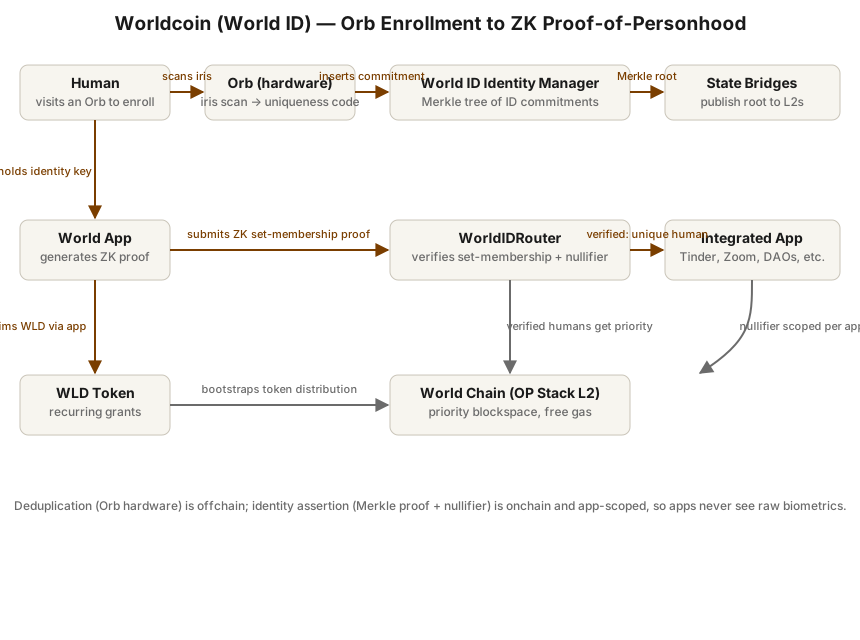 Open full-size diagram
Summary
Worldcoin — rebranded to "World" in October 2024 — is the most capital-intensive proof-of-personhood experiment ever attempted onchain. Conceived in 2019 by Sam Altman, Max Novendstern, and Alex Blania (via the company Tools for Humanity), it launched publicly with the WLD token on July 24, 2023. The thesis: as AI makes fake humans cheap, the internet needs a global, privacy-preserving "proof of human." The mechanism combines custom biometric hardware (the Orb, which images irises to compute a uniqueness code), a zero-knowledge identity protocol (World ID, built on Semaphore), a self-custodial wallet (World App), UBI-style WLD grants to verified humans, and since late 2024 a dedicated OP Stack L2 (World Chain) where verified humans get priority blockspace and free gas. As of mid-2026 the network claims 35M+ participants, roughly 18M Orb-verified humans across 160 countries, and hundreds of millions of World ID proofs — while also facing enrollment bans or data-deletion orders from regulators in several countries, including Kenya and Spain.
Design (Mechanism)
The core design separates biometric deduplication (offchain hardware) from identity assertion (onchain ZK proofs):
- Orb verification. A custom device captures iris imagery and computes an iris code used solely to check uniqueness against previously enrolled users. The company states images are encrypted to the user's phone and deleted from the device; the iris code is what prevents double-enrollment.
- Onchain identity registry. Enrollment inserts an identity commitment (a Semaphore public key hash) into a Merkle tree managed by World ID Identity Manager contracts on Ethereum; signup sequencers batch insertions. State-bridge contracts publish the Merkle root to World Chain, Optimism, Base, and Polygon so proofs can be verified on any supported chain.
- ZK set-membership + nullifiers. To prove personhood to an app, a user generates a zero-knowledge proof that their commitment is in the tree, scoped to an app-specific and action-specific "nullifier hash." The nullifier lets an app enforce one-action-per-human without linking the user's activity across apps or to their biometrics. Apps verify via a single
WorldIDRoutercontract (or the hosted Developer Portal API for off-chain checks). - Token distribution as bootstrapping. Verified humans claim recurring WLD grants — the largest attempted "UBI-style" airdrop, and the incentive that drove queues at Orb sites in Kenya, Argentina, and Southeast Asia. WLD was notably not offered to US users at launch (until the US launch on May 1, 2025).
- World Chain. An OP Stack L2 where Orb-verified humans get free gas allowances and priority inclusion, inverting the usual bot-dominated blockspace market.
Outcome
Ongoing, and genuinely bifurcated. On scale, it is unmatched among personhood systems: ~18M Orb-verified humans and 475M+ World ID proofs by mid-2026, integrations announced with Tinder, Zoom, and Docusign (April 2026), a US expansion from May 2025, a next-generation Orb, and a fresh $52.5M raise led by Pantera in July 2026. Competing personhood projects (Proof of Humanity, BrightID, Idena) never exceeded low tens of thousands of verified users. On legitimacy, data-protection regulators in several countries — including Kenya, Spain, and Thailand — ordered enrollment suspended or biometric data deleted between 2023 and 2025; Thailand's order alone covered 1.2M iris records. WLD token performance has been weak relative to expectations, with heavy unlock overhang and most supply allocated to insiders and the foundation. Black markets for verified World IDs emerged in countries like Cambodia and China, undermining the one-person-one-ID guarantee in exactly the places enrollment incentives were strongest.
Why it worked
- It paid users to enroll. WLD grants gave millions of people a concrete reason to visit an Orb — solving the cold-start problem every prior personhood scheme died on.
- Sound cryptographic core. Semaphore-based ZK proofs with per-app nullifiers are a genuinely well-designed privacy primitive: apps get sybil resistance without cross-app linkability or access to biometrics.
- Vertical integration. Custom hardware, wallet, L2, and developer SDK meant the team controlled the whole funnel rather than depending on third-party adoption.
- AI timing. The 2023–2026 explosion of AI agents and deepfakes turned "proof of human" from a crypto curiosity into a problem mainstream platforms (Zoom, Tinder) would pay attention to.
- Founder gravity. Sam Altman's involvement guaranteed capital (Tools for Humanity/World Foundation raised hundreds of millions) and press that no competitor could match.
Limitations and criticisms
- Biometric collection collided with data-protection law. Regulators in several jurisdictions found consent, transparency, and deletion practices inadequate, forcing the project out of some markets and ordering records destroyed.
- Incentivized enrollment targeted the global poor. Recruiting in low-income countries with token payments drew credible exploitation critiques (MIT Technology Review, 2022) and made regulators hostile.
- The uniqueness guarantee leaks at the edges. Verified IDs and accounts were resold on black markets — biometrics prove a human enrolled, not that the credential's current holder is that human.
- Trust bottleneck in the Orb and sequencer. Users must trust proprietary hardware and Tools for Humanity's enrollment pipeline; the trusted-hardware root is philosophically at odds with crypto's verify-don't-trust ethos.
- Token economics as reputational drag. Low float / large insider allocation at launch, plus grants that many recipients immediately sold, made WLD read as extraction rather than UBI.
Lessons
- Paying people to bootstrap an identity network works for scale but creates exactly the adversaries (credential resellers, sybil farmers, hostile regulators) that identity networks must resist.
- Biometric enrollment is a physical-world, jurisdiction-by-jurisdiction regulatory problem; ZK privacy at the proof layer does not immunize the collection layer from data-protection law.
- Proof-of-personhood credentials are only as strong as their weakest transfer path: if an ID can be sold or rented, per-app nullifiers enforce "one credential per action," not "one human per action."
- Separating deduplication (offchain, hardware) from assertion (onchain, ZK) is a reusable architecture — the Semaphore/nullifier pattern outlived most critiques of the Orb itself.
- A trusted-hardware root of trust can be commercially viable while remaining ideologically unacceptable to much of the crypto community; adoption and legitimacy are separate axes.
Redesign (EDITORIAL — hypothesis, not fact)
This section is editorial hypothesis, not fact. A redesign might keep the Semaphore/nullifier proof layer but decentralize the enrollment root: instead of one company's Orb fleet, accept multiple attestation roots (government eID ZK-wraps, web-of-trust vouching, and hardware biometrics) weighted into a confidence score, so no single hardware vendor or jurisdiction is a chokepoint and regulators can be engaged per-root. Replace lump-sum enrollment grants with utility-gated streaming rewards (earned only through ongoing verified usage) to devalue credential resale — a resold ID stops earning when the buyer can't re-attest liveness. Add periodic, phone-based ZK liveness re-attestation to time-bound credentials. Finally, launch token distribution after regulatory groundwork in each market rather than before; Worldcoin's own trajectory suggests the token accelerated growth but purchased most of its legitimacy problems.
Sources
- World Developer Docs — On-chain Verification / Contract Addresses — primary (docs)
- worldcoin/world-id-contracts (GitHub) — primary (contract)
- worldcoin/world-id-protocol (GitHub) — primary (contract)
- World official site (Year Three, Phase 3) — primary (docs)
- World blog — new Orb and new ways to verify, scaling to 1 billion humans — primary (docs)
- Wikipedia — World (blockchain) (analysis)
- CoinDesk — World Foundation raises $52.5M led by Pantera (July 2026) (news)
- Rest of World — US tech embraces Sam Altman's iris-scan ID banned elsewhere (2026) (news)
Related experiments
Last verified: 2026-07-26 · Spot an error? Suggest a correction