UBI
An ERC-20 token that streams newly minted 'universal basic income' to every human verified in the Proof of Humanity registry, at a fixed rate accrued per second.
▶ Run interactive simulation animated mechanism with editable parameters
How it works onchain
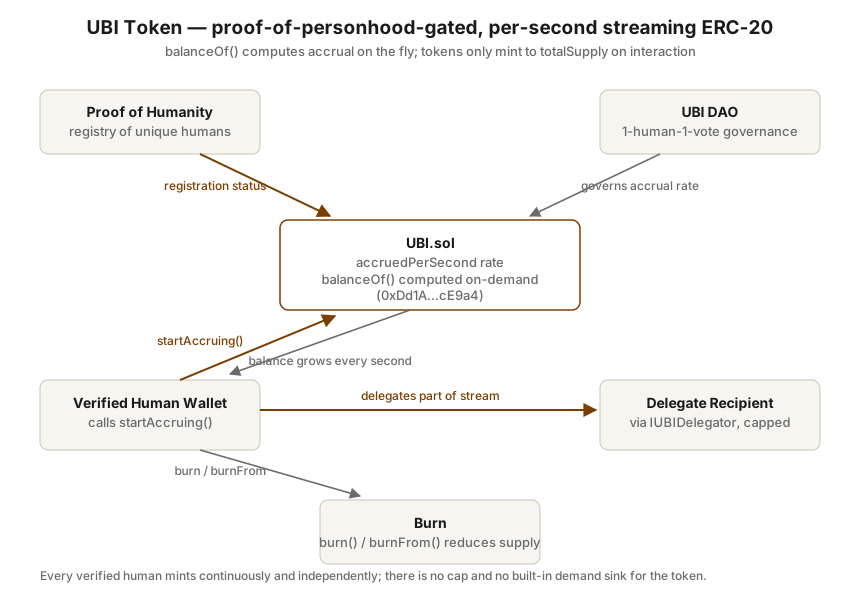 Open full-size diagram
Summary
UBI is an ERC-20 token designed to distribute an unconditional, continuously accruing "universal basic income" to verified humans. It was the first application built on top of Proof of Humanity (PoH), the Sybil-resistant identity registry co-created by Kleros and Democracy Earth Foundation. Any address whose owner is registered as a unique human in PoH can call startAccruing() and begin minting UBI tokens at a fixed rate — set at genesis to roughly 1 UBI per hour (≈720 UBI/month). The token went live on Ethereum mainnet on March 10, 2021, with a public introduction and Gnosis-auction-style liquidity program around March 12, 2021.
The project's thesis was radical: rather than fund UBI from taxation or a treasury, the token itself is the money supply, minted directly into the wallets of verified people at a uniform per-capita rate. Because minting is gated by proof-of-personhood, the supply grows with the human population rather than with capital, which the designers argued produces a fairer, more egalitarian distribution than proof-of-work or proof-of-stake issuance. Contributors credited across primary sources include Santiago Siri and Pia Mancini (Democracy Earth) and Federico Ast and Clément Lesaege (Kleros), with Jimmy Ragosa as a lead engineer.
Design (Mechanism)
The core contract (UBI.sol, Solidity 0.7.3, MIT, an OpenZeppelin upgradeable ERC-20) implements several distinctive mechanisms:
- Proof-of-personhood-gated minting. Only addresses registered in the Proof of Humanity registry may accrue.
startAccruing()checks PoH registration and records a timestamp;reportRemoval()stops accrual if a human is challenged/removed. - Per-second streaming accrual. A public parameter
accruedPerSeconddefines how many tokens per second are minted for each valid human. Instead of an active drip transaction, entitlement grows continuously against wall-clock time. - On-demand balance computation. A notable design choice:
balanceOf()is overridden to compute the accrued-but-unminted UBI on the fly (base balance + seconds elapsed × rate). Tokens are only physically minted tototalSupplywhen the human interacts (e.g., transfers), so the displayed balance rises every second without any transaction. - Stream delegation. Via an
IUBIDelegatorinterface, a human can delegate part or all of their accrual stream to another contract/recipient, capped so delegated value cannot exceedaccruedPerSecond(tracked bylockedDelegatedValue). This enabled experiments like directing streams to pooled/charitable recipients. - Burning.
burn()/burnFrom()reduce balance andtotalSupply; the DAO design used burning as proposal cost. (Plain transfers do not burn.)
Governance was intended to run through a UBI DAO using one-human-one-vote / quadratic voting by PoH members to tune parameters such as the accrual rate. At genesis 10 million UBI were minted for liquidity, early Democracy Earth "HOUR" token holders, and a community treasury; ongoing supply then came purely from human accrual.
Outcome
Status: technically successful, commercially unsuccessful.
The mechanism worked as specified: verified humans could and did accrue and claim UBI on-chain, the contract remains deployed at 0xDd1Ad9A21Ce722C151A836373baBe42c868cE9a4, and the design (PoH-gated per-second minting with on-demand balances) was a genuinely novel, functioning implementation of "crypto UBI."
Economically, it failed to sustain value. UBI peaked near $0.28 in January 2022 and subsequently collapsed by more than 99% to fractions of a cent, with negligible trading volume and effectively no centralized-exchange support (traded mainly on Uniswap v2). Continuous, uncapped, per-human minting created relentless sell pressure with no offsetting demand sink, so price decayed toward zero. Momentum was further undermined by governance turmoil in the underlying Proof of Humanity ecosystem — a 2023 split between the Kleros-aligned and Democracy Earth-aligned camps that produced competing PoH versions and fractured the community. Democracy Earth has since pivoted toward a separate "ubi.eth" application-chain effort (a distinct project from this 2021 ERC-20).
Why it worked
- Proof-of-personhood actually gated issuance. Coupling minting to a working Sybil-resistant registry demonstrated that "one human, one income stream" could be enforced on-chain, not just theorized.
- Elegant streaming primitive. Computing accrual inside
balanceOfmeant users needed no keeper bots or periodic claim transactions to see their balance grow — a clean, gas-light UX innovation later echoed by other streaming-money designs. - Strong narrative and credible backers. UBI as a cause plus the Kleros/Democracy Earth pedigree attracted early attention, liquidity, and a real registered-human user base.
Why it failed or underperformed
- No demand sink versus perpetual supply. Every verified human minted tokens continuously, but nothing forced anyone to buy UBI. Structural inflation with weak demand is a near-guaranteed path to price decay.
- Identity registry was the bottleneck and the fault line. UBI inherited all of Proof of Humanity's costs (deposit, video submission, challenge risk) and, fatally, its politics: the 2023 governance schism split the very human base UBI depended on.
- Speculative listing outran utility. With no merchants, no burn-heavy utility loop, and thin liquidity, the token behaved as a speculative asset whose only fundamental (people minting more supply) was net-dilutive.
Lessons
- A basic-income distribution mechanism is not the same as a stable-value currency. Solving fair issuance (proof-of-personhood gating) does nothing to solve demand; a UBI token needs a genuine, recurring sink (payments, fees burned, redemption) or it will inflate to zero.
- Coupling a token tightly to an identity registry imports that registry's governance risk. UBI's fate was hostage to Proof of Humanity's fork; downstream apps should treat the personhood layer as a dependency that can fracture.
- On-demand accrual in
balanceOfis a reusable, elegant primitive — continuous entitlement without keeper transactions — worth borrowing even when the surrounding economic model does not survive. - Egalitarian per-capita minting maximizes fairness but also maximizes sell pressure, because recipients with low income are rational immediate sellers; distribution equity and price stability are in direct tension.
Redesign (EDITORIAL — hypothesis, not fact)
The following is the researcher's analysis and speculation, not established fact.
A redesign should decouple the social goal (recurring per-human transfers) from the demand for a volatile native token. Rather than minting a new inflationary asset, a modern UBI protocol could stream a stable unit of account (e.g., a decentralized stablecoin or yield-bearing dollar) funded by a productive treasury — real yield from staking, protocol fees, or endowed capital — so that distributions are backed rather than diluted. Proof of personhood remains the gate, but sourced from a redundant, portable identity layer (e.g., combining Gitcoin Passport / World ID / Proof of Humanity) so no single registry fork can capsize the system.
If a native token is retained, it should function as a claim/governance right with strong sinks — burned or locked to receive the income stream, creating structural demand proportional to the number of participants — rather than as the payout itself. The accrual-in-balanceOf primitive is worth keeping, but paired with a supply schedule tied to treasury inflows, not to headcount. Finally, distribution should be per-human but rate-adaptive, letting quadratic governance throttle emissions when sell pressure or treasury runway demands it, converting the "fixed forever" rate that led to the original's collapse into a solvent, sustainable stream.
Sources
- UBI.sol contract source (DemocracyEarth/ubi, MIT) — primary (contract)
- UBI token contract on Etherscan — primary (contract)
- Introducing UBI: Universal Basic Income for Humans (Kleros blog) — primary (docs)
- DemocracyEarth/ubi repository — primary (docs)
- Proof of Humanity and the Universal Basic Income Coin (Scott Santens) (analysis)
- Universal Basic Income (UBI) price & history (CoinMarketCap) (news)
- Proof of Humanity Launches UBI Token on Gnosis Auction (news)
Related experiments
Last verified: 2026-07-26 · Spot an error? Suggest a correction