Cent (Valuables)
Cent's Valuables marketplace let anyone bid on any tweet and let the tweet's author mint and sell it as an 'autographed' NFT — producing the $2.9M Jack Dorsey first-tweet sale before collapsing under counterfeit-content fraud and evaporating resale value.
▶ Run interactive simulation animated mechanism with editable parameters
How it works onchain
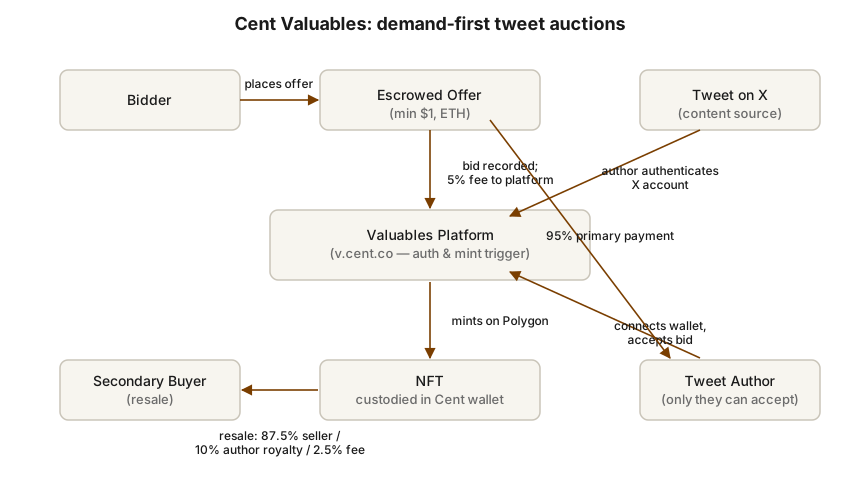 Open full-size diagram
Summary
Valuables was an NFT marketplace launched in late 2020 by Cent, a creator-monetization startup founded in 2017 by Cameron Hejazi (CEO) and Max Brody. Its premise was that content originally published off-chain — specifically tweets — could be monetized on-chain: any user could place a bid on any tweet, and only the tweet's verified author could accept, minting a one-of-one "autographed" NFT of the tweet. The experiment produced one of the defining events of the 2021 NFT boom: Jack Dorsey sold an NFT of his first tweet ("just setting up my twttr," 2006) for 1,630.58 ETH (~$2.92M) to Bridge Oracle CEO Sina Estavi on March 22, 2021, donating the proceeds (converted to Bitcoin) to GiveDirectly. Cent raised a $3M seed in August 2021 (Galaxy Interactive, Jeffrey Katzenberg, will.i.am, Mark Pincus). In February 2022, Cent halted most NFT sales on its broader marketplace, with Hejazi telling Reuters that counterfeit and plagiarized mints were "rampant" and a "fundamental problem with Web3." The Dorsey NFT's 2022 resale attempt (listed at $48M) drew a top bid of roughly $280, becoming the emblem of NFT value evaporation.
Design (Mechanism)
- Demand-first auctions on other people's content. Anyone could paste a tweet URL into v.cent.co and place a USD-denominated offer (minimum $1). The tweet's author was notified via a Twitter reply. Nothing existed on-chain until the author opted in — an inversion of the usual mint-then-list flow.
- Author-gated minting via Twitter authentication. To sell, the author authenticated their Twitter account on Valuables, connected MetaMask, and accepted a bid. Acceptance minted the NFT; per the official FAQ, minting occurred on Matic (Polygon), with metadata including the tweet's timestamp, text, a screenshot URL, sale date, and the creator's digital signature from their wallet address. A wallet, once linked to a Twitter account, could not be re-linked to another.
- What buyers got. The FAQ was explicit: a "digital certificate... the creator's autograph on a digital file." No copyright or commercial rights transferred; the tweet stayed on Twitter and could be deleted by the author.
- Escrowed bids. Offers were held in escrow; counter-offers had to exceed the standing bid by 10% or $1 (whichever was greater); outbid or cancelled (after 24 hours) bidders were refunded. There was no auction clock — sellers could accept whenever, or never.
- Fee splits with baked-in royalties. Primary sales: 95% creator / 5% Cent. Secondary sales: 87.5% seller / 10% original creator / 2.5% Cent.
- Custodial by default. NFTs were custodied in Cent's wallet, with manual transfers to self-custody available on request — a notable centralization for an "on-chain autograph."
Outcome
Valuables generated over $270,000 in open offers by February 2021 and a wave of celebrity activity (Mark Cuban, Elon Musk — who received a $1.12M bid he declined). The Dorsey sale in March 2021 was the peak: ~$2.92M, with 95% to Dorsey (donated) and 5% to Cent. The August 2021 $3M seed round followed. Then the model degraded on both sides: in February 2022, Cent froze most NFT transactions on its main marketplace after a "whack-a-mole" battle with users minting unauthorized copies of NFTs and content they didn't own (tweet sales on Valuables, where authorship was Twitter-authenticated, were the noted exception). In April 2022, Estavi listed the Dorsey NFT for $48M and received a top bid of about $280 (later reported bids under $10K), a >99.9% markdown. Cent subsequently pivoted toward NFT-publishing tooling ("Cent Pages," 2022) and brand digital collectibles. Valuables' site remains reachable, but the tweet-NFT market it created is effectively dead. Current operational status of the marketplace: Unknown / not found beyond these facts.
Why it worked
- Authenticity was structurally enforced for the core asset. Because only the authenticated tweet author could accept a bid, the primary Valuables flow could not mint counterfeits — a real mechanism-design insight that its sibling open marketplace lacked.
- Demand-first bidding created zero-cost supply discovery. Authors did nothing until money was already on the table; the Twitter-reply notification doubled as viral distribution on the exact platform where the content lived.
- A clean royalty story. The 10% perpetual creator cut on resales was an early, legible implementation of the creator-royalty thesis.
- Perfect cultural timing. It gave the 2021 mania its most narratively pure artifact — the first tweet — and rode the resulting press.
Where the design broke
- The asset had no floor beyond narrative. Buyers received an autograph-certificate with no rights, no scarcity of the underlying content (the tweet remained public and copyable), and no utility. When attention rotated, bids went to ~zero, as the Dorsey resale proved publicly and humiliatingly.
- The authenticated model didn't generalize. Cent's broader marketplace, without author-gating, was overrun by plagiarized and copy-minted content; Hejazi shut most sales rather than keep playing whack-a-mole, conceding there was no industry-wide standard for stopping bad actors.
- Platform dependency. The "on-chain" object pointed at Twitter-hosted content and a Cent-hosted screenshot URL, and NFTs sat custodied in Cent's own wallet — multiple central points of failure for a purportedly permanent collectible.
- One-off windfalls, thin recurring economics. A 5%/2.5% take on a market driven by a handful of headline sales left little durable revenue once celebrity novelty faded.
Lessons
- Authentication at mint is the cheapest anti-fraud tool a UGC-NFT market has. Valuables' author-gated flow stayed clean while the ungated marketplace drowned in counterfeits; identity-bound minting should be the default, not the exception.
- An NFT that confers no rights is priced purely by attention, and attention mean-reverts. Autograph framing is honest but demands autograph-market prices, not $2.9M; mechanisms should tie value to something enforceable (rights, access, revenue) if they want a floor.
- Demand-first ("bid on anything, owner opts in") is a powerful cold-start pattern — it manufactures supply and distribution simultaneously — and is separable from the speculative wrapper that discredited it.
- Custodial NFTs undermine the product's own thesis. If the certificate lives in the platform's wallet and points at platform-hosted metadata, the buyer holds a claim on a startup, not a durable on-chain object.
Redesign (EDITORIAL — hypothesis, not fact)
This section is editorial hypothesis, not historical fact. A modern Valuables would keep the two genuinely good primitives — author-gated minting and demand-first bidding — and fix the asset. First, bind the certificate to attestations rather than screenshots: the author signs the canonical text with a key linked to their social identity (e.g., via sign-in-with-X plus an on-chain attestation registry), with content archived to IPFS/Arweave so the object survives both the platform and the tweet's deletion. Second, mint non-custodially to the buyer's wallet at settlement — no platform escrow of the NFT itself. Third, give the asset a floor: bundle each sale with an enforceable, on-chain-referenced license (limited commercial display rights) or a creator-funded buyback/redemption option, converting pure attention value into a priced option. Fourth, generalize the author-gate into the marketplace layer: any content NFT must carry a verifiable authorship attestation to be listed, turning Cent's fatal counterfeit problem into a listing requirement. The plausible outcome is a smaller, saner "autograph economy" — lower headlines, but assets that survive the hype cycle.
Sources
- Valuables FAQ (archived copy of official docs) — primary (docs)
- Valuables by Cent (official site) — primary (docs)
- Cent, the platform that Jack Dorsey used to sell his first tweet as an NFT, raises $3M (TechCrunch) (news)
- Jack Dorsey sells his first tweet ever as an NFT for over $2.9 million (CNBC) (news)
- Cent CEO Cameron Hejazi clamped down on NFT sales because of fraud (Slate interview) (retrospective)
- Right-click savers send NFT marketplace Cent into indefinite hiatus (Protos) (news)
- 'Jack Dorsey's First Tweet' NFT went on sale for $48M, top bid ~$280 (CoinDesk) (news)
- NFT of Jack Dorsey's first tweet plunges in value (CNBC) (news)
- Valuables — IQ.wiki entry (analysis)
Related experiments
Last verified: 2026-07-26 · Spot an error? Suggest a correction