ContentmentCoin
A Base-based proof-of-concept memecoin whose ERC-1155 companion NFT changes 'mood' (happy/angry/content) with the last trade, paired with a Uniswap v4 hook that charges profitable traders a variable creator fee and lets losing traders pay nothing.
▶ Run interactive simulation animated mechanism with editable parameters
How it works onchain
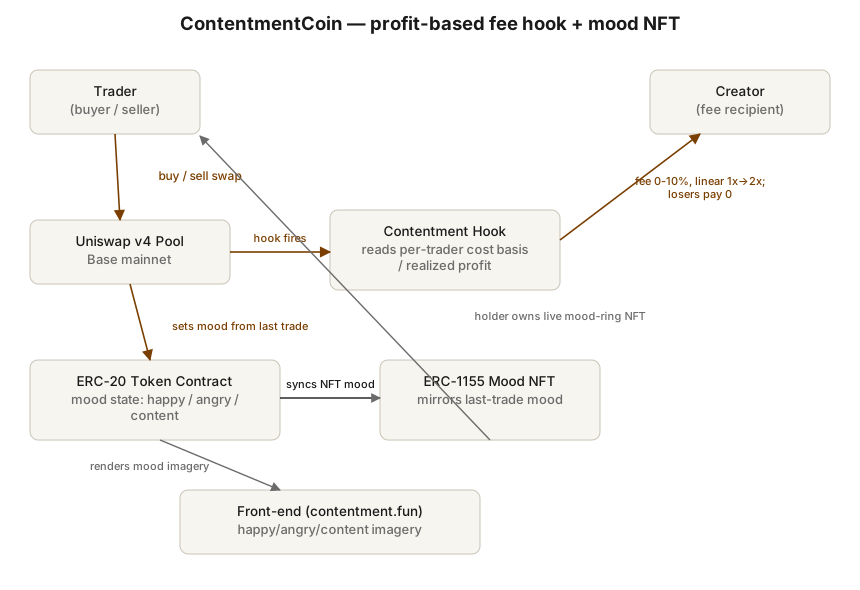 Open full-size diagram
Summary
ContentmentCoin (site: contentment.fun) is a small, self-described "proof of concept" memecoin experiment on Base. Its hook is emotional theatre bolted onto market microstructure: the token has a "mood" that flips with trading activity, and a companion NFT visually renders that mood in real time. The site's tagline plays on the word — "Con·tent·ment: The state of being satisfied and happy" — and asks whether you will buy the token to make it happy or sell it to make it angry.
Underneath the meme, the interesting claim is a market-design one. The project pairs the ERC-20 token with a custom Uniswap v4 hook that charges a variable creator fee based on trader profit: profitable traders pay more, losing traders pay nothing. The stated goal was to test "a better way to reward creators than the current model on launchpads like Zora/Clanker," where creator fees are typically flat and skimmed from every trade regardless of whether the trader made or lost money.
The project is obscure. There is no discoverable documentation beyond the site itself, no confirmed founder, no verified X account, and no third-party coverage. As of mid-2026 the domain contentment.fun is listed as available for registration, and no live DEX pool is indexed on DexScreener or GeckoTerminal for the name — indicating the experiment has been abandoned (or was always a low-liquidity demo).
Design (Mechanism)
All mechanism details below are taken verbatim from the project's own front-end bundle ("How it works" section):
- Mood state (meme layer). "The token is happy when the last trade was a buy, angry when the last trade was a sell, and content when the token is not traded for a while." The site swaps between
happy.png,angry.png, andcontent.pngand renames the display token Happycoin / Angrycoin / Contentmentcoin accordingly. - Mood-reactive NFT. "Holding the ERC20 token will also give you an ERC1155 NFT displaying the current mood automatically." The NFT is a Base ERC-1155 (linked out to an OpenSea item page), so holders carry a live, on-chain "mood ring" for the token.
- Profit-based variable creator fee (the real experiment). "This project also uses a custom Uniswap v4 hook that takes a variable creator fee based on trader profit." Concretely: "Traders that make a profit pay a higher creator fee, and traders that lose money pay nothing (Linearly between 0% and 10% from 1x to 2x)." In other words the fee scales linearly from 0% (at breakeven, 1x) up to a 10% cap (at a 2x return), and losing exits are fee-free.
- Stated purpose. "This is a proof of concept to see if this is a better way to reward creators than the current model on launchpads like Zora/Clanker."
- Chain / infra. The front end hard-checks
chainId === 8453(Base mainnet), uses RainbowKit for wallet connection, links "View Chart" to a GeckoTerminal Base pool and "View NFT" to an OpenSea Base item. This is consistent with a Uniswap v4 pool on Base.
Mechanically, the profit-aware fee is the notable contribution. A standard AMM fee (and standard launchpad creator fee) is symmetric and profit-blind — it taxes the winner and the loser identically. ContentmentCoin's hook attempts profit contingency: it needs to know each trader's cost basis to compute realized gain at sell time and price the fee off it. That is exactly the class of stateful, per-trader accounting that Uniswap v4 hooks (with dynamic fees and custom accounting) were introduced to make possible.
Outcome
outcome_status: abandoned. The experiment appears to have launched around April 2025 (earliest Wayback capture 2025-04-22, with internal links pointing at OpenSea/GeckoTerminal captures of the same date). By mid-2026 there is no indexed live pool, no market data, and the domain is available to register again. No metrics (market cap, holders, fees collected, trade count) could be found — treat all quantitative outcomes as Unknown / not found. The founder and any official X account are likewise Unknown / not found; the site links to no social accounts, and search surfaced only same-name impostors ("Content Coin," "CON$," etc.) that are unrelated. It reads as a builder's demo of a v4 hook idea rather than a launch that sought or found a market.
Why it worked
Judged as a concept demonstration rather than a commercial launch, a few things are genuinely well-designed:
- Legible incentive alignment. "Winners pay the creator, losers pay nothing" is intuitively fair and easy to communicate — it reframes creator fees as a success-share rather than a toll.
- Native use of v4 hooks. The profit-based fee is a real, non-trivial hook use-case, exactly the kind of stateful logic v3 could not express. As a portfolio piece it shows off dynamic fees plus custom per-trader accounting.
- Meme surface that fits the mechanism. The happy/angry/content NFT gives an otherwise dry fee experiment a shareable, self-explanatory hook, tying token sentiment (buys vs. sells) to a visible artifact holders own.
Where the design broke
- No distribution and no narrative owner. With no verifiable founder, no X presence, and no docs beyond a one-screen site, the experiment had no way to attract liquidity or attention. Memecoins live or die on social distribution; this had none.
- The fee model discourages exactly the winners it taxes. Charging profitable exits up to 10% is a disincentive to take profit on-platform and invites avoidance (moving size, splitting exits, or trading around the hook). A profit-blind competitor can undercut it for winning traders.
- Cost-basis accounting is fragile and gameable. Computing "profit" on-chain per trader is hard: transfers between wallets, LP entry/exit, and buys at multiple prices all complicate basis tracking. Any simplification opens avoidance vectors (e.g., resetting basis via fresh wallets) and any complexity raises gas and audit risk.
- Proof-of-concept framing capped ambition. The team explicitly called it a POC. That honesty is admirable but also self-limiting — nothing signaled it was meant to be sustained, and it wasn't.
Lessons
- Profit-contingent fees are an appealing but leaky primitive. "Tax winners, spare losers" is attractive UX, but on permissionless rails the taxed party can route around you; fee designs must assume adversarial cost-basis gaming, not cooperative reporting.
- A clever hook is not a launch. The most interesting part of ContentmentCoin (the v4 profit-fee) was undermined by the complete absence of distribution, identity, and liquidity. Mechanism design without a go-to-market and a credible owner rarely survives contact with the market.
- Dynamic NFTs are a strong communication layer for market state. Rendering "last trade = buy/sell" as an owned, mood-reactive ERC-1155 is a genuinely good pattern for making abstract order-flow legible to holders — reusable well beyond this project.
- Provenance matters for the Atlas. When a project ships no docs, no socials, and no named team, the honest record is "Unknown," and the strongest evidence is the deployed front end / contracts themselves — which is what was used here.
Redesign (EDITORIAL — hypothesis, not fact)
The following is the researcher's editorial hypothesis, not established fact.
The salvageable idea is the profit-share creator fee, and it should be re-scoped away from taxing individual traders (which is gameable and unpopular) toward taxing the pool's realized value creation. A cleaner v4 hook would (1) charge a flat, low base swap fee to everyone, and (2) route an additional creator cut only out of protocol-captured value that is hard to avoid — e.g., a slice of LP fees plus a small, transparent "graduation" fee triggered when the pool crosses liquidity/market-cap milestones, rather than trying to read each trader's PnL. This keeps the "creators earn when the token succeeds" spirit while removing the per-trader basis-tracking that invites wallet-splitting and gas bloat.
I would also make the mood NFT do real work instead of being decorative: tie the ERC-1155 metadata to cumulative pool health (net inflow, holder count, time-since-last-sell) rather than the single last trade, so it becomes a tamper-resistant, glanceable reputation badge for the token — and gate a modest fee rebate to holders who keep the NFT, turning sentiment into retention. Finally, none of this matters without a named steward and a public postmortem: even a POC should ship a one-paragraph "here's the hook, here's the contract, here's who built it, here's what we learned," so the experiment survives as a citable result even after the liquidity is gone.
Sources
- contentment.fun — official site (Wayback capture, 2025-04-22) — primary (archive)
- contentment.fun — official site (Wayback capture, 2025-12-06) — primary (archive)
- contentment.fun front-end bundle (index chunk) — mechanism/copy verbatim, via Wayback — primary (contract)
- Uniswap v4 dynamic fees (context for the hook mechanism) (docs)
Related experiments
Last verified: 2026-07-26 · Spot an error? Suggest a correction