Sound.xyz
A music-NFT platform that let artists sell limited-edition songs onchain with timestamped fan comments, a pseudo-random 'Golden Egg' 1/1 upgrade, and 100% of primary sales to artists — technically influential but shut down in January 2026.
▶ Run interactive simulation animated mechanism with editable parameters
How it works onchain
 Open full-size diagram
Summary
Sound.xyz was a music-NFT platform founded in 2021 by David Greenstein (an ex-Pandora product manager), Vignesh Hirudayakanth, and Matt Masurka (the electronic musician Gigamesh). Artists released songs as limited-edition NFTs; collectors who minted got a visible spot in the song's "audience," could pin a public comment to a timestamp in the track, and had a chance at a pseudo-randomly assigned "Golden Egg" that upgraded one mint into a 1/1 with special artwork. Artists kept 100% of primary sales. Sound raised a $5M seed in December 2021 (a16z, Variant, Atelier, 21 Savage, and others) and a $20M Series A led by a16z crypto in July 2023, when it opened from invite-only beta to all artists. Its open-source, MIT-licensed Sound Protocol (ERC721A editions cloned from a factory, with modular minters and later a bonding-curve secondary market) became one of the most technically respected NFT stacks of the era. But music-NFT demand collapsed after 2022; Sound entered maintenance mode in 2025 to focus on its non-crypto successor Vault.fm, announced shutdown on December 17, 2025, and went offline on January 16, 2026, with NFTs remaining onchain and artist funds withdrawable via Splits contracts.
Design (Mechanism)
- Edition sales, not 1/1 auctions. Unlike early 1/1 music NFTs (e.g., Catalog), Sound sold N copies of a song at accessible prices, framing collecting as patronage and early-fan status rather than a single-owner trophy. Serial numbers (mint #1, #2, ...) created intra-edition status.
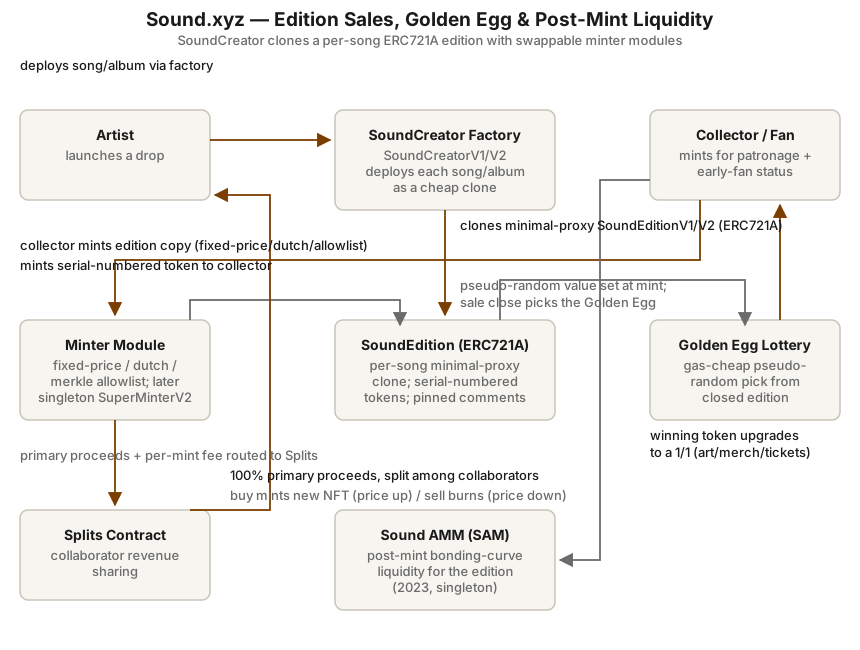
- Sound Protocol architecture. A factory (SoundCreatorV1, later SoundCreatorV2 at 0x0000...3522) deployed each song/album as a cheap minimal-proxy clone of a gas-optimized ERC721A implementation (SoundEditionV1, later SoundEditionV2_1 at 0x0000...11CC). Mint logic was separated into swappable minter modules (fixed-price, range/dutch-style schedules, merkle allowlists), later consolidated into a singleton SuperMinterV2 — a notably clean separation of token, sale logic, and metadata.
- Golden Egg lottery. At mint time a gas-cheap pseudo-random value was set; when the sale closed it designated one token as the Golden Egg, which upgraded into a 1/1 with artist-chosen artwork (sometimes bundled with merch or tickets). Sound's own technical writing acknowledged the value is not truly random but argued it was hard to game via MEV in practice.
- Social layer on top of ownership. Minting unlocked the right to leave one comment pinned to a timestamp in the waveform, and "Listening Parties" turned each drop into a synchronous community event. The collectible bought identity and voice, not just media.
- Economics. Artists received 100% of primary proceeds (paid via Splits contracts, enabling collaborator revenue sharing) plus secondary royalties; Sound monetized via a per-mint fee added on top, and later paid protocol rewards (e.g., 0.000555 ETH per paid mint) to referring curators and artists. Free mints on Optimism (June 2023) and Base (August 2023) with gasless uploads pushed reach over revenue.
- Sound Swap / SAM (2023). A singleton "Sound Automated Market" let artists attach a bonding curve after the initial mint: buying minted a new NFT and moved the price up; selling burned into the curve and moved it down — an attempt to give song NFTs continuous liquidity. It was externally audited (zobront, April 2023).
Outcome
Sound was arguably the category leader in music NFTs. By July 2023 it had paid roughly $5.5M to about 500 invited artists across ~1,600 songs (Decrypt/official Series A post), with individual successes like Reo Cragun earning $120k+ from ~500 collectors; L2 expansion later drove million-plus cumulative song mints (including one Optimism celebration edition with ~732k free mints). Marquee artists (Snoop Dogg was a Series A investor) and a16z's backing made it the reference implementation for "collect this song." But activity tracked the broader NFT cycle down. In 2025 the team froze new uploads ("Focus is life or death at a startup"), and on December 17, 2025 Greenstein announced shutdown effective January 16, 2026, pivoting the team to Vault.fm, a web2-style artist-to-fan CRM (uploads unlocked by email/phone, direct outreach). Media and funds remain retrievable onchain/decentralized storage; the protocol repo was archived in March 2026. No token was ever issued.
Why it worked
- Craftsmanship earned trust. The protocol was open-source, permissionless, gas-optimized, and cleanly modular; serious builders and auditors treated it as best-in-class, and artists trusted a platform that took 0% of primary sales.
- It sold status and belonging, not files. Audience walls, timestamped comments, serial numbers, and the Golden Egg lottery gave collectors social artifacts — the strongest known demand driver for NFTs.
- Artist-first economics (100% of primaries, splits for collaborators, gasless L2 uploads) made it genuinely better than streaming payouts for a niche of crypto-native musicians during the bull market.
Where the design broke
- Demand was cyclical, not structural. Buyers were largely crypto collectors speculating on culture, not music fans; when NFT speculation died in 2023–2024, per-drop revenue collapsed and never found a non-crypto audience.
- The fan funnel was too narrow. Wallets, gas, and ETH pricing excluded ordinary fans; Sound's own successor pitch (Vault.fm: "I dropped a song. I have no idea who listened") implicitly concedes that onchain collecting never became a mainstream fan-relationship channel.
- Monetization mismatch. Taking 0% of primaries was great positioning but left Sound dependent on mint fees on volume that evaporated; SAM's bonding-curve liquidity arrived as demand was already fading.
Lessons
- Superb contract engineering and artist-friendly economics cannot compensate for a missing durable buyer base; mechanism design must answer "who buys this in a bear market?"
- Attaching social rights (comments, visible audience membership, lottery upgrades) to ownership measurably outperforms selling media alone — this pattern outlived Sound in later social-mint platforms.
- 0%-take platforms need a real business model before the subsidy phase ends; per-mint fees are a leveraged bet on perpetual volume.
- Graceful shutdown matters: because assets were onchain, media on decentralized storage, and payouts via Splits, artists kept their money and collectors kept their tokens — a template for winding down an NFT platform without rugging users.
Redesign (EDITORIAL — hypothesis, not fact)
This section is editorial hypothesis, not established fact. A redesigned Sound might invert the funnel: acquire fans with free, custodial, email-login "collects" (as Base-era free mints already hinted), and treat the chain purely as portable fan-CRM infrastructure — every collect an onchain attestation the artist can export and re-target, merging Sound's provenance with Vault.fm's reachability. Monetization could shift from per-mint fees to a small take on a patronage subscription per artist, smoothing revenue across cycles. The Golden Egg could become a repeatable, verifiably random (VRF-based) engagement lottery across an artist's whole catalog rather than a one-shot per drop, and SAM-style curves might be reserved only for artists with proven secondary demand to avoid liquidity theater. The bet would be that onchain ownership survives as invisible plumbing for fan relationships, not as a storefront.
Sources
- soundxyz/sound-protocol (GitHub, archived March 2026; deployed addresses) — primary (contract)
- Sound.xyz protocol docs — SoundEdition / SoundCreatorV1 — primary (docs)
- Sound.xyz official site (shutdown notice, Jan 16 2026) — primary (docs)
- Sound.xyz is entering maintenance mode (official Paragraph post) — primary (retrospective)
- David Greenstein shutdown announcement on X (Dec 2025) — primary (retrospective)
- Sound.xyz Opens to All, Raises $20m (official Mirror post) — primary (retrospective)
- Sound Swap Technical Deep Dive (official Mirror post) — primary (docs)
- zobront audit report covering Sound SAM (April 2023) — primary (audit)
- NFT Music Startup Sound.xyz Raises $5M From a16z, 21 Savage (CoinDesk, Dec 2021) (news)
- Sound Raises $20 Million, Opens Music NFT Platform to All Artists (Decrypt, July 2023) (news)
- Investing in Sound.xyz (a16z crypto) (analysis)
Related experiments
Last verified: 2026-07-26 · Spot an error? Suggest a correction