SuperRare
Curated single-edition NFT art marketplace that pioneered the 10% onchain artist royalty and later attempted to decentralize curation via the RARE token and a DAO.
▶ Run interactive simulation animated mechanism with editable parameters
How it works onchain
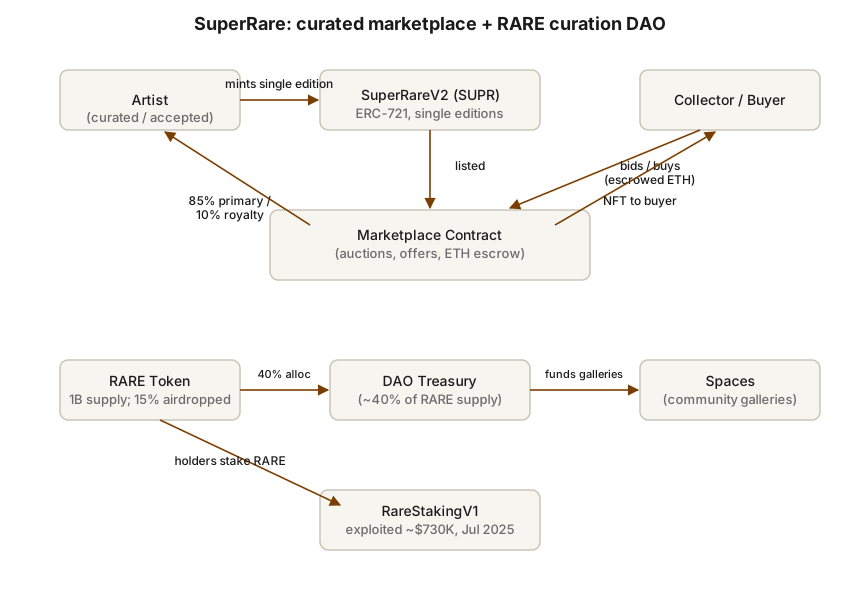 Open full-size diagram
Summary
SuperRare launched on Ethereum in April 2018, built by brothers John and Charles Crain with Jonathan Perkins. It positioned itself as the "Instagram meets Christie's" of crypto art: a tightly curated marketplace where every work is a single-edition (1/1) NFT minted by a verified artist. Two design choices proved historically important. First, artists had to apply and be accepted, making scarcity and quality control the product in a sea of open-mint platforms. Second, SuperRare hard-wired a 10% artist royalty on secondary sales into its marketplace from the earliest days — a mechanism that became the de facto industry standard for NFT art. In August 2021, at the peak of the NFT boom, SuperRare Labs launched the RARE "curation token," airdropped 150M tokens (15% of a 1B supply) to past artists and collectors, and announced a DAO with community-run galleries called "Spaces." The platform remains live in 2026, though volumes are far below 2021 peaks, staff was cut 30% in January 2023, and a staking contract was exploited for ~$730K in July 2025.
Design (Mechanism)
- Curated supply. Artists apply; only accepted artists can mint on the flagship SuperRareV2 ERC-721 contract (SUPR, 0xb932...b9e0). All works are single editions, and the social contract (later formalized) required works to be unique to SuperRare. Scarcity is enforced at the platform layer, not the protocol layer.
- Fee/royalty split. Primary sales: artist keeps 85% (15% platform commission), plus a 3% buyer-side marketplace fee. Secondary sales: 10% royalty to the artist, enforced by SuperRare's own marketplace contracts. SuperRare later experimented with "collector royalties" rewarding early collectors on downstream sales.
- Market mechanics. Onchain offers, auctions (scheduled and reserve-triggered), and fixed-price listings settle through marketplace contracts against escrowed bids in ETH.
- RARE token & DAO (Aug 2021). 1B supply; 15% retroactively airdropped (based on buy/sell activity before July 21, 2021, with a 90-day claim window), ~40% to a community treasury governed by RARE holders, with team/investor allocations for the remainder. A genesis governance "council" bootstrapped the DAO.
- Spaces. The core decentralization mechanism: independent, community-vetted storefront galleries. RARE holders vote on which operator teams receive a Space; operators then curate and onboard artists themselves, fragmenting the curation bottleneck without abandoning curation.
- Staking. A later RARE staking system (RareStakingV1) let holders stake on/around curation; its
updateMerkleRoot()function shipped with a broken access-control check, enabling the July 2025 exploit (~11.9M RARE, ~$730K).
Outcome
SuperRare became the blue-chip venue of the 2020–21 crypto-art movement: over $90M in cumulative volume by the token launch in August 2021 (with ~$13M in that month alone and average sale prices above $17K), and hundreds of millions in artist earnings and royalties over its lifetime. Its royalty model was copied across the industry. The DAO/token pivot had mixed results: the airdrop rewarded genuine participants, and Spaces launched real community galleries, but governance activity and RARE's value tracked the broader NFT decline rather than reversing it. The 2022–23 bear market forced a 30% staff cut (January 2023). The July 2025 RareStakingV1 exploit ($730K, marketplace and token unaffected) damaged confidence in the newer token infrastructure. The marketplace itself continues operating in 2026 as a niche but respected high-end art venue. Status: ongoing — a clear success as an art-market institution and royalty pioneer; unproven as a decentralized curation network.
Why it worked
- Curation as moat. When anyone could mint anywhere, acceptance to SuperRare was itself a signal. Collectors outsourced quality judgment to the platform, which supported high average prices.
- Royalties aligned artists. The enforced 10% secondary royalty gave artists lasting upside and made SuperRare the artist-friendly default, generating loyalty that open marketplaces couldn't buy.
- Right primitive, early. Single-edition ERC-721 art in 2018 predated the boom; by 2021 SuperRare had years of provenance, brand, and artist relationships that new entrants couldn't replicate.
- Retroactive airdrop credibility. Distributing RARE to actual past users (rather than speculative farmers) was among the cleaner token distributions of the 2021 cohort.
Limitations and criticisms
- Royalties depend on the venue, not the chain. SuperRare's royalty is enforced by its own contracts, not the ERC-721 standard; the 2022–23 royalty wars (Blur, optional royalties on OpenSea) showed the "standard" evaporates the moment trading moves to a venue that chooses not to honor it.
- Token utility lags the narrative. RARE governs Spaces and a treasury, but curation votes are not a strong enough sink to sustain demand once NFT volumes collapsed; the token's fate is coupled tightly to a shrinking market rather than to platform fundamentals.
- Decentralization is partial. SuperRare Labs still runs the flagship feed, employment, and product; the DAO governs only the periphery (Spaces, treasury). This is a defensible operating choice, but it means "decentralized curation network" overstates what actually exists today.
- New infrastructure adds new risk. The 2025 staking exploit came from an access-control bug in ancillary token machinery — risk added by the token layer, not the art marketplace that made the platform's name.
Lessons
- Platform-enforced royalties are a business-model choice, not a property right; they hold only as long as the platform is where trading happens. Durable royalties need protocol- or social-layer enforcement, which the NFT ecosystem never achieved.
- Curation scales badly but is precisely what collectors pay for; SuperRare's Spaces model — delegating curation to token-vetted sub-curators — is a more honest scaling path than opening the floodgates.
- Retroactive airdrops to authentic users buy legitimacy, but legitimacy without ongoing token utility decays with the market cycle.
- Adding token/staking infrastructure to a working product expands the attack surface; the exploit hit the newest, least battle-tested contract, not the 2018 core.
Redesign (EDITORIAL — hypothesis, not fact)
This section is editorial speculation, not historical fact. A redesign would decouple the three products SuperRare bundled: (1) an onchain artist registry and provenance attestation layer (the durable asset), (2) marketplace venues that compete on fees, and (3) curation as an explicitly staked market — curators lock RARE behind artists or works and earn a share of future royalties, taking slashing-style losses on delisted or plagiarized work, so curation signal has skin in the game rather than committee votes. Royalties would be enforced via transfer-hook standards (e.g., locked/soulbound-until-paid patterns or ERC-721C-style enforceable royalties) at the token contract level, so the artist's 10% survives venue migration. The DAO would govern only the registry and royalty parameters — the smallest credible surface — leaving product execution with an accountable company, and any staking contract would ship behind a timelock with the same audit rigor as the core marketplace.
Sources
- SuperRare: SUPR Token (SuperRareV2) — Etherscan — primary (contract)
- SuperRare (RARE) ERC-20 — Etherscan — primary (contract)
- Announcing the $RARE Curation Token and the SuperRare Network (SuperRare Labs) — primary (docs)
- Assets — SuperRare Developer Documentation — primary (docs)
- Ethereum NFT Marketplace SuperRare Launches Token — Decrypt (Aug 17, 2021) (news)
- The Co-Founders of SuperRare on Becoming a DAO — Artnet News (news)
- NFT Marketplace SuperRare Cuts Staff by 30% — CoinDesk (Jan 2023) (news)
- SuperRare Hack Analysis (RareStakingV1 exploit, July 2025) — SolidityScan (analysis)
- The Art Royalty Revolution — SuperRare Labs — primary (docs)
Related experiments
Last verified: 2026-07-26 · Spot an error? Suggest a correction