Fantasy.top
A SocialFi trading-card game on Blast (later Base) that turned Crypto Twitter influencers into tradable NFT hero cards scored by their real X engagement — a viral 2024 hit that never found durable product-market fit and wound down in mid-2026.
▶ Run interactive simulation animated mechanism with editable parameters
How it works onchain
 Open full-size diagram
Summary
Fantasy.top was a "SocialFi" trading-card game that launched on the Blast L2 on May 1, 2024, built by a pseudonymous founder known as "Travis Bickle." It was essentially Sorare for Crypto Twitter: instead of footballers, players collected ERC-721 "hero" cards of roughly 120+ (eventually more) crypto influencers, built five-card decks, and entered tournaments whose scores were driven by the heroes' real engagement metrics on X. The game went instantly viral — within its first week it had paid out $1.25M in ETH to the influencers it depicted, and at its 2024 peak it ranked among DeFiLlama's top-10 protocols by fees and revenue. Activity then collapsed with the broader Blast/NFT cycle; the team pivoted (V2, prediction markets, jackpots), raised a $4.25M seed led by Dragonfly (announced December 2024), migrated to Base in July 2025, weathered "soft rugpull" accusations from angel investors in March 2026, and finally announced shutdown on May 20–21, 2026, with final competitions ending June 18, 2026. Over its life it returned $20M+ to players and $3.2M to heroes, and refunded pre-seed/seed investors dollar-for-dollar. No native token was ever launched.
Design (Mechanism)
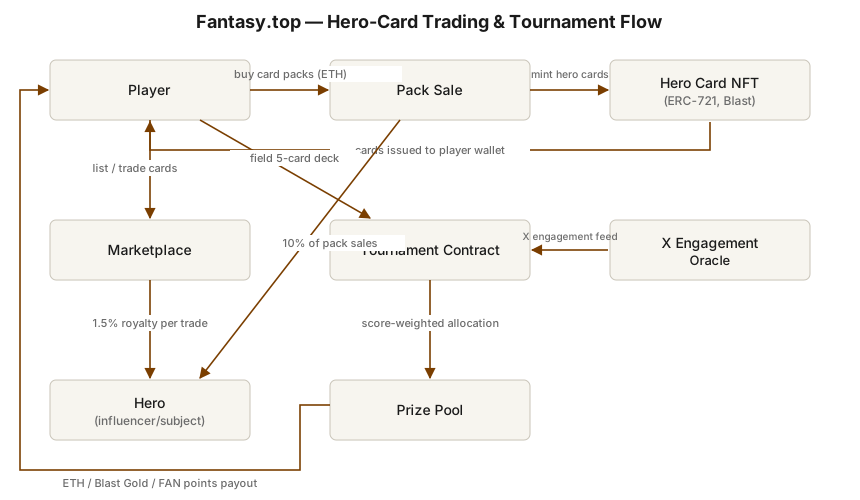
- Hero cards. Each crypto-Twitter personality ("hero") was minted as NFT cards on Blast (ERC-721 contract 0x0aaa...0734) in four rarities: common, rare, epic, legendary. Supply entered circulation via card-pack sales and a secondary marketplace.
- Fantasy tournaments. Players needed at least 5 cards to field a deck in recurring competitions. Scoring was computed from each hero's X engagement (views/likes/interactions on posts) during the tournament window — an oracle-fed "social performance" feed replacing sports statistics. Prize pools paid ETH, Blast Gold, and FAN points (a loyalty-points program widely assumed to precede a token; the token never came).
- Card leveling/burning. Five identical cards could be fused to level up a card, a supply sink borrowed from TCGs.
- Aligned-influencer flywheel. Heroes earned a 1.5% royalty on all secondary trades of their own cards plus a reported 10% share of pack sales — directly paying the people whose attention and reach marketed the game. Influencers therefore promoted Fantasy.top to pump their own card volume, which recruited players, which raised prize pools.
- Revenue model. Protocol income came from pack sales and marketplace trading fees; at launch this briefly made it one of crypto's highest-fee-generating apps. Later additions (V2 in late 2024, prediction markets on hero metrics, jackpots) attempted to diversify beyond card-flipping volume.
Outcome
Explosive launch, long decay, orderly wind-down. Week one: $1.25M ETH distributed to heroes; 2024 peak: top-10 on DeFiLlama by fees/revenue alongside pump.fun. By June 2025, monthly fee revenue had fallen ~93% from peak to roughly $200K, and active users ~80% to about 2,000 (DL News), prompting the July 15, 2025 migration from the fading Blast ecosystem to Base. In March 2026 angel investors publicly accused the team of a "soft rugpull" (unreturned angel checks, silence, salary payments); the founder replied that operations had been fully self-funded from product revenue. On May 20–21, 2026 the team announced closure: "Despite strong experimentation and iteration speed, none reached durable market fit," and, per team member Kipit, "We tried to put crypto on top of a model that was never built for crypto." Final competitions ran through June 18, 2026; lifetime distributions totaled $20M+ to players and $3.2M to heroes, with pre-seed and seed investors refunded in full — an unusually clean exit for the category.
Why it worked
- Perfect audience-mechanism fit at launch: the players, the "assets," and the marketing channel were all the same people — Crypto Twitter. Making influencers profit from their own cards (1.5% royalties + pack-sale cut) conscripted the loudest accounts in crypto as unpaid growth marketers.
- Legible, verifiable scoring: X engagement was a stat everyone already watched, making fantasy competition instantly understandable.
- It rode two speculative waves at once: Blast's points/airdrop meta (Blast Gold rewards) and the 2024 SocialFi/NFT revival, plus its own FAN-points airdrop expectation.
- Real cash out the door: large, fast, visible ETH payouts to heroes and players created proof-of-rewards social content that fueled the loop.
Where the design broke
- Speculators, not players. By the team's own postmortem, the user base treated cards as flip inventory, not game pieces; when price appreciation stopped, both volume-based revenue and gameplay engagement evaporated together.
- Revenue was a function of mania. Fee income depended on churn in card trading; it fell ~93% within a year of launch. TCG economics assume durable collector demand that never materialized on-chain.
- Dependence on a declining host chain and an unpaid promise. Blast's collapse in activity dragged the game down (forcing the Base migration), and FAN points' implied token never launched, exhausting the airdrop-farming cohort's patience.
- Influencer incentives cut both ways: heroes hyped the game while their royalties flowed, and moved on when volumes died — the marketing engine was rented, not owned.
- Trust erosion late in life: the March 2026 angel-investor dispute damaged credibility even though institutional investors were ultimately made whole.
Lessons
- Aligning the subjects of speculation with distribution (paying influencers royalties on their own cards) is one of the most effective cold-start mechanisms ever demonstrated on-chain — but it buys ignition, not retention.
- If revenue = trading fees on your own game assets, your business is short volatility of your own hype cycle; gameplay demand must eventually replace flip demand, and mechanisms should be stress-tested against the day price appreciation stops.
- Points programs with an implied token are unsecured debt to your community; carrying that liability for two years without a TGE converts loyal farmers into resentful creditors.
- Chain choice is a dependency, not a detail: coupling to Blast's airdrop meta supercharged launch and then imposed the ecosystem's decay on the game.
- An orderly shutdown — refunding seed investors and distributing $20M+ back to users — preserved reputations in a sector where most dying projects simply vanish; graceful exits are themselves a mechanism worth designing in advance.
Redesign (EDITORIAL — hypothesis, not fact)
This section is editorial hypothesis, not established fact. A redesigned Fantasy.top might survive by (1) severing revenue from card churn: charge tournament entry fees or season passes so income scales with players, not flippers; (2) making cards depreciating "athlete contracts" (seasonal expiry with renewal burns) so the supply sink is structural rather than optional fusion, and floor prices anchor to expected tournament EV instead of pure resale hope; (3) paying heroes from tournament rake tied to how often they are drafted, rather than trade royalties, so influencer incentives reward sustained playability, not volume spikes; (4) settling the points question early — either commit to a token at launch with a fixed conversion schedule or explicitly promise never to issue one; and (5) deploying chain-agnostically from day one so the game is not levered to any single L2's incentive season. The unresolved question is whether any fantasy game about crypto influencers can outlive a bull market, since its underlying "sport" — Crypto Twitter attention — is itself cyclical.
Sources
- Fantasy hero-card NFT contract on Blastscan — primary (contract)
- Fantasy Top — The Official Playbook (GitBook) — primary (docs)
- What Is Fantasy Top? The Ethereum Game on Blast Turning Crypto Twitter Into a Fantasy Sport (Decrypt) (news)
- Ethereum Game 'Fantasy Top' Pays $1.25M to Twitter Influencers It Turned Into NFT Cards (Decrypt) (news)
- Fantasy.top announces V2 and $4.25 million seed funding from Dragonfly and Manifold Ventures (The Block) (news)
- SocialFi project fantasy.top ditches Blast for Coinbase's Base after fee revenues drop over 90% (DL News) (news)
- Fantasy.top founder pushes back on 'soft rugpull' allegations after angel investors claim team went silent (The Block) (news)
- Ethereum Crypto Influencer Game 'Fantasy Top' Shutting Down (Decrypt) (news)
- Fantasy Top to shut down after two years, returning $20M to users along the way (Crypto Briefing) (news)
- fantasy.top on DefiLlama (fees/revenue data) (analysis)
Related experiments
Last verified: 2026-07-26 · Spot an error? Suggest a correction