ChronoBank (LabourHour / TIME)
An Australian ICO that tried to tokenize an hour of labor as a stable, redeemable unit of value, backed by a recruitment-fee-earning TIME governance/dividend token.
▶ Run interactive simulation animated mechanism with editable parameters
How it works onchain
 Open full-size diagram
Summary
ChronoBank was a late-2016 Australian ICO that tried to build a labor-hour-backed digital token, an on-chain analog to timebanking. Instead of collateralizing a token with fiat or crypto reserves, ChronoBank proposed backing its "LabourHour" (LH) token with the promise of one hour of a defined category of labor, redeemable through partner recruitment/staffing agencies (starting with Edway Group, an Australian industrial labor-hire firm co-founded by ChronoBank's Sergei Sergienko). A second token, TIME, was sold to ICO investors as a claim on the network's future transaction-fee revenue: every time an LH token was minted or traded, a cut of the fee flowed to TIME holders. The project raised roughly 5,400 BTC (~$5.4M at the time) across its token sale, which concluded in February 2017. It later rebranded its product suite under the "chrono.tech" umbrella and launched LaborX, a crypto-payable freelance/recruitment marketplace, as its flagship surviving product.
Design (Mechanism)
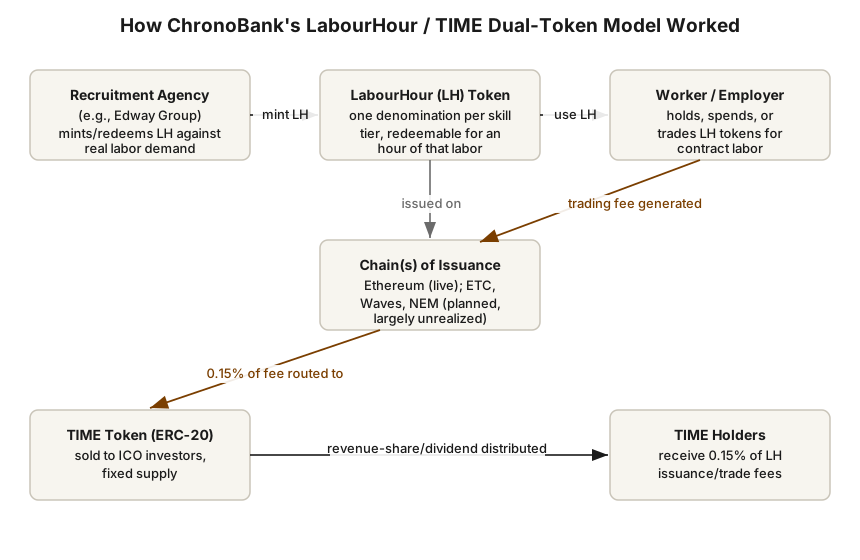
The core pitch was price stability without fiat or asset backing: because an hour of a given skill tier of labor changes in market value much more slowly than a typical cryptocurrency, LH tokens were meant to behave like a "labor-denominated stablecoin" — a hedge against crypto volatility that recruitment agencies could actually use to price contracts. LH tokens were to be issued in multiple denominations (e.g., unskilled, semi-skilled, skilled labor) and were meant to be redeemable with the agencies that opted into the network for actual paid work hours, effectively making licensed staffing firms the off-chain "central banks" minting and burning LH supply against real labor demand. ChronoBank also planned to issue LH on multiple blockchains (Ethereum, Ethereum Classic, Waves, NEM) rather than committing to one chain.
TIME was the ICO/investment token: a fixed-supply ERC-20 sold to raise development capital, entitling holders to 0.15% of all transaction fees generated by LH issuance and trading across the network — essentially a revenue-share/dividend token layered on top of the labor-hour unit. This two-token design (a "stable" utility unit plus a fee-capturing equity-like token) prefigured later dual-token models used by many algorithmic-stablecoin and real-world-asset protocols.
Outcome
The ICO successfully raised capital (5,400 BTC) and shipped a working product suite, unusual for 2017-era ICOs. However, the original labor-hour-backed LH token model — the project's central mechanism-design claim — never achieved meaningful adoption or liquidity; recruitment agencies broadly did not adopt LH as a settlement instrument, and multi-chain LH issuance largely did not materialize as originally scoped. The company pivoted its resources toward LaborX (a freelance marketplace paying out in crypto, closer to a conventional gig-economy platform than a labor-hour stablecoin) and later added TimeX (an exchange), PaymentX (payroll/invoicing), AUDT (an AUD-pegged stablecoin), and TimeFarm (a mobile/gamified user-acquisition app). As of mid-2026 the TIME token still trades on exchanges (Uniswap, KuCoin, Gate.io) and the company remains operational under the chrono.tech brand, but the original "labor-hour as a stable unit of account" thesis was effectively abandoned in favor of a more conventional token-utility/exchange-fee business.
Why it worked
- The ICO itself was a fundraising success: it hit its raise target during the 2016-17 ICO wave and gave the team runway to build multiple years of product.
- The product mix shifted toward a simpler, more legible offering (LaborX, a crypto-paid freelance marketplace) rather than the harder-to-enforce labor-hour-backed token, which let the company survive multiple crypto cycles when many 2017 ICOs did not.
- Having a real offline business (Edway Group, an established Australian staffing firm) gave the project a credible go-to-market anchor that pure-crypto ICOs lacked.
Where the design broke
- The LH mechanism required a two-sided market (recruitment agencies willing to mint/redeem LH against real labor, and workers/employers willing to hold and spend it) that never developed meaningful liquidity; agencies had little incentive to accept a volatile, thinly-traded crypto asset as a labor-hour proxy over fiat invoicing.
- "Backing" a token with a service (an hour of undefined future labor) rather than a fungible, verifiable asset made redemption enforcement and price-stability claims difficult to substantiate on-chain; there was no real collateral or oracle mechanism ensuring LH actually tracked labor value.
- Multi-chain issuance across Ethereum, Ethereum Classic, Waves, and NEM fragmented liquidity and required maintaining parity across four separate deployments, without a clear reason any given labor market needed to choose among them.
- The TIME token's revenue-share thesis depended entirely on LH transaction volume that never materialized at scale, making TIME's early years largely speculative rather than cash-flow-backed.
Lessons
- Backing a token with a promise of future service delivery (rather than fungible collateral) creates a redemption/enforcement gap that's much harder to close than fiat- or crypto-collateralized designs.
- A credible offline anchor business (Edway Group) can fund survival through a bear market even when the core on-chain mechanism fails to gain traction — but survival isn't the same as validating the original design.
- Two-sided marketplace tokens (LH) are much harder to bootstrap than platform/fee-capture tokens (TIME); a pivot from one to the other is a change in the underlying mechanism even when project communications describe it as "ecosystem expansion."
- Shipping on many chains at once, absent chain-specific demand, fragments liquidity and adoption effort rather than expanding accessibility.
Redesign (EDITORIAL)
EDITORIAL — hypothesis, not fact. A more viable version of ChronoBank's core idea might have skipped the "labor-hour-backed stable token" framing entirely and instead built a narrow escrow/invoicing rail on a single chain: smart contracts that lock a stablecoin (e.g., USDC) payment for a freelance engagement, release it against verifiable milestones or agency attestations, and pay a small protocol fee to a governance token — essentially LaborX's actual outcome, but designed intentionally from day one rather than arrived at after the LH thesis failed. Removing the redemption promise of "one hour of labor" (which required trusting an off-chain agency to honor a peg with no on-chain enforcement) in favor of an actual USD-stable settlement asset would have made the value proposition legible to both freelancers and employers without asking either side to speculate on a bespoke, illiquid labor-denominated unit.
Sources
- ChronoBank Launch Initial Coin Offering (ICO) For Blockchain Recruitment Product (news)
- ChronoBank (TIME) ICO details — ICO Drops (aggregator)
- ChronoBank Whitepaper: Phase 1 — A Non-Volatile Digital Token Backed by Labour-Hours — primary (whitepaper)
- Chrono.tech official site — primary (official site)
- ChronoBank 'Crypto' Startup Attracts $3M Bitcoin, Forges Changelly App Partnership — Forbes (news)
- Looking Ahead: Chrono.tech's Ecosystem Expansion and 2024 Roadmap — primary (project blog)
Related experiments
Last verified: 2026-07-27 · Spot an error? Suggest a correction