KlimaDAO
An OlympusDAO-fork 'carbon-backed reserve currency' that used bonding and rebase staking to absorb millions of tokenized carbon credits into a DAO treasury, sparking a boom-bust in on-chain carbon markets before pivoting to carbon-market infrastructure (Klima 2.0 on Base).
▶ Run interactive simulation animated mechanism with editable parameters
How it works onchain
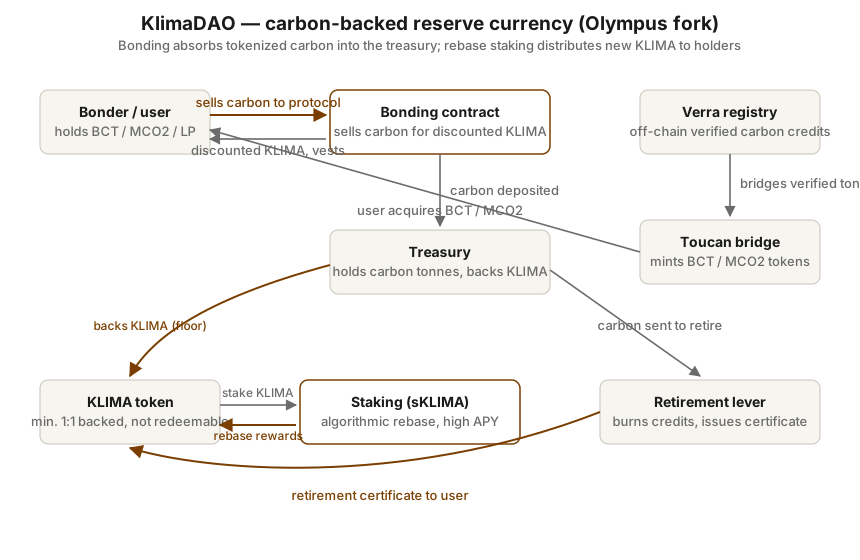 Open full-size diagram
Summary
KlimaDAO launched on Polygon on October 18, 2021 as an OlympusDAO fork whose treasury reserve asset was not DAI but tokenized carbon credits — primarily Toucan Protocol's Base Carbon Tonne (BCT), each representing one verified tonne of CO2 offsets bridged from the Verra registry. The pitch: create a "carbon-backed reserve currency" (KLIMA, backed at minimum 1:1 by carbon tonnes) whose demand-driven treasury accumulation would sweep cheap carbon credits off the voluntary carbon market (VCM), drive up the price of carbon, and make polluting more expensive. Founded by a pseudonymous team (core founding members known as Dionysus, Archimedes, and 0xylos, among others), it briefly became the flagship of the "ReFi" (regenerative finance) movement, attracting backing from Mark Cuban. KLIMA spiked to roughly $2,500–$3,700 shortly after launch amid five-to-six-figure advertised APYs, then collapsed more than 99% as the rebase math unwound. The DAO nonetheless accumulated on the order of 18+ million tonnes of tokenized carbon in its treasury and later rebuilt itself as "Klima 2.0" / Klima Protocol, a two-token carbon-market infrastructure system that migrated to Base in 2025.
Design (Mechanism)
- Carbon-backed reserve token. Each KLIMA was backed by at least one BCT (or other carbon pool token) held in the DAO treasury. Backing was a floor, not a peg; KLIMA traded far above intrinsic backing.
- Bonding. Users sold BCT, MCO2, or KLIMA/BCT LP tokens to the protocol in exchange for discounted KLIMA vesting over several days. This was the intake valve pulling carbon tonnage into the treasury and building protocol-owned liquidity (the Olympus mechanism, pointed at a real-world asset).
- Rebase staking. Stakers received sKLIMA with algorithmic rebase rewards (advertised APYs exceeded 30,000% at launch — one launch-era report cited over 200,000%), funded by new issuance justified by excess treasury backing. The (3,3) meme did the marketing.
- Retirement lever. Carbon in the treasury could ultimately be retired (permanently consumed) on-chain, converting speculative demand into claimed climate impact; a retirement aggregator later let anyone burn pooled credits.
- Klima 2.0 (KIP-65, "Metamorphosis"). After the collapse, governance approved a redesign separating the asset claim from risk governance: a new KLIMA token representing a claim on the carbon portfolio (burnable for retirement certificates) and KLIMAX governing issuance rate and portfolio risk, with rules-based carbon "classes," forward markets, and a 2025 migration and fair-launch TGE on Base with liquidity on Aerodrome.
Outcome
Launch was delayed hours by a griefing incident (a rogue low-liquidity BCT/KLIMA pool). KLIMA then ran to an all-time high commonly cited around $2,500 (some sources cite ~$3,681 in late October 2021) before falling below $10 within months and later below $1 — a >99.9% drawdown against USD, and far below staking-adjusted breakeven for most late entrants. On the carbon side the flywheel genuinely worked for a while: the bonding program absorbed over 18 million tonnes of tokenized credits (KlimaDAO cited $100M+ treasury assets and ~$4B in cumulative carbon-token trading through 2022) and briefly moved prices in the off-chain VCM. But CarbonPlan's analysis showed the absorbed BCT credits were overwhelmingly old, low-quality tonnage (99.9% ineligible for CORSIA), meaning the buying pressure largely revalued junk credits rather than financing new abatement. In May 2022 Verra prohibited tokenization of retired credits, severing the original bridge design and crippling supply growth. The DAO survived, kept shipping (retirement aggregation, Carbonmark marketplace), and executed the Klima 2.0 migration to Base in 2025; the legacy Polygon KLIMA token now trades at fractions of a cent. Outcome: partial_success — the mechanism demonstrably bootstrapped on-chain carbon liquidity at unprecedented scale, but the monetary design failed holders and the climate impact of the absorbed credits is heavily disputed; the successor protocol is ongoing.
Why it worked
- A real sink for a real asset. Unlike pure Ohm forks, bonding demand pulled an external real-world asset on-chain, briefly making KlimaDAO the largest single buyer-side force in tokenized carbon and proving DeFi could build RWA liquidity fast.
- Narrative-mechanism fit. "Speculate and save the planet" fused degen yield with a legible mission; the (3,3) social game and pseudonymous-but-vocal team generated enormous distribution at zero marketing cost.
- Protocol-owned treasury. Because liquidity and reserves were protocol-owned, the DAO retained a large carbon treasury even after the token collapsed — the crash did not kill the organization.
Why it failed or underperformed
- Ponzi-adjacent emission math. Rebase APYs required perpetual net inflows; once bond demand slowed, dilution overwhelmed price, exactly as in every Olympus fork. Backing was a psychological anchor, not a redemption floor.
- Garbage-in carbon quality. The cheapest credits flowed to the bonds first (adverse selection). Absorbing near-worthless legacy tonnage inflated "impact" metrics without funding new carbon removal, drawing credible criticism from CarbonPlan and others.
- Registry dependency risk. Verra's May 2022 tokenization ban showed the whole design depended on a permissioned off-chain registry that could — and did — unilaterally cut off supply.
- Price signal confusion. A reserve currency wants number-go-up; a carbon-retirement engine wants cheap acquisition and credible burn. The single token had to serve both, and served neither well.
Lessons
- Backing that cannot be redeemed at the floor is narrative, not collateral. If holders cannot exit at intrinsic value, "backed by X" mostly functions as marketing during the down leg.
- When you subsidize acquisition of a heterogeneous real-world asset, you will be adversely selected. Any bonding/buyback mechanism for RWAs needs quality gating (vintage, methodology, rating) priced into the discount — Klima 2.0's "carbon classes" are the direct admission of this.
- Off-chain registries are a centralization choke point for RWA protocols. A single policy change by Verra invalidated the bridge architecture; RWA designs need explicit contingency for their permissioned upstream.
- Reflexive-token booms can still leave durable residue. The speculative phase funded a treasury, tooling, and market infrastructure that outlived the token price — sequencing "bubble as bootstrapping" can work if the treasury is protocol-owned.
- Separate the impact instrument from the speculation instrument. Combining store-of-value, governance, and retirement claims in one token produced incoherent incentives; the 2.0 dual-token split (KLIMA claim vs. KLIMAX governance) is the textbook fix.
Redesign (EDITORIAL — hypothesis, not fact)
This section is editorial hypothesis, not fact. A redesigned KlimaDAO would invert the flow: instead of minting a reserve token against whatever carbon shows up, it would run a standing on-chain reverse auction for retirement, where a burn-only "impact" token entitles holders to retire specific, quality-scored carbon classes at treasury-subsidized rates. Quality gating would be priced directly into bond discounts (steep discounts for high-integrity removals, zero or negative for legacy avoidance credits), turning adverse selection into positive selection. The speculative layer, if kept at all, would be an explicitly labeled governance/equity token with no backing claim, so no one confuses treasury accounting with a redemption floor. Registry risk would be diversified from day one across multiple registries plus native on-chain MRV (measurement, reporting, verification) projects, with the treasury holding a contractual, over-collateralized bridge rather than depending on one registry's tokenization policy. Finally, the protocol would publish retirement — not accumulation — as its headline KPI, since tonnage hoarded in a treasury is inventory, not impact. Klima 2.0 adopts several of these ideas; whether rules-based classes and the KLIMA/KLIMAX split can attract demand without the reflexive APY engine that powered the original is the open question.
Sources
- Klima Protocol official site (successor to klimadao.finance) — primary (docs)
- KlimaDAO deployment addresses (docs) — primary (docs)
- KLIMA token on PolygonScan — primary (contract)
- KIP-65: Klima 2.0 - Metamorphosis (governance forum) — primary (governance)
- Klima 2.0 whitepaper — primary (docs)
- KlimaDAO Launch Announcement (Smart Liquidity Research, Oct 2021) (archive)
- Klima DAO: a crypto answer to carbon markets (Journal of Organization Design) (analysis)
- CarbonPlan: A response to KlimaDAO's analysis of Base Carbon Tonne tokens (analysis)
- KlimaDAO Impact Report: Analysis of the Base Carbon Tonne — primary (retrospective)
- Verra bans tokenizing retired carbon credits (CarbonCredits.com, May 2022) (news)
- Protos: How billionaire Mark Cuban got revenge on DeFi with KlimaDAO (news)
Related experiments
Last verified: 2026-07-26 · Spot an error? Suggest a correction