LinksDAO
A golf-club DAO that raised ~$10.5M in a 48-hour NFT membership mint and actually bought a real Scottish golf course, but has struggled to deliver its 'top-100 course' promise.
▶ Run interactive simulation animated mechanism with editable parameters
How it works onchain
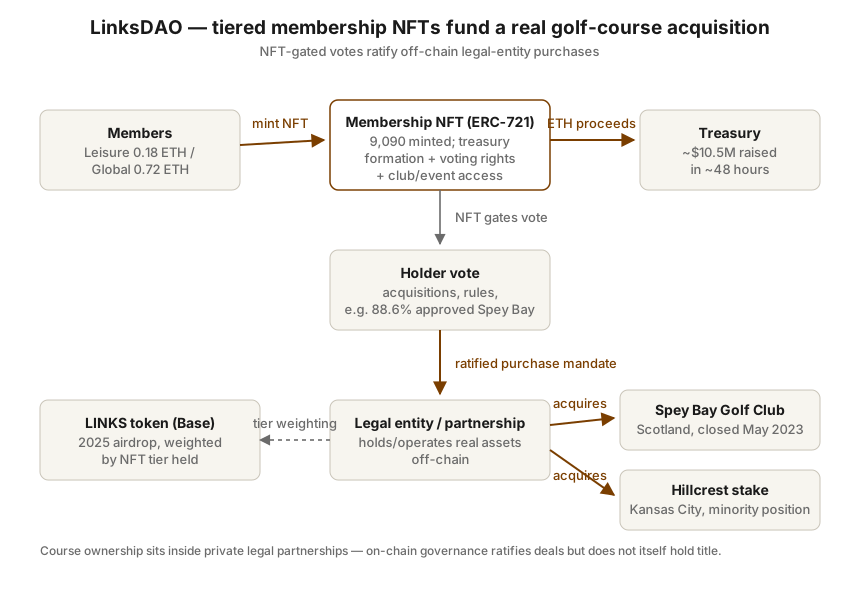 Open full-size diagram
Summary
LinksDAO is the canonical "DAO buys a real-world thing — and actually closes" experiment. Conceived in late 2021 by Mike Dudas (founder of The Block, later 6th Man Ventures) with Jim Daily and Chris Maddern, it launched a membership NFT mint over New Year's 2021–22 with the stated ambition of buying and operating "one of the world's top 100 golf courses" and building "the world's best golf and leisure club." The mint of 9,090 ERC-721 memberships sold out in roughly 48 hours, raising ~$10.4–11M. Unlike ConstitutionDAO (its explicit inspiration), LinksDAO completed a purchase: after an 88.6% member vote, it won the bid for Spey Bay Golf Club in Scotland in March 2023 (asking price ~$905K) and closed in May 2023. It later took a stake in the Hillcrest Country Club restoration in Kansas City and launched a LINKS token on Base (announced with an airdrop weighted toward NFT holders). As of mid-2026 the club operates and runs events, but reporting documents stalled construction and contractor liens at Hillcrest, an undocumented ownership claim disputed by the property's majority owner, and an unimplemented redesign at Spey Bay — a real but much more modest outcome than the top-100 pitch.
Design (Mechanism)
- Tiered membership NFT crowdfund. 9,090 NFTs (10% reserved by the DAO) in two tiers: Leisure at 0.18 ETH (
$676 at mint) and Global at 0.72 ETH ($2,703). The mint doubled as treasury formation (~$10.5M) and membership roster. Contract: 0x696115768bbef67be8bd408d760332a7efbee92d (Ethereum ERC-721). - NFT-gated governance. Membership NFTs carry voting rights over key decisions — course acquisitions, club rules, brand partnerships. Major moves (the Spey Bay bid, the Hillcrest deal) were put to holder votes; the Spey Bay bid was approved with 88.6% in favor.
- Planned token-weighted layer. A LINKS governance token airdrop was planned from the start, with Global-tier holders slated for 4x the allocation of Leisure holders — proportionally greater voting power for larger backers. The LINKS token was ultimately announced for Base in 2025, with roughly a third of supply to NFT holders and allocations to other NFT communities (e.g., Pudgy Penguins, BAYC) as a growth mechanic.
- Legal-wrapper RWA ownership. The golf courses are held/operated through conventional legal entities and partnerships rather than directly by token holders on-chain; the NFT functions as club membership plus governance signal, not a securities-style equity claim. The Hillcrest arrangement is a minority/partnership position alongside majority owner Robb Heineman's $30M renovation project.
- Membership utility loop. NFTs unlock the digital community, merch/partner perks, event and tournament access, and (from March 2025) actual member initiation at Hillcrest "permissionlessly via their NFTs."
Outcome
Partial success, still ongoing. Verified wins: the sell-out mint (~$10.5M in ~48 hours, Jan 1–3, 2022); the Spey Bay acquisition (won bid March 2023 after an 88.6% member vote, closed May 2023) — one of the first DAO-governed purchases of a functioning real-world business; continued operations, events, new-member sales (reopened Aug 2023), and a 2025 LINKS token launch on Base. Verified shortfalls (per Fried Egg Golf's 2025 investigation): Spey Bay is a charming ~$1M municipal-grade links, not a top-100 course, and its planned redesign has not been implemented (the architects, Clayton, DeVries & Pont, uninvolved since June 2024); Hillcrest construction stalled in summer 2025 with three liens filed against the owner's entity (including $431,927 claimed by Matrix Golf), the late-2026 preview opening in doubt; and LinksDAO's claimed Hillcrest ownership stake is undocumented publicly and characterized by Heineman as "profits interests" rather than ownership. Roughly $10.5M raised bought far less golf course than the marketing implied.
Why it worked
- A crisp, legible dream. "We're buying a golf course" is instantly understandable, memeable, and aspirational to a large non-crypto demographic — golfers priced out of country clubs.
- Right-sized target. Unlike ConstitutionDAO's one-shot auction, golf courses are a liquid market with many sub-$5M assets; failure to win one deal didn't kill the project.
- Membership utility as downside floor. Even before any purchase, the NFT delivered community, perks, and events, so the token wasn't a pure claim on a future asset.
- Credible operators. Founders with real consumer/fintech track records (The Block, Teads, Button) plus celebrity backers gave the fundraise mainstream legitimacy.
- Governance actually used. Binding-in-practice member votes on acquisitions made the "DAO" label more than branding and sustained community buy-in through a two-year search.
Where the design broke
- Expectation–treasury mismatch. A top-100 course costs tens of millions plus heavy capex; ~$10.5M (partly ETH, in a falling market through 2022) could realistically buy a ~$1M Scottish links. The founding promise set a bar the treasury could not clear.
- RWA opacity crept back in. The Hillcrest position — the deal meant to deliver the "top-100 potential" course — is governed by private agreements the DAO leadership says it cannot publish, and is disputed by the majority owner. On-chain governance ends where off-chain contracts begin.
- Execution risk transferred to a partner. Hillcrest's stalled construction and contractor liens sit with the majority owner's entity, but LinksDAO members bear the delivery failure of the club experience they were promised.
- Slow asset, fast community. A multi-year acquisition-and-renovation cycle strains a community acquired overnight in a speculative mint; secondary prices and attention faded long before the product existed.
Lessons
- Crowdfund velocity is not operating capability. Raising $10M in 48 hours is a distribution achievement; buying, renovating, and running golf courses is a decade-long operating business — DAOs should scope promises to the treasury they actually raised.
- The NFT-as-membership pattern outperforms NFT-as-claim. LinksDAO survived the 2022–23 bear because holders got a club, not just exposure; utility floors keep RWA DAOs alive through long acquisition timelines.
- RWA DAOs are only as transparent as their weakest legal wrapper. Once the key asset sits inside a private partnership whose documents "can't be provided externally," token-holder governance becomes advisory; disclosure commitments should be negotiated into the deal, not requested afterward.
- Pick markets with many acquirable targets. LinksDAO's edge over ConstitutionDAO was a repeatable target class — losing any single bid was survivable.
- Votes legitimize, but ratifying leadership-sourced deals is thin decentralization. High-approval votes (88.6%) on pre-packaged deals sustain engagement but concentrate real diligence in a small core team.
Redesign (EDITORIAL — hypothesis, not fact)
This section is editorial hypothesis, not reporting. A redesigned LinksDAO would (1) invert the promise: market the raise as "buy course #1 of 10 modest courses," letting members upgrade expectations as the treasury compounds, rather than anchoring on "top-100" and under-delivering; (2) hold each course in a transparent per-asset legal wrapper (e.g., a Wyoming DAO LLC or UK company whose filings, leases, and partnership agreements are hash-committed on-chain and viewable by members), making the Hillcrest-style "trust us, we own some of it" situation structurally impossible; (3) convert treasury to fiat/stables at mint for any near-term acquisition budget to eliminate ETH drawdown risk between raise and close; (4) tie the LINKS token to verifiable club economics (rounds played, membership dues, event revenue reported via attested oracles) instead of airdrop-driven growth marketing; and (5) escrow renovation capex with milestone-based release voted by members, so construction stalls surface as failed on-chain milestones rather than surprise mechanics' liens. The hypothesis: the mint would raise less, but the club would compound trust — the scarcest asset in RWA DAOs.
Sources
- LinksDAO NFT Sale Books First $10M Toward Buying an Actual Golf Course (CoinDesk) (news)
- Links Enters Into Exclusivity Agreement to Purchase Spey Bay Golf Course (official LinksDAO newsletter) — primary (docs)
- LinksDAO membership NFT contract (Etherscan) — primary (contract)
- LinksDAO to Bid on Scottish Golf Course Following Vote (CoinDesk) (news)
- LinksDAO Wins Bid to Buy Scottish Golf Course (Decrypt) (news)
- LinksDAO Struggles to Deliver on Promises (Fried Egg Golf, 2025) (analysis)
- LinksDAO Announce LINKS Token and Buy U.S Golf Course (Sporting Crypto) (analysis)
- This DAO says it raised $10.4 million in 48 hours selling NFTs (CNBC) (news)
Related experiments
Last verified: 2026-07-26 · Spot an error? Suggest a correction