Royal
VC-backed music-rights platform (co-founded by DJ 3LAU) that sold fractional streaming-royalty shares as ERC-1155 'Limited Digital Assets' on Polygon before sunsetting its marketplace in 2024.
▶ Run interactive simulation animated mechanism with editable parameters
How it works onchain
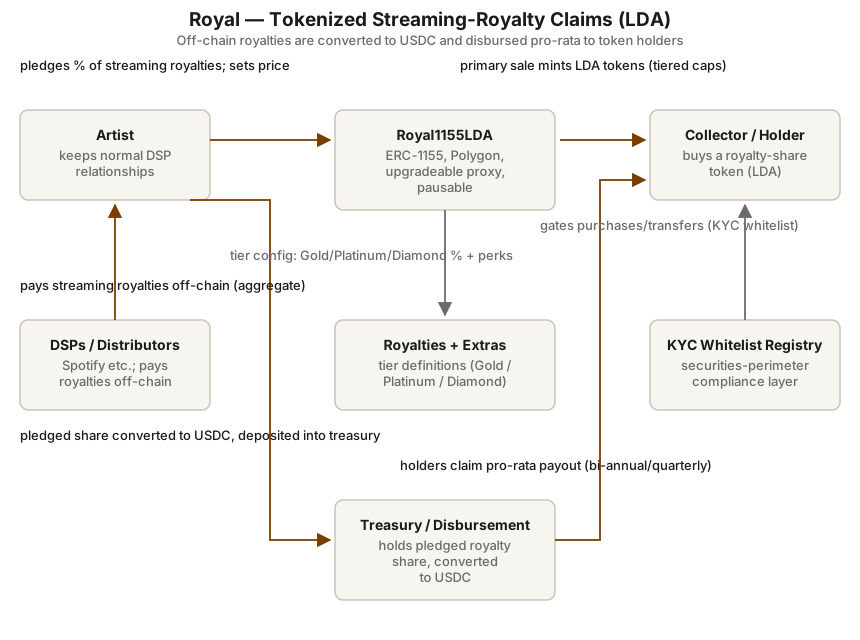 Open full-size diagram
Summary
Royal (royal.io) was one of the best-funded attempts to put music streaming royalties onchain. Founded in May 2021 by electronic artist Justin "3LAU" Blau and Opendoor co-founder JD Ross, and based in Austin, Texas, it raised a $16M seed (August 2021, led by Founders Fund and Paradigm) and a $55M Series A (November 2021, led by a16z, with participation from Nas, The Chainsmokers, Logic, Kygo, Joyner Lucas, and others) — roughly $71M total. Royal sold "Limited Digital Assets" (LDAs): ERC-1155 tokens on Polygon that entitled holders to a pro-rata share of a song's streaming royalties, paid in USDC. It executed high-profile drops with 3LAU, Nas, Diplo, and The Chainsmokers, and began royalty payouts in July 2022. Demand for primary drops was real but secondary activity withered with the broader NFT market, and in April 2024 Royal announced it was sunsetting the marketplace to pivot toward AI-music-related products; the site now offers only a "legacy royalty claim" support contact (royalties@royal.io) and a teaser about new music+crypto products.
Design (Mechanism)
- Asset: an LDA is an ERC-1155 token (verified
Royal1155LDAcontract on Polygon, upgradeable proxy, pausable, tiered supply caps) representing a claim on a defined percentage of a specific song's streaming royalties — typically master-recording streaming royalties only, not publishing, sync, or ownership of the recording itself. - Tiers: each drop was split into tiers (e.g., Gold / Platinum / Diamond) with different royalty percentages and off-chain perks ("extras" such as merch, access, or artwork variants), managed via companion Royalties and Extras contracts referenced by the LDA contract.
- Distribution flow: the artist keeps their normal relationships with DSPs/distributors and receives royalties off-chain in aggregate; the pledged share is then deposited (converted to USDC) into a treasury/disbursement contract, and holders claim their pro-rata amount through the Royal dashboard. Payouts were periodic (roughly bi-annual/quarterly depending on the song), and eligibility keyed on holding the token at distribution time.
- Compliance layer: a KYC whitelist registry contract gated purchases/transfers — an acknowledgment that royalty-bearing tokens sit near the securities perimeter.
- Pricing/primary sales: artists chose what percentage of a song to sell and at what price; Royal also built a public "song valuation calculator" estimating fair market value of future streaming royalties.
Outcome
- Notable drops: 3LAU's "Worst Case" (October 2021, marketed as the first "fan-owned" song), Nas's "Ultra Black" and "Rare" (January 2022 — the drop's demand crashed the site; reported >$560K total revenue), Diplo's "Don't Forget My Love" (March 2022), and The Chainsmokers distributing 4,000 tokens carrying album royalty shares to fans (May 2022).
- First royalty payouts flowed in July 2022; by early reports, over $100K in royalties had been paid across ~9,200 collectors, and by January 2023 Royal cited ~$156K in royalties paid, ~$2.5M raised for artists, and ~$7.5M in music rights traded across 111 countries.
- A public secondary marketplace launched in late 2022 (Decrypt, October 2022), but volumes collapsed along with the wider NFT market.
- April 2024: Royal announced it would sunset the marketplace and pivot toward AI-generated-music challenges, stating existing tokens would remain tradable via OpenSea and royalties would continue to be honored; the official site today is a holding page with a legacy-LDA support email.
- Net: the mechanism worked as engineered — real royalties reached real holders onchain — but the business did not sustain itself relative to $71M raised. Outcome: technically_successful_commercially_unsuccessful.
Why it worked
- Genuine cash flows: unlike most music NFTs, LDAs were backed by actual recurring streaming royalties paid in USDC — a real-world-asset design, not pure collectibles.
- Star power and distribution: founder-artist 3LAU plus Nas, Diplo, and The Chainsmokers gave drops mainstream reach; primary sales repeatedly sold out and even overwhelmed infrastructure.
- Sound contract architecture: separating the 1155 asset, treasury disbursement, and KYC registry was a clean, auditable pattern for compliant royalty tokenization, and cheap Polygon transactions made small quarterly claims economical.
- Artist-friendly framing: artists set the percentage sold and retained creative control, making Royal an advance-like financing tool rather than a rights grab.
Where the design broke
- Yield vs. price mismatch: streaming royalties on a single song are tiny relative to the collectible-level prices fans paid during the 2021–22 bull market; realistic yields implied decades-long paybacks, so holders were effectively speculating on resale, which evaporated in the bear market.
- Trust and legal indirection: the royalty stream depended on off-chain contracts and the artist/Royal actually depositing funds — holders owned a claim on a promise, not the DSP payment rails themselves.
- Securities overhang: royalty-share tokens sold to retail sit close to the Howey line; KYC gating and cautious structuring constrained liquidity and product velocity (no public enforcement action against Royal was found — Unknown / not found).
- Thin supply funnel: sourcing A-list catalog at attractive terms is slow, deal-by-deal work; the platform could not scale drop volume fast enough to justify a $71M-funded marketplace.
- Market timing: launched at the NFT peak; secondary volume across music NFTs collapsed within a year, removing the flywheel.
Lessons
- Tokenizing real cash flows is technically easy; the hard part is that retail prices anchored to fandom vastly exceed discounted-cash-flow value, guaranteeing disappointed "investors" when speculation fades.
- RWA royalty tokens are only as strong as their weakest off-chain link — the deposit obligation from artist/platform to the treasury contract — so legal enforceability and escrow design matter more than token standards.
- Compliance gating (KYC registries, transfer restrictions) is survivable for primary sales but strangles secondary liquidity, which was the main thing buyers were actually paying for.
- A drop-by-drop supply model with A-list gatekeeping cannot amortize venture-scale burn; royalty marketplaces need either programmatic supply (catalogs, funds) or much lower cost structures.
- Wind-downs of cash-flow-bearing tokens create a long-tail obligation: Royal still has to service "legacy royalty claims" years after sunsetting, a liability pure-collectible projects never face.
Redesign (EDITORIAL — hypothesis, not fact)
This section is editorial hypothesis, not a description of anything Royal did. A more durable version would (1) price primary sales off transparent DCF of trailing 12-month streaming data with a visible premium band, killing the yield/price mismatch that burned buyers; (2) route royalties trustlessly by having the distributor (not the artist) contractually pay the pledged share directly into the onchain treasury, ideally with an assignment of receivables, so holders own a claim on the payment rail rather than a promise; (3) pool many mid-tier songs into diversified, index-like royalty vaults (an ERC-4626-style wrapper over LDA cash flows) to smooth idiosyncratic song risk and create something tradeable on yield rather than fandom; and (4) run the venue under an explicit exempt-offering or tokenized-security framework (Reg A+/Reg CF or an ATS partner) so secondary trading is legal-by-design instead of liquidity-throttled. The fan-perks layer should be split into a separate, freely tradable collectible so the security-like instrument and the fandom object stop cross-contaminating each other's pricing.
Sources
- Royal1155LDA verified contract on Polygonscan — primary (contract)
- Royal.io official site (post-sunset holding page + legacy LDA support) — primary (docs)
- Royal: building an open market for music rights (Alchemy case study) (analysis)
- Royal.io — Wikipedia (archive)
- 3LAU Raises $16M for Music Rights Marketplace Royal (Billboard) (news)
- Joyner Lucas, Nas join $55m Series A in 3LAU's Royal (Music Business Worldwide) (news)
- 3LAU's Royal Debuts Marketplace to Bring Music NFTs to the Masses (Decrypt) (news)
- 3LAU and Royal Start First Round of Royalty Payouts to Fans (Hypebeast) (news)
- Royal.io — Center for a Digital Future (retrospective analysis incl. April 2024 sunset) (analysis)
- Music NFTs and Web3: The 2026 Post-Mortem (Chartlex) (analysis)
Related experiments
Last verified: 2026-07-26 · Spot an error? Suggest a correction