Coinvise
No-code platform for creators and communities to mint social tokens and run airdrops, quests, vesting, and token-gated rewards on Ethereum and Polygon.
▶ Run interactive simulation animated mechanism with editable parameters
How it works onchain
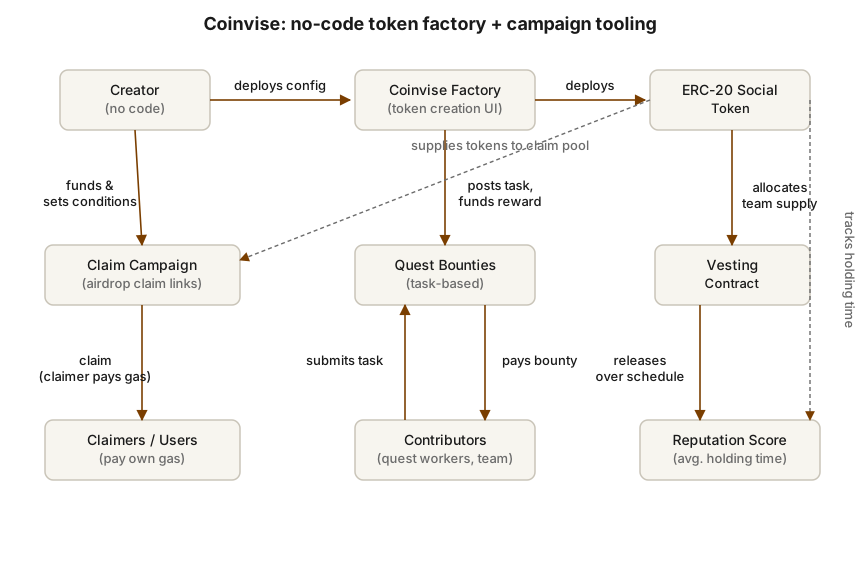 Open full-size diagram
Summary
Coinvise was one of the flagship tooling platforms of the 2020–2022 "social token" wave. Founded in late 2020 by Jenil Thakker, it let creators and communities mint their own ERC-20 tokens with no code, then operate an economy around them: airdrops via claimable links, quests (task-based bounties paid in the community token), vesting schedules, crowdfunding, NFT memberships, and token-gated access. It ran on Ethereum and Polygon and positioned itself against Rally, Roll, and Fyooz — but unlike Rally's sidechain-custodial model, Coinvise was non-custodial and composable on public chains. It raised a $2.5M seed in June 2021 led by Galaxy Digital HK and IDEO CoLab Ventures (with Scalar Capital, A.Capital, Volt Capital, DeFi Alliance, The LAO, and angels including Jill Carlson and Jaynti Kanani). As the social-token narrative faded, Coinvise pivoted toward general onchain rewards/engagement infrastructure ("find, onboard and retain users"); as of 2025–2026 it operates at coinvise.ai under "TokenFi Inc" with a small team, claiming 220k+ collectors.
Design (Mechanism)
- No-code token minting. A creator deploys a standard ERC-20 ("social token") on Ethereum or Polygon in a few clicks, retaining full custody. Supply, allocation, and distribution are left to the creator — Coinvise is tooling, not a bonding-curve market maker (a deliberate contrast to Rally/Roll's managed models).
- Airdrops as claim campaigns. Rather than pushing tokens to addresses (paying all gas upfront and spraying inactive wallets), Coinvise generated claim links/pages with conditions (e.g., follow, join, hold an NFT). Claimers pay their own gas; unclaimed tokens can be withdrawn and campaigns stopped — turning airdrops into opt-in acquisition funnels with measurable conversion.
- Quests (bounties). Communities post tasks (content, contributions, referrals) paying out in the community token — a lightweight contributor-compensation loop meant to bootstrap two-sided token demand.
- Vests. Onchain vesting schedules for contributor/team allocations, managed from the same dashboard.
- Composability via widgets (V3.1, April 2022). Token creation, airdrops, quests, and vests became embeddable widgets; community profiles aggregated active campaigns with "1-click" participation and onchain activity feeds.
- Token reputation. V3.1 introduced a reputation signal computed from average token holding time — an attempt to distinguish holders from airdrop farmers.
- Open-source contracts. Contract code (MIT) is public at github.com/coinvise/contracts, with a curated social-token registry at coinvise/social-token-list. Specific canonical deployed addresses were not published in the materials reviewed (Unknown / not found).
Outcome
Coinvise shipped continuously through the cycle (V3.1 "Web3 Coordination Console" in April 2022) and hosted token launches and airdrop campaigns for many mid-tier creator communities; its airdrop/quest tooling was its stickiest product (the founder described token creation + airdrops as the first and core features). But the social-token category itself collapsed after 2021–2022: most creator tokens lost liquidity and relevance, competitor Rally shut down its sidechain (2023), and Roll suffered a hot-wallet hack. Coinvise survived by repositioning from "social token platform" to onchain rewards/quest infrastructure for web3 projects — a crowded category (Galxe, Layer3, POAP). Company trackers show a 1–10 person team by 2024, and the current site brands it "Coinvise by TokenFi Inc," claiming 220k+ collectors. The company persists (ongoing as a business), but the original social-token experiment underperformed its thesis; hence partial_success.
Why it worked
- Non-custodial, standards-based design. Plain ERC-20s on Ethereum/Polygon meant tokens outlived the platform and composability with DeFi/NFT tooling — avoiding the fate of Rally's walled-garden sidechain, where tokens died with the platform.
- Claim-based airdrops solved a real cost/targeting problem. Shifting gas to claimers and adding conditions made distribution measurable and cheap; this primitive outlived the social-token narrative and became the pivot vector.
- No-code UX at the right moment. In 2021, deploying and operating a token required real skill; Coinvise compressed it to minutes, capturing the creator-token boom demand.
Where the design broke
- The underlying asset class failed. Creator tokens mostly had no sustainable demand side: thin liquidity, no cash-flow claim, regulatory ambiguity, and fan bases that wanted content, not exposure. Tooling quality couldn't fix a broken primitive.
- No moat in tooling. Token factories, airdrop claimers, and quest boards are easily cloned; Galxe/Layer3 out-scaled the quest niche while Coinvise carried social-token brand baggage.
- Incentive-farming adversaries. Paid quests and conditional airdrops attract mercenary farmers; the holding-time reputation signal was a late, partial countermeasure.
- Platform take vs. creator economics never resolved. Small communities generated little recurring revenue for the platform, making the business dependent on venture funding through a long bear market.
Lessons
- Tooling platforms inherit the fate of their asset class: if the primitive (creator ERC-20s) lacks organic demand, the best UX only accelerates launches into illiquidity.
- Non-custodial + standard token formats is the survivable architecture: Coinvise-minted tokens remained usable after the pivot, whereas custodial sidechain competitors (Rally) stranded their users' assets.
- Pull-based (claim) distribution beats push-based airdrops: making recipients pay gas and satisfy conditions filters for intent and converts distribution into an acquisition funnel — the one mechanism from this era that generalized.
- Reputation must be designed in from day one: retrofitting anti-farmer signals (holding-time reputation) after incentives are live means the mercenary equilibrium is already established.
Redesign (EDITORIAL — hypothesis, not fact)
This section is editorial hypothesis, not fact. A redesigned Coinvise would invert the order of operations: start with contribution accounting, end with the token. Communities would first run non-transferable point/attestation systems (quests logging onchain credentials rather than paying liquid tokens), accumulating a Sybil-resistant contribution graph. Only communities crossing engagement thresholds would unlock a token-generation event, with supply algorithmically allocated against the recorded contribution graph and streamed via vesting — so the liquid token launches into an existing holder base with proven intent, not a farmer queue. The platform's revenue should be a protocol fee on redemption utilities (gated commerce, membership renewals) rather than on minting, aligning Coinvise with token usage instead of token launches. Finally, publishing canonical, audited factory contracts with onchain registries would make the token list a public good and the reputation layer — not the token factory — the defensible asset.
Sources
- Coinvise official site (now 'Coinvise by TokenFi Inc') — primary (docs)
- coinvise/contracts — Smart contracts for tokenizing creators & communities (MIT) — primary (contract)
- Introducing Coinvise V3.1 — The Web3 Coordination Console (official blog, Apr 4, 2022) — primary (docs)
- Pioneer Interview: Jenil Thakker — primary (retrospective)
- Web3 Creators Have a New Platform for Minting Social Tokens (CoinDesk via Yahoo Finance, Jun 29, 2021) (news)
- Meet Coinvise — the no-code tooling platform for creators (YourStory) (news)
- Tools for Executing Airdrops with Coinvise (Mint podcast, Adam Levy, Sep 2022) (analysis)
- coinvise/social-token-list — curated list of social tokens on Coinvise — primary (archive)
Related experiments
Last verified: 2026-07-26 · Spot an error? Suggest a correction