Convex
A yield-and-governance aggregator that pooled users' CRV into perpetual veCRV, tokenized the boost, and turned Curve's vote-escrow into a tradable, rentable meta-layer that dominated the Curve Wars.
▶ Run interactive simulation animated mechanism with editable parameters
How it works onchain
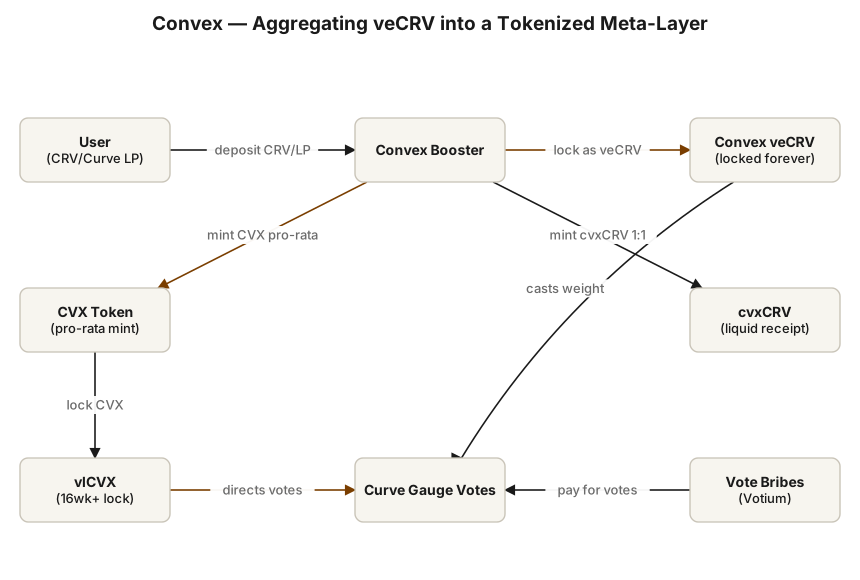 Open full-size diagram
Summary
Convex Finance launched in May 2021 as a yield and governance aggregator built on top of Curve Finance's vote-escrow (ve) model. Curve rewarded liquidity providers with boosted CRV emissions only if they locked CRV as veCRV — for up to four years, non-transferable and illiquid. Convex removed that friction: users deposit CRV (or Curve LP tokens), and Convex permanently locks the CRV as veCRV on their behalf, socializing the maximum "boost" across all depositors while handing them a liquid receipt token (cvxCRV) instead of a four-year lock. In doing so, Convex became the single largest holder of veCRV — controlling roughly half of all veCRV within its first months — and turned Curve's governance into an asset that could be aggregated, tokenized, and effectively rented. It became the central battlefield and arms dealer of the "Curve Wars." The project was built by a pseudonymous/anonymous team and remains one of the canonical demonstrations of a "meta-governance" layer sitting atop another protocol's token model.
Design (Mechanism)
The design has three interlocking pieces:
Boost socialization + liquid wrapping. When users deposit CRV, Convex locks it as veCRV forever (the lock is never unwound) and mints cvxCRV 1:1. cvxCRV is a liquid, tradable claim on the underlying yield stream (CRV rewards, Curve trading fees, 3CRV) — solving Curve's core UX problem that veCRV is illiquid and time-locked. Curve LPs who deposit their LP tokens via Convex's Booster contract receive Curve's maximum emission boost without individually locking CRV, because Convex's giant veCRV position supplies the boost pooled across everyone.
CVX and pro-rata emissions. CVX is the native token, capped near 100,000,000 supply. Crucially, CVX is minted pro-rata each time a Curve LP claims CRV on Convex, with the mint ratio decreasing over cumulative issuance (a taper). Reported allocation: ~50% Curve LP rewards, 25% liquidity mining, 10% team, ~9.7% treasury, ~3.3% investors, and ~1%+1% to veCRV voters/holders (airdrops at launch). This tied token distribution directly to real protocol usage rather than a fixed schedule.
vlCVX — the meta-governance layer. Because Convex holds the veCRV, someone has to decide how that veCRV votes on Curve's bi-weekly gauge-weight elections (which pools receive CRV emissions). Convex delegates this to vote-locked CVX (vlCVX): users time-lock CVX for 16+ weeks, and their vlCVX weight determines, via Snapshot, how Convex casts its aggregated veCRV votes. This created a two-layer stack: control CVX → control Convex's veCRV → control CRV emissions to your pool. That made vlCVX the cheapest lever to steer Curve incentives, which is exactly why protocols (Frax, Lido/stETH, MIM/Abracadabra, etc.) accumulated CVX and paid "bribes" (vote incentives, largely routed through the third-party Votium market) to rent vlCVX votes each round.
Contracts are immutable and non-upgradeable — a deliberate design choice with real consequences (see below).
Outcome
Status: major_success. Convex achieved product-market fit almost immediately, becoming the dominant veCRV holder in under a month and, at peak, sitting near the top of DeFi by total value locked (multi-billion dollars). It captured a large share of CRV supply, became the pricing venue for Curve governance, and spawned an entire ecosystem of vote-bribe markets and secondary strategies. As of late 2025 the protocol still held roughly ~$1B TVL and remained a structurally important veCRV holder — Convex and Yearn addresses have cast the overwhelming majority of votes on major Curve DAO proposals, evidence of durable governance influence years after launch. CVX's market price is highly correlated with Curve's fortunes; it declined sharply from its 2021 highs into 2024–2025 (trading around ~$2 in late 2025) while the mechanism itself kept functioning.
One notable near-miss: in March 2022, a bug was discovered in the vlCVX contract that would have granted certain users disproportionate rewards. Because contracts are immutable, the team deployed a new vlCVX contract and force-unlocked all locked CVX (over 72% of circulating supply had been locked), requiring users to re-lock. No exploit occurred and no funds were reported lost, but the forced unlock caused a temporary supply shock (CVX fell ~15–20% intraday). Most users re-locked.
Why it worked
- It solved a real, painful UX constraint. Curve's four-year illiquid lock was a barrier; Convex offered maximum boost + liquidity + auto-compounding with none of the lock-up commitment for the end user.
- Emissions tracked usage. Pro-rata CVX minting on CRV claims aligned token issuance with genuine activity and created a reflexive flywheel: more deposits → more CVX minted → more incentive to deposit.
- It became the cheapest control point. Aggregating veCRV and re-exposing control via vlCVX made CVX the most capital-efficient way to buy Curve emissions, so demand for CVX (and the bribe economy) became self-sustaining.
- Neutrality and immutability. Convex positioned itself as infrastructure any protocol could use, and immutable contracts made its veCRV position credibly permanent — a prerequisite for others to build strategies on top.
Limitations and criticisms
Convex is dominant, but it carries real structural limits:
- Total dependency on Curve. Convex has no standalone product; CVX value is a leveraged bet on Curve TVL, CRV emissions, and Curve's health. As Curve's relevance and emissions declined, so did CVX's price and the value of the vote-market it anchors.
- Immutability cut both ways. The 2022 bug showed that non-upgradeable contracts turn a bug fix into a disruptive full migration and forced unlock rather than a patch.
- Centralization of governance. Concentrating half of veCRV in one protocol created systemic and political risk for Curve itself, and the vlCVX/bribe layer arguably financialized governance to the point where votes went to the highest briber rather than protocol health.
Lessons
- A meta-layer that tokenizes another protocol's illiquid governance can capture enormous value — but its fate is permanently bound to the host protocol; it inherits all of the host's upside and downside.
- Tying token emissions to real usage (pro-rata minting) aligns incentives far better than fixed inflation schedules, and creates a reflexive growth flywheel.
- Immutability is a double-edged sword: it makes a position credibly permanent (a feature others can build on) but converts routine bug-fixes into disruptive migrations; design an emergency path that doesn't require force-unlocking the entire supply.
- Vote-escrow "wars" externalize governance into a rentable market; once votes are a purchasable commodity, incentive-direction optimizes for bribe revenue, not necessarily for the underlying protocol's long-term health.
Redesign (EDITORIAL — hypothesis, not fact)
The following is the researcher's editorial hypothesis, not established fact.
A modern redesign would attack Convex's two structural weaknesses: single-host dependency and rigid immutability. First, generalize the aggregator from a Curve-specific wrapper into a chain- and protocol-agnostic ve-aggregation primitive, standardizing the "lock host token forever → mint liquid receipt → expose control via a locked meta-token" pattern so a single vlToken governs positions across multiple ve-style hosts (Curve, Balancer, Frax, and successors). This diversifies revenue away from one declining host. Second, replace naked immutability with immutable core accounting plus a narrowly-scoped, time-locked, guardian-gated upgrade module for reward/locker logic only, so a future vlCVX-style bug can be patched without force-unlocking the entire supply — retaining the credibility of a permanent underlying position while removing the migration cliff. Third, redesign the vote market to cap or curve the influence of pure bribe-buying (e.g., reputation- or usage-weighted vote multipliers, or partial routing of bribe revenue to protocol-health objectives) to counter the "governance-for-sale" failure mode. Finally, make cvxCRV-style liquid wrappers natively cross-margin and yield-tranched, letting conservative depositors take base yield and speculators take the volatile bribe/emissions upside separately — improving capital efficiency without the reflexive fragility that couples CVX's price so tightly to a single host's incentive budget.
Sources
- Convex Finance official website — primary (docs)
- Understanding CVX — Convex docs — primary (docs)
- Voting and Gauge Weights — Convex docs — primary (docs)
- Contract Addresses — Convex docs — primary (contract)
- August Update + CVX Voting! — Convex Finance (Medium) — primary (retrospective)
- Convex Finance Bug Causes CVX Token to Sink on Forced Token Unlock — CoinDesk (news)
- The Great Curve War (aka. Convex War) — Jason Ye (Medium) (analysis)
- Emergent Outcomes of the veToken Model — arXiv (analysis)
- Convex Finance — IQ.wiki (archive)
Related experiments
Last verified: 2026-07-26 · Spot an error? Suggest a correction