SPAWN
A satirical ERC-20 + Uniswap v4 hook by TokenWorks where every swap spawns a new child token, building an ever-branching tree of tokens whose creator fee rises with each generation.
▶ Run interactive simulation animated mechanism with editable parameters
How it works onchain
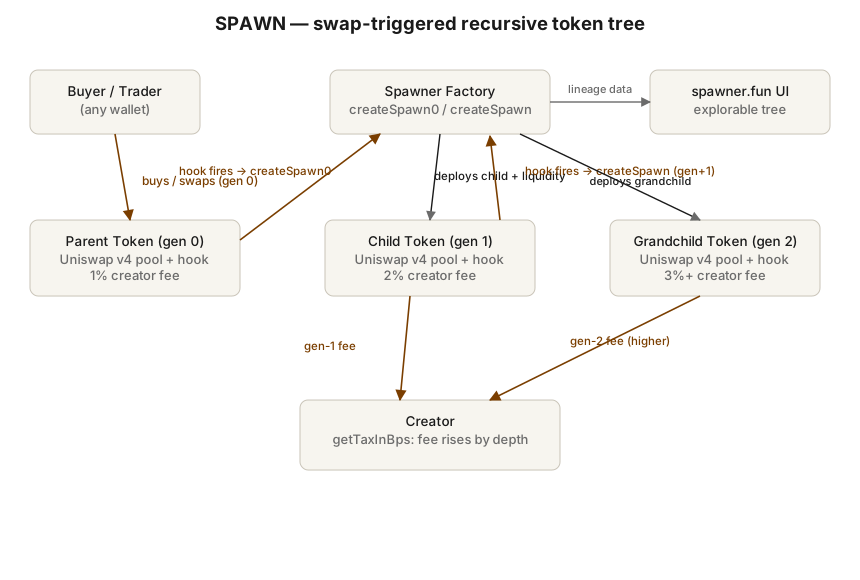 Open full-size diagram
Summary
SPAWN (styled "S.P.A.W.N.", catalog #006) is the sixth experiment released by TokenWorks, a pseudonymous studio that describes itself as "a playground for onchain financialized ideas." It launched on Base on 30 March 2025. Mechanically, SPAWN is an ERC-20 token wired to a Uniswap v4 hook: every time someone buys (swaps into) a SPAWN-family token, the hook deterministically "spawns" a brand-new child token. Those children can themselves be swapped and spawn further children, producing a rapidly branching genealogical tree of tokens. Each successive generation carries a higher creator fee (a tax measured in basis points that scales with depth). TokenWorks shipped the experiment with an explorable token-map UI at spawner.fun and framed it explicitly as satire — a "protest against meta churn" and a critique of the crypto industry's "tokenize everything" reflex, taken to its absurd logical endpoint: a token that endlessly reproduces tokens.
The on-chain machinery is real and verified (the Spawner factory contract is source-verified on BaseScan), which places SPAWN in the lineage of "art-as-financial-mechanism" pieces where the mechanism is the message. Commercially it remained a small, niche experiment — secondary analysis cites a peak market capitalization on the order of $300K — consistent with a piece intended as commentary rather than as a durable financial primitive.
Design (Mechanism)
The core contract is a factory called Spawner, deployed at 0x95fE5bC073763feD6e8572E33db9e0e1C06BC78E on Base and verified with Solidity v0.8.26. From the verified source, the design has these moving parts:
- Root and descendants. A
createSpawn0function mints the genesis / generation-0 token, whilecreateSpawnmints descendant tokens. The factory tracks parent-child relationships, so every token knows its lineage back to the root, forming a tree. - Swap-triggered reproduction. SPAWN-family tokens trade through Uniswap v4 pools that attach a hook. The hook fires on swaps, and a buy triggers the creation ("spawning") of a new child token — turning ordinary trading activity into the engine of tree growth. This is the essence of the piece: liquidity provision and speculation literally breed more assets.
- Generational fee escalation. A
getTaxInBpsfunction returns a creator fee (in basis points) that increases with generation depth. Deeper in the tree, each swap is taxed more heavily (framed publicly as 1%, then 2%, and so on by generation). This makes the tree self-limiting economically — the further reproduction goes, the more expensive it becomes to trade the newest tokens — while routing escalating fees to the creator. - Administrative controls. The contract includes owner functions and hook management, i.e. the studio retains levers over hook configuration.
- Explorer UI. spawner.fun renders the tree as an explorable graph ("nodes"), with Creations and Holdings views so participants can watch the genealogy expand and locate their positions in it.
The combination — v4 hook + factory + generational tax — is what makes SPAWN novel: it uses Uniswap v4's programmable hooks not to optimize a market but to make the market recursively generative, an artistic exploitation of the same hook primitive that let 2025's wave of Base speculative token launches attach arbitrary logic to every swap.
Outcome
Outcome status: technically_successful_commercially_unsuccessful.
Technically the experiment worked: the factory and hook are deployed, source-verified, and the token-tree UI functions as designed. As a conceptual/artistic artifact it succeeded at its stated goal — it is repeatedly cited in ecosystem write-ups as the canonical satire of the "tokenize everything" narrative built natively on Uniswap v4 hooks.
Commercially it stayed small. Secondary analysis places its peak market capitalization around $300K, and it did not become a widely used launchpad or sustained fee engine. There is no evidence of an exploit, rug, or catastrophic failure; rather, it behaved like a bounded art piece that made its point and then receded — consistent with TokenWorks moving on to later experiments (Content #007, TokenWorks S01 #008, CabalCoin #009, CTO #010, PunkStrategy #011).
Why it worked
- Native use of a new primitive. Uniswap v4 hooks were fresh, and SPAWN found a striking, legible use for them: making swaps mint tokens. The mechanism reads instantly, which is what good satire needs.
- Self-documenting UI. The spawner.fun tree turns an abstract idea into something you can click through, so the critique lands visually rather than requiring a whitepaper.
- Verified, honest contracts. The factory is source-verified on BaseScan, giving the piece credibility as a real mechanism rather than vaporware — important for an art project whose entire value is the mechanism.
- Generational fee as a built-in brake. Rising fees by generation kept the tree from becoming a pure infinite-inflation machine, giving the joke an internally coherent economic logic.
Where the design broke
- Satire is not a business. By design SPAWN is a critique of speculative churn, not a product with retention or a value-accrual story for holders — so there was little reason for capital to stay.
- Recursive token trees fragment liquidity. Endlessly spawning children splinters attention and liquidity across many thin markets, which caps meaningful market cap and makes any single branch fragile.
- Escalating fees suppress deep-tree activity. The generational tax that makes the concept elegant also discourages the very trading that would grow the tree, so growth self-throttles.
- No named team or narrative flywheel. TokenWorks is deliberately pseudonymous, and SPAWN carried no roadmap, governance, or community-ownership hook to convert curiosity into a durable following.
Lessons
- Mechanism-as-message can be fully on-chain and verified without being a viable financial product. SPAWN shows you can ship real, audited-in-spirit contracts purely to make an artistic/critical point; success should be judged against that intent, not against TVL.
- Programmable hooks turn AMMs into expressive canvases. v4 hooks let a swap do arbitrary work (here, minting) — a reminder that the AMM is now a place to encode incentives and even art, with all the systemic-risk implications that carries.
- Recursive/reflexive tokenomics are self-limiting. Designs where activity spawns more supply fragment liquidity and attention; built-in escalating friction (rising fees) is a reasonable governor, but it also kills the growth it governs.
- Satirical primitives can still be forked into non-satirical harm. A "buy mints a new token" hook is exactly the kind of pattern that unscrupulous launchpads could weaponize; the critique and the exploit share a codebase.
Redesign (EDITORIAL — hypothesis, not fact)
The following is the researcher's editorial hypothesis, not established fact.
SPAWN succeeds as a joke but leaves its most interesting idea — swaps that generate assets — underexploited as a serious design. A redesign could keep the recursive-spawning hook but give it a productive telos beyond commentary:
Curatorial spawning instead of automatic spawning. Rather than every buy minting a child, gate spawning behind a small bonded action (a fee + a metadata commit) so each child is intentional. This turns the tree into a permissionless, on-chain "collection of collections" — closer to a generative-art registry than a churn machine — while preserving the visual genealogy that makes spawner.fun compelling.
Fee routing to ancestors, not just the creator. Redirect the generational tax so a share flows up the lineage to parent-token holders. This creates a real reason to hold early nodes (they earn from descendants) and converts the tree from a fragmentation problem into a value-accrual graph, aligning long-term holders with tree growth.
Liquidity concentration via v4. Use a single shared v4 pool with per-branch accounting (again via hooks) rather than spawning fresh thin pools, mitigating the liquidity-fragmentation failure mode while keeping the branching semantics.
Anti-abuse guardrails. Add explicit generation caps, per-address spawn rate limits, and transparent front-end labeling so the primitive can't be trivially forked into a predatory "infinite mint" launchpad — closing the gap between the satire and the exploit it parodies.
The hypothesis: SPAWN's recursive hook is genuinely novel, and its commercial underperformance stems from intent (pure satire) plus two fixable design choices (automatic minting and creator-only fees). Reframed as an intentional, ancestor-rewarding generative-collection primitive, the same core could be both a coherent artwork and a durable mechanism — though whether anyone should build a token that breeds tokens remains, fittingly, the open question SPAWN was asking all along.
Sources
- SPAWN factory contract (Spawner), verified source on BaseScan — primary (contract)
- TokenWorks S02 catalog — S.P.A.W.N. #006 entry — primary (docs)
- spawner.fun — SPAWN explorable token-tree UI — primary (docs)
- TokenWorks GitHub organization (links to token.works, @token_works) — primary (docs)
- TokenWorks official site — primary (docs)
- Uniswap v4 hooks ecosystem analysis (mentions SPAWN as satire, ~$300K mcap) (analysis)
Related experiments
Last verified: 2026-07-26 · Spot an error? Suggest a correction