PartyBid
A permissionless protocol that let strangers pool ETH into a single-auction 'party' to collectively win, then fractionalize, an NFT.
▶ Run interactive simulation animated mechanism with editable parameters
How it works onchain
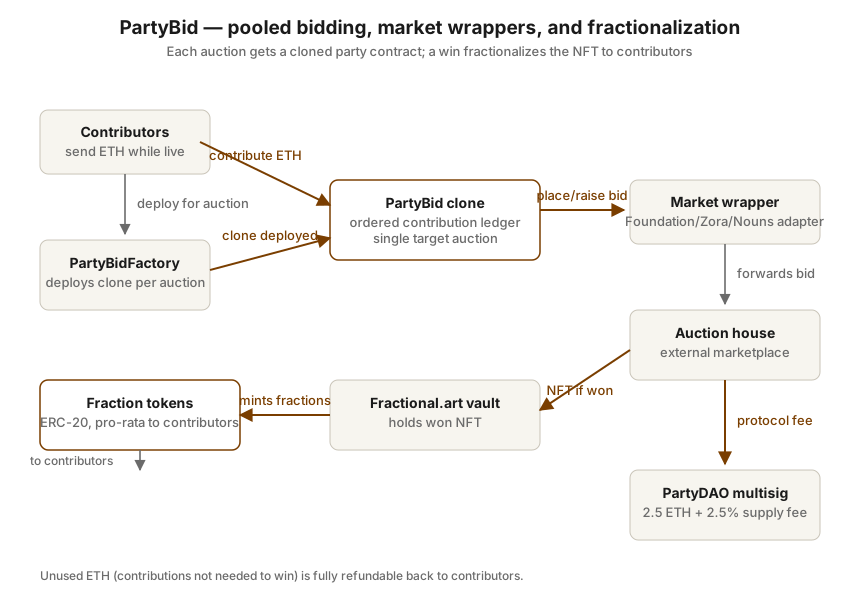 Open full-size diagram
Summary
PartyBid was the first product of PartyDAO, a DAO formed in mid-2021 specifically to ship it. The idea traces to a Twitter thread on crypto mechanism design (Paradigm's Dave White) to which Denis Nazarov, founder of Mirror, replied with the concept of pooling capital to bid on NFTs together. Over a weekend, contributor Anish Agnihotri built an MVP of the smart contracts and used them the following week to win the "Colin and Samir" NFT auction, validating the mechanism. A Mirror crowdfund of roughly 25 ETH (~$100k at the time) formally capitalized PartyDAO and distributed $PARTY governance tokens to backers. PartyBid launched publicly in August 2021.
The mechanism was deliberately narrow and permissionless: anyone could deploy a "party" targeting a single live NFT auction, anyone could contribute ETH into it while the auction ran, and any contributor could trigger the party's on-chain bid. If the party won, the NFT was fractionalized into ERC-20 tokens distributed pro-rata to the contributors whose funds were actually used; contributors whose ETH was not needed could reclaim it. PartyBid's most famous outcome came within days of launch, when the "Party of the Living Dead" party pooled 1,144.5 ETH from 457 wallets (~$3.2M) to win CryptoPunk #2066, issuing $DEAD fractional tokens to participants.
Design (Mechanism)
The core contracts are a PartyBidFactory (mainnet 0x0accf637e4F05eeA8B1D215C8C9e9E576dC63D33) that clones a single PartyBid logic contract (0x744c2BE04d079eDdb21c1a9BB13bB5259A368614). Each cloned party targets exactly one auction on a supported marketplace, abstracted behind "market wrapper" adapters — Foundation, Zora Auction House, Nouns, and Koans wrappers are deployed on mainnet. The design pattern is a single-target auction crowdfund rather than an open-ended treasury:
- Contribution: while the target auction is live, any address sends ETH; contributions are recorded in an ordered ledger.
- Bidding: any contributor can call the party to place/raise the bid on the underlying auction via the market wrapper, up to the total pooled amount.
- Settlement: if the party wins, contributions are consumed in order up to the winning price; unused contributions become fully refundable.
- Fractionalization: the won NFT is deposited into fractional.art vault contracts and split into ERC-20 fractions distributed pro-rata to contributors whose ETH was used.
- Fees: PartyDAO takes a protocol fee (documented as a 2.5 ETH fee plus 2.5% of the fractional token supply, routed to the PartyDAO multisig) on a winning party.
Later sibling contracts (PartyBuy for fixed-price "buy it now" purchases and CollectionParty for buying any NFT in a collection) extended the same factory/clone pattern beyond English auctions. The codebase is MIT-licensed; Anna Carroll is credited as protocol lead/primary author with Alex Towle credited for security review.
Outcome
Technically, PartyBid worked as designed and produced genuinely novel, headline-grabbing on-chain events: collective ownership of a seven-figure CryptoPunk by hundreds of strangers, plus wins across Zora, Foundation, and other auctions. Reported early traction was strong — on the order of 1,200+ ETH in volume and 60+ ETH in fees within the first 48 hours. On that momentum PartyDAO raised $16.4M in June 2022 in a round led by a16z.
Commercially, however, standalone PartyBid was a stepping stone rather than a durable product. Fractionalized NFT ownership proved to have weak secondary demand and thin liquidity, and once an auction resolved a party had no ongoing purpose. PartyDAO pivoted: it rebuilt the concept as the general-purpose, composable Party Protocol (V2, late 2022), which added governance so groups could hold, use, and vote on assets — not just win a single auction. Party Protocol went on to report tens of thousands of parties and 100k+ users. As of 2026, the successor Party product has itself been deprecated, with the team announcing it would no longer be accessible after March 9, 2026, marking the end of the lineage's active operation. The original PartyBid V1 was effectively retired well before that.
Why it worked
- Sharp, permissionless primitive. A party did exactly one legible thing — pool ETH to win one auction — which made it easy to understand, easy to audit, and easy to virally coordinate around.
- Narrative-native product. Hundreds of people co-owning a CryptoPunk was a story the 2021 NFT market wanted to tell; the mechanism manufactured shareable, high-status collective moments.
- Credible-neutral settlement. Ordered contributions, automatic refunds of unused ETH, and pro-rata fractions removed trust from the pooling step, which is exactly where informal group buys usually break down.
Where the design broke
- Dead-end after the win. A winning party left holders with illiquid fractional tokens and no coordination surface to manage, sell, or govern the asset — value leaked immediately post-auction.
- Fractionalization's weak market. Fractional NFT tokens depended on shaky secondary liquidity and unclear redemption/buyout dynamics; this limited real financial upside for contributors.
- Single-purpose contracts couldn't compound. Because each party was disposable and auction-specific, PartyBid couldn't accrue network effects the way an ongoing group treasury could — forcing the Party Protocol rebuild.
Lessons
- A tightly-scoped, permissionless coordination primitive can achieve viral distribution far faster than a general platform — but scope that wins attention can also cap the product's lifespan.
- The hard problem in collective ownership is not acquisition but what happens after: governance, liquidity, and exit. Solving only the buy-in step leaves the value proposition half-built.
- Fractionalization is a distribution mechanic, not automatically a market; issuing ERC-20 shares does not create the secondary liquidity needed to make co-ownership financially meaningful.
- A successful "wedge" experiment is worth keeping even after you outgrow it: PartyBid's real payoff was the credibility and user base that funded and seeded Party Protocol.
Redesign (EDITORIAL — hypothesis, not fact)
The following is the researcher's analysis, not established fact. PartyBid's structural flaw was treating the auction win as the terminal state. A redesign should treat winning as the creation of a persistent group entity, not the end of one. Concretely: on settlement, instead of minting bare fractional tokens, mint governance-bearing membership NFTs into a lightweight party vault (the eventual Party Protocol direction) so the group retains a live coordination surface for holding, lending, or selling the asset. Pair this with an explicit, on-chain exit menu — a buyout auction with a Harberger-style or Dutch-declining reserve, plus a scheduled "dissolution vote" — so members always have a credible path to liquidity rather than being trapped in an illiquid fraction. Fee design could shift from a flat 2.5 ETH toward a small success fee capped as a percentage, lowering the barrier for smaller parties (the 2.5 ETH minimum implicitly excluded low-value auctions). Finally, cross-marketplace and cross-chain market wrappers should be first-class and community-extensible, so parties are not bottlenecked on the core team shipping each new venue adapter. The throughline: keep the viral single-target crowdfund as the entry point, but never let a party's on-chain life end at the moment it wins.
Sources
- PartyDAO/partybid contracts (GitHub, README + deployed addresses) — primary (contract)
- PartyBid mainnet deployed-contracts (factory + logic + market wrappers) — primary (contract)
- PartyDAO on Building and Launching PartyBid (Zora Zine interview) — primary (retrospective)
- Party (Party Protocol) official site — successor product, deprecation notice — primary (docs)
- Can't Afford a CryptoPunk? New Platform Lets Buyers Join Forces (The Defiant) (news)
- PartyBid V2 Unlocks Community Control of NFTs (The Defiant) (news)
- PartyDAO, Parent of PartyBid, Secures $16.4M Funding (Coinspeaker) (news)
- PartyBid Punk#2066 collection (on-chain fractional token, OpenSea) (archive)
Related experiments
Last verified: 2026-07-26 · Spot an error? Suggest a correction