Juicebox
A programmable Ethereum treasury and crowdfunding protocol that lets projects raise ETH, mint tokens to contributors, and enforce payout/redemption rules entirely in smart contracts.
▶ Run interactive simulation animated mechanism with editable parameters
How it works onchain
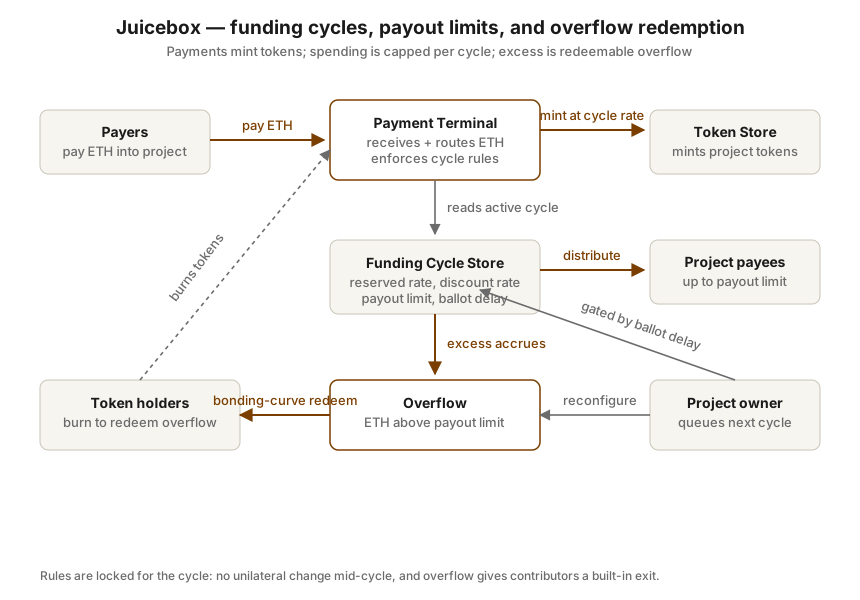 Open full-size diagram
Summary
Juicebox is a programmable treasury and crowdfunding protocol on Ethereum, launched around July 2021 by the pseudonymous developer Jango (jango.eth) and stewarded by JuiceboxDAO. It lets anyone deploy a "project" whose fundraising and payout logic is enforced entirely in smart contracts: supporters pay ETH into a project and automatically receive project tokens, treasury spending is bounded by hard-coded payout limits, and unspent funds ("overflow") can be reclaimed by burning tokens. Unlike Kickstarter or GoFundMe, no platform staff has discretion over funds — the rules are onchain and, within a funding cycle, cannot be unilaterally changed. Juicebox became the default infrastructure for a wave of high-profile 2021–2022 "single-purpose" and community DAOs, most famously ConstitutionDAO ($47M, 11,600 ETH, 17,000+ contributors) and AssangeDAO ($55M, 16,593 ETH — its largest project). It is one of the canonical pieces of DAO tooling from that era and remains actively developed.
Design (Mechanism)
A Juicebox project is configured through funding cycles — time-boxed periods (e.g. 14 or 30 days) that lock in a set of rules. Key parameters:
- Contribution-minted tokens: every ETH payment mints project tokens to the payer at the current cycle's rate, creating a transparent, pro-rata cap-table of supporters.
- Reserved rate: a percentage of newly minted tokens set aside for the team/DAO/other recipients rather than the payer.
- Discount rate: each new cycle can reduce the token issuance rate, rewarding earlier contributors with more tokens per ETH.
- Payout limit (distribution limit): a hard cap on how much ETH can leave the treasury per cycle, split across predefined payees. Anything above the limit is overflow.
- Overflow / redemptions (bonding curve): token holders can burn their tokens to reclaim a share of overflow ETH, governed by a redemption bonding curve. This is the built-in "refund" mechanism — if a project fails or over-raises, holders can exit.
- Reconfiguration + ballots: changes to future cycles must be queued and can be gated by a reconfiguration delay/ballot, so contributors get advance notice before rules change.
The protocol is architected as a small set of core contracts (a controller, directory, funding-cycle store, token store, and payment terminals) plus surface contracts. It has iterated through V1 (2021), V2 (2022), and V3, with migrations required between major versions. Governance runs through JuiceboxDAO and the JBX token; early governance was administered by a multisig requiring 2-of-4 signatures.
Outcome
Status: major_success as infrastructure. Juicebox became the canonical crowdfunding rail of the 2021–2022 DAO boom and processed hundreds of millions of dollars across projects with no protocol-level loss of user funds.
- ConstitutionDAO (Nov 2021): raised
$47M / 11,600 ETH from 17,000+ contributors in under a week to bid on a first-edition U.S. Constitution at Sotheby's. It lost the auction to Citadel CEO Ken Griffin ($43.2M). PEOPLE holders could redeem tokens for ETH via Juicebox's overflow mechanism, but high gas made small refunds uneconomical; PEOPLE persisted as a cultural/meme asset listed on major exchanges. - AssangeDAO (Feb 2022): ~$55M / 16,593 ETH — the largest Juicebox project ever — but its $JUSTICE token collapsed in value, and governance votes over sanctions and refunds became divided.
- MoonDAO (2021): ~$8.3M / 2,600 ETH to fund a member's spaceflight.
The protocol itself has been repeatedly audited (Code4rena contests in July 2022, Oct 2022, and May 2023). A medium-severity V2 funding-cycle bug was disclosed on 24 May 2022 (a missing OR condition in JBFundingCycleStore._configureIntrinsicPropertiesFor could make a queued reconfiguration activate early); no funds were lost, fixes were deployed the next day, and JuiceboxDAO assisted affected projects with migration.
Why it worked
- Trust-minimized fundraising at speed: hard-coded payout limits and onchain rules let strangers pool tens of millions in days without trusting an organizer's discretion — the exact property ConstitutionDAO cited when choosing Juicebox.
- Built-in refunds via overflow: the redemption/bonding-curve design gave contributors a credible exit, which was decisive for one-shot acquisition DAOs where the raise might fail.
- Right product at the right cultural moment: viral single-purpose DAOs gave Juicebox enormous, self-reinforcing distribution and battle-tested it publicly.
- Composable, transparent primitives: minting tokens on contribution turned every raise into a legible cap-table and a tradable community asset.
Limitations and criticisms
Juicebox's "rules-in-code" model has real, structural limits that persist even though the protocol itself works as designed:
- Code cannot guarantee good outcomes: ConstitutionDAO's transparent, capped treasury still lost the auction partly because rivals could see its funds; AssangeDAO's token collapsed and fractured its community despite flawless contract execution.
- Gas-bounded refunds: the redemption mechanism was economically unusable for small contributors during high-gas periods, leaving many holders effectively unable to exit at the smallest ticket sizes.
- Migration friction: V1→V2→V3 upgrades force projects through non-trivial migrations, and the May 2022 funding-cycle bug required DAO-funded remediation rather than being caught by prior audits.
- Governance/accountability gaps: onchain payout and redemption rules constrain treasury fund flows, but they do not constrain what happens to already-issued tokens on the secondary market or how a project's stated mission can drift after launch, as AssangeDAO's disputes showed.
Lessons
- Encoding rules in code removes platform discretion but not human risk — transparent treasuries can be gamed by adversaries and cannot enforce a team's off-chain integrity.
- Refund/exit mechanisms must be economically viable at the smallest ticket size; a redemption path that costs more in gas than it returns is not a real refund.
- Single-purpose "acquisition" DAOs are structurally fragile — a binary success condition plus public, capped funds is a poor match for competitive auctions.
- Battle-testing beats audits alone: massive real-world usage surfaced a live funding-cycle bug that structured audits had not caught, and the DAO's fast, funded remediation preserved trust.
- Token-on-contribution is powerful but double-edged: it bootstraps community and cap-tables, but a speculative secondary market can hijack an activist mission (AssangeDAO/$JUSTICE).
Redesign (EDITORIAL — hypothesis, not fact)
The following is speculative analysis, not established fact. If rebuilt today, a Juicebox-style protocol could address its historical pain points by: (1) batched, gas-abstracted redemptions — allow contributors to signal exit intent onchain and settle refunds in aggregate via an L2 or ERC-4337 paymaster so small holders can actually reclaim overflow; (2) milestone-gated payouts with contributor veto — release treasury funds against verifiable milestones (or oracle-attested events like an auction result) so a failed one-shot goal auto-triggers refunds rather than relying on manual redemption; (3) anti-front-running for acquisition DAOs — optional commit-reveal or private-treasury modes so a competitive bid does not broadcast its exact war chest; (4) vesting/lockups on reserved and secondary tokens to reduce sell pressure on newly minted tokens in the period immediately following a raise, which coincided with AssangeDAO's $JUSTICE price decline; and (5) native L2 deployment to make micro-contributions and micro-refunds economical, removing the gas floor that made 2021's refund mechanism impractical for the median donor. These would preserve Juicebox's core insight — trust-minimized, rule-bound treasuries — while closing the gap between what the contracts guaranteed and what contributors actually experienced.
Sources
- Juicebox Docs — home / social links — primary (docs)
- Juicebox for Fundraising (mechanism + campaigns) — primary (docs)
- How ConstitutionDAO was configured on Juicebox — primary (docs)
- Juicebox core V1 contracts (GitHub) — primary (contract)
- Juicebox core V2 contracts (GitHub) — primary (contract)
- Juicebox core V3 contracts (GitHub) — primary (contract)
- V2 postmortem, 5.24.2022 (funding-cycle bug) — primary (audit)
- Juicebox V2 Code4rena contest (July 2022) — primary (audit)
- Juicebox DAO Code4rena contest (Oct 2022) — primary (audit)
- Juicebox Buyback Delegate Code4rena (May 2023) — primary (audit)
- Terminal V1 on Etherscan — primary (contract)
- ConstitutionDAO (Wikipedia) (archive)
- AssangeDAO Has Now Raised More Ethereum Than ConstitutionDAO (Decrypt) (news)
- A detailed look at Juicebox's largest DAO — AssangeDAO (dere.eth) (analysis)
- 'Buy the Constitution' Aftermath (Vice) (news)
Related experiments
Last verified: 2026-07-26 · Spot an error? Suggest a correction