Counterparty
A 2014 meta-protocol that embedded token issuance, a native DEX, and betting into Bitcoin transactions, bootstrapped its XCP token by provably burning ~2,125 BTC, and incubated the first NFT ecosystems (Spells of Genesis, Rare Pepes) years before Ethereum's ERC standards.
▶ Run interactive simulation animated mechanism with editable parameters
How it works onchain
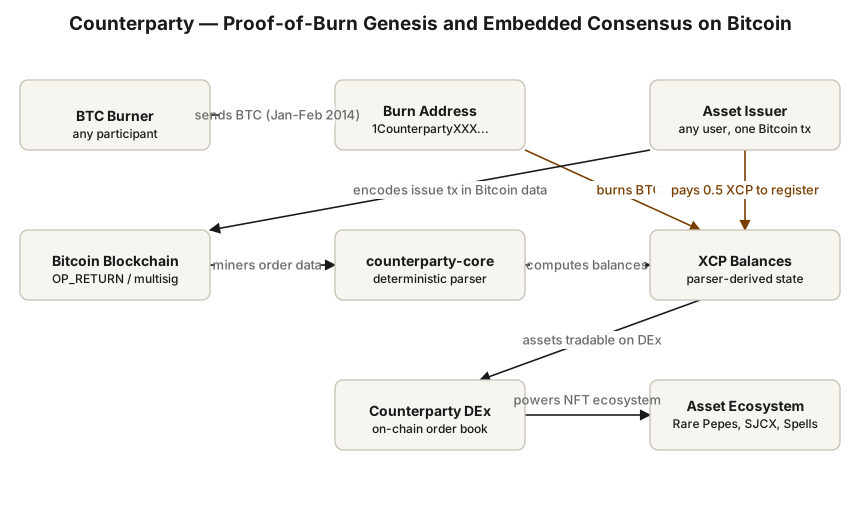 Open full-size diagram
Summary
Counterparty is a meta-protocol launched in January 2014 by Adam Krellenstein, Robby Dermody, and Evan Wagner (initially pseudonymous on Bitcointalk) that "writes in the margins" of ordinary Bitcoin transactions to add token issuance, a fully on-chain decentralized exchange, dividends, and oracle-fed betting to Bitcoin — years before Ethereum shipped. Its native token, XCP, was distributed by the most radical fair launch ever attempted: between January 2 and February 3, 2014 (a 5,000-block window), anyone could send BTC to the provably unspendable address 1CounterpartyXXXXXXXXXXXXXXXUWLpVr; roughly 2,125.63 BTC (about $1.8M at the time) were destroyed, minting ~2.6M XCP. The founders received no allocation except what they burned themselves. Counterparty went on to host the first token sales on Bitcoin (Storj's SJCX in 2014), the first blockchain trading-card game (Spells of Genesis, 2015), and Rare Pepes (2016) — foundational artifacts of NFT history. It then lost the token economy to Ethereum, but never died: the Ordinals era revived interest, and Counterparty Core v10 (2024) added UTXO-attached assets and a Fair Minting protocol.
Design (Mechanism)
Embedded consensus. Counterparty has no chain and no contracts of its own. Users encode protocol messages (issue, send, order, bet, dividend, broadcast) into Bitcoin transactions — originally in bare multisig outputs, later primarily in OP_RETURN (payloads under 80 bytes) with multisig fallback for larger data. Every Counterparty node runs counterparty-core alongside a Bitcoin full node, parses the Bitcoin chain deterministically, and computes identical state. Bitcoin miners order the messages; they neither validate nor even need to know Counterparty exists. Consensus is "whatever every honest parser computes from the same Bitcoin history."
Proof-of-burn genesis. Instead of a pre-mine or sale, all XCP came from destroying BTC. Each burned BTC minted 1,000–1,500 XCP, with earlier burns rewarded more. This bought regulatory distance (no issuer received funds), aligned founders with users, and made the launch trustless and auditable on-chain.
XCP as anti-spam and fuel. Named assets (e.g., PEPECASH) cost 0.5 XCP to register, discouraging namespace squatting; numeric assets are free. XCP is the quote currency where BTC can't be escrowed by the protocol, and fuels dividends and bets. Simple sends and issuances need no XCP at all.
Native DEX. Orders are broadcast as Bitcoin transactions; the protocol matches them in Bitcoin block order and settles escrowed assets automatically — an on-chain order book with no operator, predating Ethereum DEXes by years.
Extensions. Broadcasts act as signed oracle feeds enabling peer-to-peer bets; in 2016 the team even ported the Ethereum VM to a Counterparty testnet (never activated on mainnet). The 2024 v10 releases added UTXO-bound assets (Ordinals-style, an asset travels with a specific UTXO) and open "fair minting."
Outcome
Counterparty was the dominant "Bitcoin 2.0" platform of 2014–2016: over a million transactions, Overstock's Medici stock-exchange project selected it as a backbone, and its ecosystem (Storj, FoldingCoin, LTBCoin, Spells of Genesis, Rare Pepes, Sarutobi) pioneered nearly everything later called ICOs and NFTs. In March 2015 the three founders decamped to found Symbiont with Mark Smith of MathMoney f(x), taking momentum with them. Ethereum's 2015–2017 rise, plus Bitcoin's 2017 fee spike and Core's hostility to non-monetary data (the 2014 OP_RETURN size reduction fight), drained developers and issuers. XCP's market value collapsed relative to peers and never recovered. Yet the assets endured: a Rare Pepe sold for ~$500K in 2021 (via Emblem Vault wrapping on OpenSea), Bitcoin Stamps initially built on Counterparty in 2023, and volunteer developers shipped Counterparty Core v10 in 2024. The protocol is alive and historically monumental; as an economic venture, XCP underperformed nearly every contemporary.
Why it worked
- Credible neutrality by construction. Proof-of-burn meant no founder allocation, no investor overhang, and no one to sue or shake down — an unmatched fair launch that built deep community trust.
- Right primitives, first. User-issued assets, an on-chain DEX, dividends, and oracles were exactly what the market wanted; Counterparty proved demand for all of them before Ethereum existed.
- Bitcoin's security for free. Embedded consensus inherited Bitcoin's ordering and immutability with zero validator bootstrapping, which is why 2014-era assets like Rare Pepes still resolve perfectly today.
- Cultural lightning. Scarce, meme-native assets (Rare Pepes, PEPECASH) created durable collector culture that outlived the platform's commercial relevance.
Where the design broke
- Host-chain hostility. Bitcoin Core developers viewed data embedding as spam, shrank OP_RETURN, and offered no roadmap for expressiveness; Counterparty was a tenant whose landlord wanted it gone.
- No throughput or programmability headroom. Every action cost a Bitcoin transaction; 2017 fees made small trades and card packs absurdly expensive, while Ethereum offered Turing-complete contracts and cheap blockspace.
- Founder exit. The entire founding team left for Symbiont in 2015, leaving a volunteer community to compete against VC-funded platforms.
- Burn model starved development. The fair launch left no treasury; there was never a war chest for grants, audits, or marketing, and XCP fee sinks generated no funding loop.
- Weak XCP value accrual. Most activity (sends, numeric issuances) never touched XCP, so ecosystem success translated poorly into token demand.
Lessons
- Fair launches buy legitimacy but forfeit the treasury that funds the decade-long grind; sustainable protocols need an endogenous funding mechanism, not just an honest genesis.
- Building on a host chain whose culture rejects your use case is platform risk as severe as technical risk — Counterparty was strangled less by bugs than by Bitcoin's blockspace politics and fee spikes.
- Being first creates historical value, not captured value: the ideas (tokens, DEX, NFTs) were validated on Counterparty and monetized on Ethereum. Distribution and developer experience beat priority.
- Founder continuity is a protocol parameter; a leaderless volunteer phase right as a better-funded competitor (Ethereum) emerged was fatal to momentum.
- Immutable, chain-inherited assets have remarkable option value — Rare Pepes lay dormant for years before the NFT boom repriced them, precisely because they never depended on a company staying alive.
Redesign (EDITORIAL — hypothesis, not fact)
This section is editorial speculation. A modern Counterparty would keep the proof-of-burn genesis but burn into a protocol-owned liquidity/endowment position rather than pure destruction — e.g., burns mint XCP while a fixed protocol fee on named assets and DEX fills streams into a development endowment governed by XCP holders, solving the no-treasury failure. It would treat the host chain as a settlement layer only: execute on a Bitcoin-anchored rollup or client-side-validation scheme (RGB/Taproot-assets style) so fees don't scale with Bitcoin congestion and Core politics can't throttle payloads. XCP value accrual should be made structural: all asset registrations, DEX matching, and oracle attestations denominated in XCP with burn-and-reissue balancing. Finally, encode succession: a standing grants program and multiple independent client teams from day one, so a founder exit is an event, not an era.
Sources
- Counterparty official site — primary (docs)
- Counterparty docs — What is XCP? — primary (docs)
- CounterpartyXCP GitHub (counterparty-core) — primary (contract)
- Bitcoin Magazine — Counterparty and MathMoney f(x) create Symbiont (news)
- Decrypt — What Is Counterparty? Historical NFTs Built on Bitcoin (analysis)
- Wikipedia — Counterparty (platform) (archive)
- Artnome — Rare Pepe Wallet and the Birth of CryptoArt (analysis)
- CoinDesk — Rare Pepe fetches $500K on OpenSea (2021) (news)
Related experiments
Last verified: 2026-07-27 · Spot an error? Suggest a correction