CoW Protocol
Intent-based trading protocol where competing solvers settle batched orders via uniform-price 'coincidence of wants' auctions, shielding traders from MEV.
▶ Run interactive simulation animated mechanism with editable parameters
How it works onchain
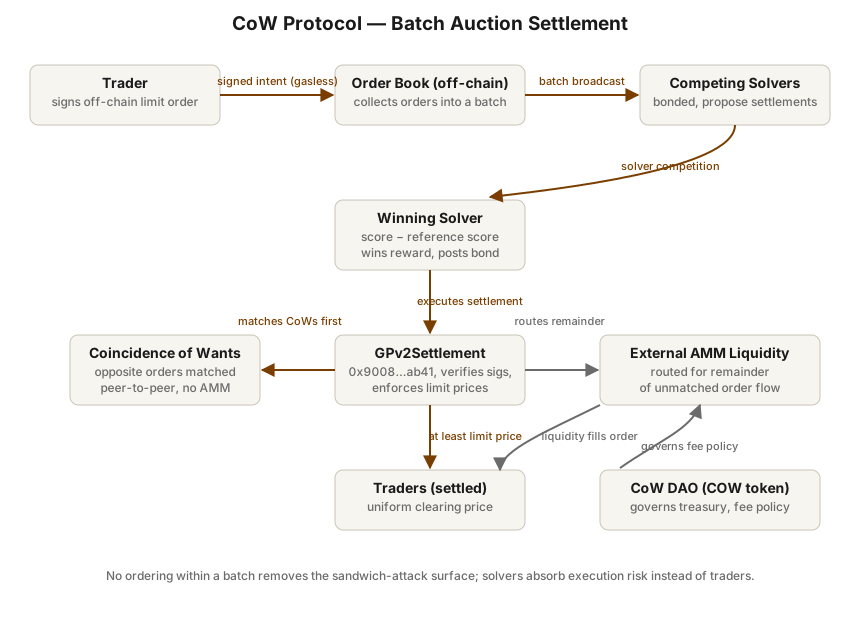 Open full-size diagram
Summary
CoW Protocol (originally Gnosis Protocol v2) is the flagship "intents" experiment in DEX design: instead of users submitting on-chain swap transactions that can be front-run, they sign off-chain orders expressing what they want, and a permissionless network of competing "solvers" batches those orders and finds the best settlement — matching opposite orders directly (a "Coincidence of Wants") when possible and routing the remainder through on-chain liquidity. Incubated by Gnosis, the GPv2Settlement contract was deployed in June 2021 alongside the CoW Swap frontend; in March 2022 the project spun out of GnosisDAO into an independent CoW DAO with a $23M raise and the COW token. It became the leading MEV-protection venue on Ethereum, later spawning MEV Blocker (an RPC-level protection service) and CoW AMM (an LP-protecting AMM), and by 2025 was the top Ethereum DEX-aggregator frontend by market share with ~$87B in annual volume.
Design (Mechanism)
- Orders as signed intents. Users sign a limit order (sell/buy amount, validity, fee) off-chain — no gas is needed and failed transactions cost nothing. Fees are paid in the sell token, enabling "gasless" UX.
- Batching. The protocol groups open orders into discrete batches. All trades of the same token pair in a batch clear at a uniform clearing price, removing the advantage of intra-batch ordering — the core anti-MEV property, since there is no "before" or "after" inside a batch to sandwich.
- Coincidence of Wants. If two orders are (partially) opposite, a solver can cross them peer-to-peer without touching an AMM, saving fees, slippage, and LP spread for both sides.
- Solver competition. Each batch is auctioned to competing solvers, who propose settlements. Winner selection maximizes trader surplus; since 2025 the protocol has used a "fair combinatorial auction" that filters unfair solutions and then picks the surplus-maximizing combination of solutions, allowing multiple winners per batch. Solver rewards are computed as roughly
score − reference_score(a second-price flavor: you earn the amount by which you beat the best alternative), and solvers post bonds and face penalties for failing to execute — pushing execution risk (gas, reverts, slippage) onto professionals rather than users. - Settlement. The winning solver executes everything atomically through the GPv2Settlement contract (0x9008…ab41), which verifies signatures and enforces that each order receives at least its limit price.
- Governance. CoW DAO (COW token) governs treasury, solver rewards, and fee policy, per the GIP-13 spin-out from GnosisDAO.
Outcome
Ongoing and, to date, a major success. The settlement contract (deployed June 8, 2021) has processed nearly 2.9M settlement transactions on Ethereum alone. CoW Protocol did $40.2B in volume in 2024 and ~$87B in 2025 (per CoW DAO's 2025 review), with cumulative volume surpassing $200B. In early 2025 CoW Swap led Ethereum DEX-aggregator market share (The Block reported a surge past 26%; OurNetwork reported an ATH of ~42% in March 2025), competing head-to-head with 1inch and Kyber. The protocol expanded from Ethereum and Gnosis Chain to Arbitrum, Base, and (in 2025) Avalanche, Polygon, and Lens Chain. The ecosystem also shipped MEV Blocker and CoW AMM, and the "intents + solver auction" design was widely imitated (UniswapX, 1inch Fusion, and the broader intent-centric research agenda). The COW token itself has been a weaker performer than the protocol's usage metrics.
Why it worked
- It priced MEV out of existence rather than fighting it. Uniform clearing prices within batches and off-chain order submission remove the sandwich attack surface structurally, instead of relying on private mempools alone.
- Competition does the optimization. Outsourcing routing to bonded, competing solvers turned execution quality into a market: solvers who find CoWs or better liquidity win rewards, and second-price-style scoring incentivizes truthful, aggressive bidding.
- Users bear no execution risk. Signed intents mean no failed-transaction gas, fees in the sell token, and a guaranteed limit price — a genuinely better UX that attracted large/professional traders (DAOs, treasuries, whales) whose orders are most MEV-exposed.
- Credible neutrality and a clean spin-out. Incubation inside Gnosis provided engineering depth; the 2022 DAO spin-out with a community raise gave it independent governance.
Limitations and criticisms
- Latency and complexity costs. Batch settlement is slower than direct AMM swaps; solvers internalize some surplus, and auditing whether solvers/the reward mechanism deliver best execution is hard for ordinary users (academic work on intent markets flags solver-oligopoly and information-asymmetry risks).
- Solver centralization pressure. A small set of sophisticated solvers wins most batches; the protocol has had to iterate repeatedly on reward/penalty rules (leading to the 2025 combinatorial-auction redesign) to keep competition fair.
- Token-value capture lagged usage. COW's market performance has not tracked the protocol's volume growth; fee capture was introduced only gradually.
Lessons
- Batching + uniform prices is the cleanest structural MEV defense: removing ordering within the unit of settlement beats trying to police ordering.
- "Don't find the best price yourself — make experts compete to find it for you" generalizes: solver/filler auctions are now the dominant DEX-aggregation design (UniswapX, 1inch Fusion followed CoW's template).
- Auction rules are living infrastructure: CoW's move from single-winner batch scoring to fair combinatorial auctions shows that mechanism design must keep evolving as solvers learn to game the current rules.
- Selling execution certainty (no failed txs, guaranteed limit prices) can be as valuable as selling better prices, especially to large traders.
- Incubate-then-spin-out (Gnosis → CoW DAO) is a viable path to independent protocol governance with an aligned community raise.
Redesign (EDITORIAL — hypothesis, not fact)
This section is editorial analysis — a hypothesis, not established fact. If rebuilt today, the main targets would be solver-market health and verifiability. First, make best execution provable: publish signed, reproducible auction data and slash solvers whose reported surplus can't be reconstructed, moving trust from "DAO monitors solvers" to cryptographic accountability (e.g., settlement validity proofs or TEE-attested solver runs). Second, attack solver oligopoly directly: subsidize a standing open-source "baseline solver" that any newcomer can fork, and consider frequent batch auctions with enforced minimum batch times so latency infrastructure matters less than optimization quality. Third, deepen the CoW flywheel by making passive liquidity intent-native from day one (CoW AMM-style surplus-capturing pools as the default LP venue), so the protocol internalizes the spread it currently routes out to external AMMs. The main risk to this redesign is that heavier verification and fixed batch cadence add latency that pushes retail flow toward faster RFQ systems — the same tension CoW already navigates.
Sources
- CoW Protocol Documentation (docs.cow.fi) — primary (docs)
- cowprotocol/contracts (smart contracts, GitHub) — primary (contract)
- GPv2Settlement on Etherscan — primary (contract)
- GIP-13 (Phase 2): CowDAO and COW Token (Gnosis forum) — primary (governance)
- Fair Combinatorial Batch Auction (CoW docs) — primary (docs)
- Solver competition rules (CoW docs) — primary (docs)
- CoW DAO: 2025 in Review — primary (retrospective)
- CoW Protocol raises $23 million and spins out from Gnosis DAO (The Block, March 2022) (news)
- CoW Swap surges to 26% market share, challenging 1inch for DEX aggregator dominance (The Block) (news)
- An Analysis of Intent-Based Markets (arXiv) (analysis)
Related experiments
Last verified: 2026-07-27 · Spot an error? Suggest a correction