CryptoZoo
Logan Paul's celebrity-marketed BSC NFT breeding game that sold egg NFTs and a $ZOO yield token, then shipped almost no game — becoming the archetypal influencer-launch failure and a Coffeezilla exposé subject.
▶ Run interactive simulation animated mechanism with editable parameters
How it works onchain
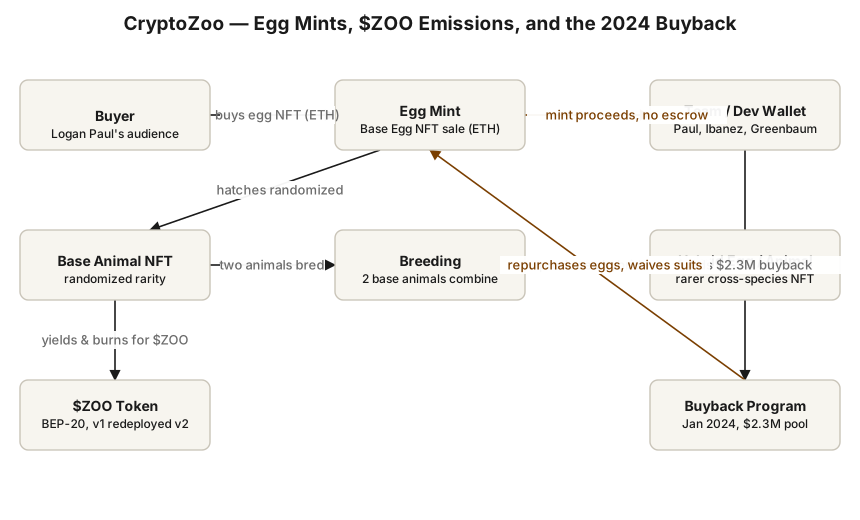 Open full-size diagram
Summary
CryptoZoo was an NFT breeding game co-founded and heavily promoted by YouTuber Logan Paul, announced on his Impaulsive podcast on August 18, 2021, with base-egg NFT sales beginning September 1, 2021. Marketed as "an autonomous ecosystem where zoo owners breed, collect, and trade exotic hybrid animals via NFTs," it paired egg/animal NFTs with a $ZOO token on BNB Chain (BSC). The project reportedly raised millions of dollars (figures around $6.5M are widely cited; exact totals are disputed) from buyers drawn largely by Paul's audience. The playable game never materially shipped: eggs initially could not be hatched, images broke, and the team went quiet within months. In December 2022, investigator Stephen "Coffeezilla" Findeisen published a three-part series alleging the project was effectively abandoned and that insiders had sold tokens. Paul funded a $2.3M NFT buyback in January 2024 (0.1 ETH per base egg/animal, excluding $ZOO).
Design (Mechanism)
- Egg mint. Users bought "Base Egg" NFTs (sales denominated in ETH; the later buyback price of 0.1 ETH matched the base mint price) that hatched into randomized cartoon "Base Animals" of varying rarity.
- Breeding for hybrids. Two base animals could be bred to produce Hybrid Eggs hatching into hybrid animals (e.g., cross-species combinations), with rarer hybrids intended to be more valuable.
- $ZOO yield emissions. Animal NFTs were designed to passively "yield" $ZOO daily, scaled by rarity — a play-to-earn-style emission of a low-float BEP-20 token whose price was market-determined.
- Burn-for-tokens. Animals could be burned in exchange for $ZOO, tying NFT floor value to the token price (and vice versa).
- Token migration. The original ZOO token (BSC contract 0x1D22...F095, BscScan-labeled "Zoo Dapp: ZOO Token") was superseded by a second contract (0x7fFC...c669, listed as "CryptoZoo (new)"), after problems with the original deployment — an early sign of engineering instability.
- Distribution. Marketing was almost entirely parasocial: Paul's podcast, YouTube, and X reach substituted for docs, audits, or a working product. Per Coffeezilla's reporting, $ZOO allocations were concentrated in a small number of wallets at launch, with no vesting or lockup constraining when those holdings could be sold into early demand.
Outcome
Failed. By "hatch day" in late 2021, many buyers could not hatch eggs at all; core features remained broken or unavailable for long stretches, and development effectively stalled — reporting indicates the original dev team was never fully paid and withheld code amid a compensation dispute. $ZOO collapsed ~99.9%+ from its highs and the game never launched in the promised form. After Coffeezilla's December 2022 series, Paul apologized and, in January 2024, ran a $2.3M buyback program (0.1 ETH per base egg/animal, excluding $ZOO, roughly $1.9M reportedly disbursed by mid-2025).
Why it worked
- Distribution-first launch mechanics. Paul's tens of millions of followers converted attention directly into mint revenue — the sale itself was a "success," raising millions in days with no product.
- Composable greed loop on paper. Egg → animal → breed → yield → burn is a coherent Axie-style token sink/faucet design; the mechanism sketch was plausible enough to pass casual scrutiny.
- Low-cost chain choice. BSC made minting, breeding, and emissions cheap enough for a mass retail audience.
Where the design broke
- No escrowed delivery mechanism. Development funding was not contractually guaranteed or escrowed against milestones, and code ownership was left ambiguous; the token contract itself had to be redeployed. Distribution reach has no mechanical link to whether a working product gets built.
- Sell-first, build-later sequencing. All revenue was collected before any playable loop existed, removing every incentive to ship and every recourse for buyers.
- Concentrated allocation, no vesting. Per Coffeezilla's reporting, a large share of $ZOO sat in a small number of wallets at launch with no lockup, so early price discovery absorbed sell pressure from those holdings alongside public demand.
- Yield token with no sink demand. $ZOO emissions had value only if the game created demand; with no game, emissions were pure sell pressure onto an illiquid pair.
- Accountability vacuum. No audits, no vesting transparency, and no contractual wrapper obligating delivery meant buyers had no enforceable claim on what was promised.
Lessons
- Vague commitments are a design flaw. If a project's promises are vague enough to carry no enforceable weight, buyers have no claim on delivery; concrete, on-chain or contractual milestones are what separate a product sale from a donation.
- Celebrity distribution amplifies both raises and blast radius. Influencer reach compresses the fundraise timeline to days but converts any delivery failure into a reputational crisis lasting years.
- Escrow dev funding before the mint. A compensation dispute over dev funding stalled the product; funding that isn't contractually escrowed ahead of a public mint has no mechanism forcing it to reach the people building the product.
- Emissions tokens need a live sink at TGE. Launching a yield token before the game that consumes it guarantees reflexive collapse.
- Buybacks bought optionality, not absolution. The 0.1 ETH buyback (excluding the token itself) shows post-hoc refunds can mitigate exposure while leaving token holders — the majority of losses — uncompensated.
Redesign (EDITORIAL — hypothesis, not fact)
This section is editorial speculation. A credible redesign would invert the sequencing: (1) escrow mint proceeds in a milestone-gated contract (e.g., Sablier/Safe multisig with third-party attestors) releasing funds only on shipped, verifiable game milestones, with automatic pro-rata refunds on missed deadlines; (2) launch the game loop first with a non-transferable points ledger, converting to a transferable $ZOO only after sinks (breeding fees, burns) demonstrably exceed faucet emissions for N weeks; (3) put all insider/KOL allocations on-chain with public vesting and a lockup extending past game launch; (4) fund development via a capped mint priced near cost, reserving upside for secondary royalties rather than a treasury token dump. The counterfactual question — whether Paul's audience would have funded a slower, escrowed launch at all — is exactly the filter such a design is meant to impose.
Sources
- Zoo Dapp: ZOO Token contract (BscScan) — primary (contract)
- CryptoZoo (new) ZOO — CoinMarketCap listing (contract, site, X handle, launch dates) (analysis)
- CryptoZoo — Wikipedia (timeline, Coffeezilla series) (archive)
- Logan Paul announces he will buy back NFTs from his failed CryptoZoo project (NBC News, Jan 2024) (news)
- The Logan Paul–Coffeezilla CryptoZoo controversy explained (Game Rant) (analysis)
Related experiments
Last verified: 2026-07-27 · Spot an error? Suggest a correction