SafeMoon
A BSC reflection token that taxed every trade 10% to 'reward holders' and auto-fill a supposedly locked liquidity pool, peaked above $5.7B, and collapsed into bankruptcy once the lock proved false.
▶ Run interactive simulation animated mechanism with editable parameters
How it works onchain
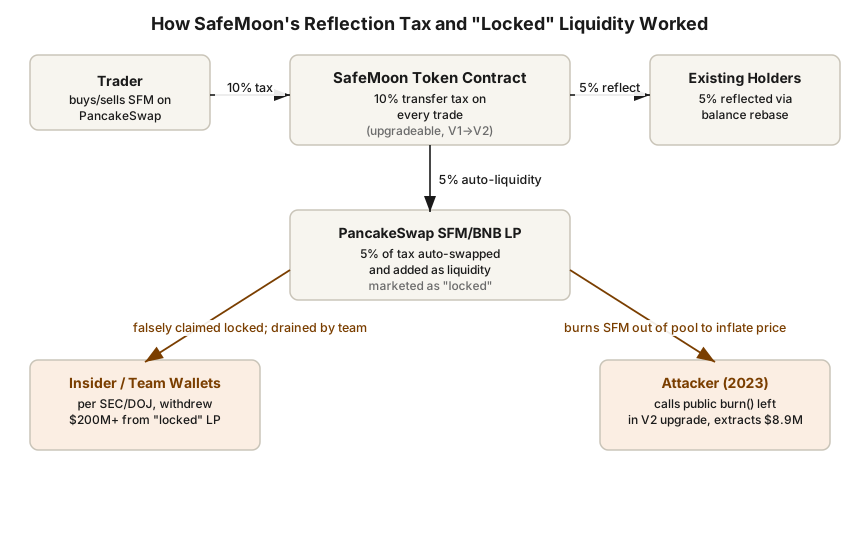 Open full-size diagram
Summary
SafeMoon was the defining "reflection token" of the 2021 BNB Chain retail mania. Launched in March 2021 by creator Kyle Nagy with CEO Braden John Karony and CTO Thomas Smith, it charged a 10% tax on every trade: half was redistributed ("reflected") to existing holders, and half was routed into a liquidity pool that the team told investors was locked and untouchable. The pitch — get paid for holding, get punished for selling, price goes "safely to the moon" — drove a rise of more than 55,000% between March 12 and April 20, 2021, and a market capitalization above $5.7 billion (with some estimates over $8 billion at peak). The liquidity was not locked as claimed: executives withdrew more than $200 million from the pool for personal use, and the token was wash-traded to simulate demand. SafeMoon US filed Chapter 7 bankruptcy in December 2023.
Design (Mechanism)
SafeMoon V1 (BSC contract 0x8076c...d8d3, source published at safemoonprotocol/Safemoon.sol) was a fork of the RFI "reflect" pattern with an auto-liquidity add-on. Three mechanisms defined it:
- Transfer tax with reflection. Every transfer incurred a 10% fee. 5% was redistributed pro-rata to all existing holders via RFI-style balance rebasing (no claim transaction needed — balances simply grew). This made "holding" itself yield-bearing, funded entirely by other people's trading.
- Auto-liquidity. The other 5% accrued to the contract; when a threshold was reached, half was swapped to BNB and paired with SFM into the PancakeSwap pool. Marketing framed this as a rising "floor." Crucially, the project's marketing claimed the LP tokens were locked so they could not be withdrawn — the central "Safe" in SafeMoon. In fact, no enforced on-chain lock existed: large portions of the pool remained accessible, and were withdrawn.
- Burns and migration. A large share of supply (1 quadrillion tokens initially) sat in a burn wallet that also received reflections, creating a deflationary drip. In December 2021 the project forced a "V2" migration (1000:1 consolidation to contract 0x42981...fcB5) with revised fees, marketed as an upgrade for exchange compatibility.
The V2 contract was upgradeable — which produced the March 28, 2023 exploit: an upgrade shipped a burn function left public and callable on arbitrary addresses. An attacker burned SFM out of the SFM/WBNB pool, artificially inflating the pool price, then sold into it in the same transaction, extracting about $8.9 million (roughly 80% was later returned under a negotiated "bounty").
Outcome
Failed, comprehensively. The price collapsed ~50% from its April 2021 peak when researchers publicized that the liquidity pool was not locked as claimed, and bled toward zero thereafter. Timeline: V2 migration (Dec 2021); $8.9M LP exploit (Mar 2023); SafeMoon US filed Chapter 7 bankruptcy in December 2023, with its wallet IP later sold at auction. Billions in retail market value were destroyed.
Why it worked
- Reflection made holding feel like yield. Watching your token balance tick up passively was viscerally compelling to first-time crypto users, and the mechanism required no staking UX at all.
- The 10% sell tax created a self-reinforcing "diamond hands" culture: selling was framed as both costly and disloyal, suppressing sell pressure during the run-up.
- "Locked liquidity" was a perfectly targeted trust story. Post-rug-pull-era retail had learned exactly one due-diligence question — "is the liquidity locked?" — and SafeMoon's entire brand was a false answer to it.
- Viral distribution: low unit price on a quadrillion-token supply, TikTok/YouTube influencer promotion, and celebrity amplification made it a social phenomenon before any fundamental scrutiny arrived.
Where the design broke
- The core promise did not hold. The safety mechanism (locked LP) that justified the whole design was never enforced on-chain: LP tokens were not held under a verifiable timelock, millions were withdrawn from the pool, and the token was wash-traded to simulate market activity.
- Reflection tokenomics are zero-sum minus tax. Holder "earnings" were simply transfers from later traders; with no external revenue, the system mathematically required perpetual new inflow — it decayed as soon as volume did.
- The sell tax trapped exit liquidity and made price discovery brutal on the way down: the same friction that suppressed selling in the mania accelerated abandonment once momentum reversed.
- An upgradeable contract carried the exploit surface forward: a public, unrestricted burn function shipped in a 2023 upgrade with no independent audit gate, enabling the $8.9M exploit.
Lessons
- A tokenomic mechanism with no external cash flow is a redistribution schedule, not a yield source. Reflection rewards are paid by incoming traders; any design whose "APY" dies when volume dies should be modeled as such from day one.
- "Locked liquidity" claims must be verifiable onchain, not asserted. The single highest-leverage check — who holds the LP tokens and under what timelock — was skipped by millions of buyers because the answer was embedded in the brand name.
- Sell taxes convert volatility into a ratchet. Friction asymmetries that pump a token in an uptrend become exit traps in a downtrend, worsening ultimate losses for exactly the loyal holders the mechanism claims to protect.
- Upgradeable contracts inherit whatever review process gated the last release. SafeMoon's exploit came not from the original code but from an unaudited upgrade — upgrade authority is an ongoing attack surface, not a one-time risk.
Redesign (EDITORIAL — hypothesis, not fact)
This is editorial speculation, not a description of anything SafeMoon did. A legitimate version of the "reward holders, deepen liquidity" idea would have to (1) replace reflections with distribution of real protocol revenue (e.g., actual LP fee income from the auto-liquidity position), so holder yield tracks genuine economic activity rather than churn; (2) put LP tokens in an immutable, publicly verifiable timelock or burn them outright, with the lock address in the token contract itself so "locked liquidity" is a machine-checkable claim; (3) cap the transfer tax low (≤1–2%) and make it symmetric, avoiding exit-trap dynamics; (4) use a non-upgradeable token contract, moving any evolvable logic behind audited, timelocked modules; and (5) hold marketing claims to the same verifiability standard as the contract itself, so safety promises are falsifiable on day one rather than trusted. Even then, the honest version likely underperforms as a growth story — SafeMoon's growth came precisely from the false safety claim and zero-sum yield illusion, which is the deeper lesson: the mechanism's virality and its false safety claim were not separable.
Sources
- SEC Charges Crypto Company SafeMoon and its Executive Team for Fraud and Unregistered Offering of Crypto Securities (Press Release 2023-229) — primary (governance)
- SEC Litigation Release LR-25888: SafeMoon LLC, SafeMoon US LLC, Kyle Nagy, Braden John Karony, Thomas Glenn Smith — primary (governance)
- DOJ EDNY: CEO of SafeMoon Sentenced to 100 Months in Prison for Multi-Million Dollar Crypto-Fraud Scheme — primary (governance)
- IRS-CI: Chief executive officer of digital asset company found guilty in multi-million dollar crypto-fraud scheme (May 2025 verdict) — primary (governance)
- safemoonprotocol/Safemoon.sol (contract source) — primary (contract)
- SAFEMOON V1 token contract on BscScan — primary (contract)
- Zellic: SafeMoon Exploit Explained (public burn bug, March 2023) (analysis)
- CoinDesk: SafeMoon LP Exploited for $8.9M; SFM Tokens Remain 'Safe,' CEO Says (news)
- SafeMoon US LLC Chapter 7 case administration (Stretto) — primary (governance)
- CoinDesk: Ex-SafeMoon CEO gets 8-year prison sentence for defrauding investors (Feb 2026) (news)
Related experiments
Last verified: 2026-07-27 · Spot an error? Suggest a correction