Curation Markets
Simon de la Rouviere's 2017 protocol-design framework for tokenized curation of information via continuous (bonding-curve) tokens — the concept never shipped as a single protocol but seeded bonding curves, TCRs, and continuous token models across the ecosystem.
▶ Run interactive simulation animated mechanism with editable parameters
How it works onchain
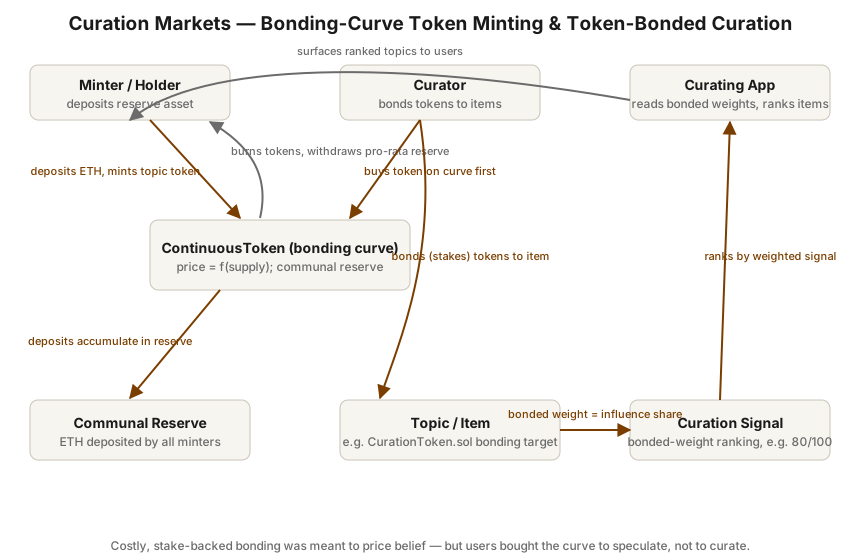 Open full-size diagram
Summary
Curation Markets is not a single product but a family of protocol designs proposed by Simon de la Rouviere (then a "social engineer" at ConsenSys) in a concept paper (April 2017) and the Medium post "Introducing Curation Markets" (May 22, 2017). The goal: let groups coordinate around a shared topic, meme, or goal and earn from the value they co-create, by minting a topic-specific token whose price follows an algorithmic curve and whose holders use it to curate information within that topic. De la Rouviere framed it as "joint-stock memes" — a way to price and trade attention/popularity itself rather than a company or commodity.
Alpha Solidity contracts were released open-source (ERC20 base plus ContinuousToken.sol for curve minting/withdrawal, CurationToken.sol for bonding stake to items, and Curator.sol as an example). No canonical mainnet deployment of "Curation Markets" as a protocol was ever launched by the author; instead the design work diffused outward. The continuous-token component was named "bonding curves" (a term coined around the Zap Oracles team in September 2017) and became one of the most-reused primitives in crypto — from early adopters like Ocean Protocol's "curated proofs markets," SingularityNET agent discovery, Meme Factory, 1Hive, and continuous-organization designs, through to the 2023–2025 wave of curve-priced token launchers (friend.tech keys, pump.fun-style launchpads), which are direct descendants of the mechanism even if they discarded the curation intent.
Design (Mechanism)
The canonical design has two separable components (de la Rouviere later explicitly split the whitepaper along these lines):
Continuous token issuance (bonding curve). Anyone can mint the topic token at any time by depositing a reserve asset (ETH) into a smart contract. Price is set algorithmically as a function of outstanding supply — early minters pay less, later minters pay more along the curve. Deposits accumulate in a communal reserve. Holders can exit at any time by burning tokens to withdraw a proportional share of the reserve. There is no ICO, no fixed cap, no counterparty needed for entry/exit: the contract itself is the always-available market maker. (Bancor independently arrived at a related "smart token" design; de la Rouviere compared the two in a 2017 post.)
Token-bonded curation. Holders bond (stake) their tokens to sub-topics or specific items/curators. Bonded weight is proportional influence: an item backed by 80 of 100 bonded tokens carries 80% of the curation signal. Applications read these weights to rank information — a stake-weighted, skin-in-the-game alternative to free voting. Because tokens are bought on the curve, signaling is costly, and because signal raises the topic's prominence (and thus demand for the token), curators are, in theory, rewarded for early identification of valuable information.
Later refinements included "verified curation markets" (adding a vetting/verification layer to the pure staking game, a lineage that runs into Token-Curated Registries, DAOstack, and Relevant) and gas-efficient curve math borrowed from Bancor's formulas (work by community contributors including Slava Balasan and Billy Rennekamp, including a bonding-curve PR submitted to OpenZeppelin in 2018).
Outcome
- The framework itself: no flagship deployment, no token, no revenue. The Curation Markets Gitter community grew to roughly 230 members by April 2018; meetup groups formed (Berlin, and events in Gothenburg/Copenhagen); a rewritten whitepaper circulated. By late 2018 de la Rouviere's updates ceased and he moved on to other work (crypto art such as "This Artwork Is Always On Sale," writing, and Neolastics). As a standalone project it was effectively wound down by ~2019.
- The ideas: unusually high propagation. Ocean Protocol's V1 tokenomics ("curated proofs markets," per Trent McConaghy) placed a bonding curve on every dataset; SingularityNET, Meme Factory, Zap, po.et, Ixo, and 1Hive adopted variants; TCRs (adchain et al.) grew from the adjacent design space; continuous organizations and later social/launchpad curves (friend.tech, pump.fun) reused the continuous-token half at massive scale.
- Outcome status is scored partial_success: as a protocol, abandoned; as a mechanism-design research program, one of the most influential of the 2017–2018 cycle.
Why it worked
- It solved a real primitive gap. Pre-Uniswap (Uniswap launched Nov 2018), a contract-as-market-maker with guaranteed entry/exit was genuinely novel; bonding curves gave any niche token instant liquidity without an exchange listing.
- Open, unowned design. Publishing the mechanism with code and no token to sell made it freely forkable, which is exactly why it spread — adoption cost was zero and no one had to route value to the originator.
- Skin-in-the-game signaling was a correct diagnosis. The insight that free votes produce spam and costly, stake-backed votes produce signal held up and reappears in TCRs, conviction voting (1Hive), and modern restaking/curation designs.
Why it failed or underperformed
- The curation half never found product-market fit. Users buy curve tokens to speculate on the curve, not to do the work of curating; nearly every implementation degenerated into price games with the curation layer unused (Ocean later abandoned per-dataset curves; TCRs saw negligible organic usage).
- Objective function problem. Stake-weighted signal measures wealth-weighted belief about future token price, not information quality — the mechanism cannot distinguish "this is good" from "others will think this is good," so it rewards reflexive speculation (the same failure later showed up in friend.tech and memecoin launchpads).
- No owner, no product. As an intentionally decentralized research program with no company, token, or roadmap, there was no one whose job it was to ship a usable consumer product; momentum dissipated when the author's attention moved on.
- Bonding curves are early-exit games. Monotonic curves structurally favor first movers and invite snipe-and-dump behavior, which poisoned the community dynamics the design was meant to foster.
Lessons
- Separating a mechanism into reusable primitives (continuous issuance vs. curation) lets the useful half survive even when the composite vision fails — the bonding curve outlived the curation market.
- Costly signaling only produces good curation if the payoff is tied to ground truth or downstream usage, not merely to later buyers; otherwise the market prices reflexivity, not quality.
- Mechanisms published as open frameworks maximize influence but capture nothing; if the goal is a living product, someone must own distribution, UX, and iteration.
- Instant liquidity is a double-edged sword: it bootstraps participation but also bootstraps mercenary speculation that can crowd out the intended contributor base.
Redesign (EDITORIAL — hypothesis, not fact)
This section is editorial hypothesis, not historical fact. A modern curation market would keep the bonding curve for entry liquidity but decouple curator rewards from curve appreciation: curators stake on items, and payouts stream only from measurable downstream consumption (retrieval fees, ad-share, API calls on the curated object), turning the game from "predict later buyers" into "predict real usage." Add slow exits (vesting or exit taxes on the curve, as Ocean and continuous-organization designs explored) to blunt snipe-and-dump; use quadratic or capped stake weight to limit plutocratic signal; and anchor identity/sybil-resistance so reputation compounds across markets. The most promising 2025-era substrate is probably AI-content provenance and dataset/model curation — domains with objective downstream usage metrics — rather than memes, where reflexive speculation is the whole point and pump.fun already serves it.
Sources
- Introducing Curation Markets: Trade Popularity of Memes & Information (with code)! — primary (docs)
- Tokens 2.0: Curved Token Bonding in Curation Markets — primary (docs)
- Curation Markets & Curved Bonding Update: 02 April 2018 — primary (retrospective)
- Verified Curation Markets & Graduating Token Bonding Curves — primary (docs)
- Curated Proofs Markets: A Walk-Through of Ocean's Core Token Mechanics (Trent McConaghy) (analysis)
- Bancor's Smart Tokens vs Token Bonding Curves — primary (analysis)
- Revisiting the Bonding Curve: Are We Using It Right? (Gate Learn) (analysis)
- Epicenter #282 — Simon de la Rouviere: Bonding Curves, Curation Markets, TCRs… and Art (retrospective)
Related experiments
Last verified: 2026-07-26 · Spot an error? Suggest a correction