Fairmint (Continuous Organization)
Fairmint implemented Thibauld Favre's Continuous Organization model — a bonding-curve 'Decentralized Autonomous Trust' that continuously sells revenue-backed securities — before pivoting to legally simpler Rolling SAFEs and onchain cap-table infrastructure.
▶ Run interactive simulation animated mechanism with editable parameters
How it works onchain
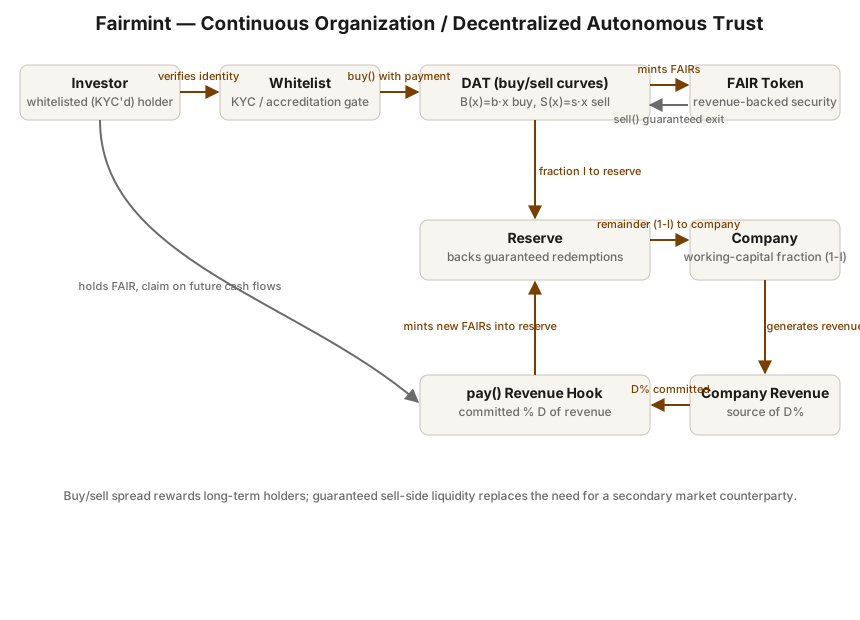 Open full-size diagram
Summary
Fairmint was founded in 2019 by Joris Delanoue (CEO) and Thibauld Favre (CTO) to commercialize the "Continuous Organization" (CO) model Favre had authored in a 2018 whitepaper (v1.2 published October 2019) while at TheFamily. The core idea: instead of discrete fundraising rounds or a one-shot ICO, a company runs a Continuous Securities Offering (CSO) — a permanent, programmatic offering in which a smart contract called a Decentralized Autonomous Trust (DAT) mints and burns revenue-backed security tokens ("FAIRs") along a bonding curve, funded by investor purchases and a committed fraction of company revenues. Fairmint built and audited the reference implementation on Ethereum (Consensys Diligence audit, November 2019; economic review by BlockScience; whitelist review by Kleros' Clément Lesaege), open-sourced it under GPL v3 in July 2020, and published a CSO Handbook in January 2020. The company raised a reported ~$7.4M round in February 2020 (Tracxn). The CSO mechanism itself saw limited direct adoption — dxDAO's DXD raise (5,000+ ETH) being the most notable use of the c-org contracts — and by early 2021 Fairmint had pivoted to the legally simpler "Rolling SAFE," then to broader equity tokenization (May 2022), and ultimately to being an SEC-registered transfer agent operating the Open Cap Table Protocol for onchain equity. The company survives; the Continuous Organization mechanism was effectively shelved.
Design (Mechanism)
The DAT acts as the organization's automated market maker and "central bank" for its own securities:
- Two linear curves. A buy curve B(x) = b·x prices primary issuance and a lower sell curve S(x) = s·x prices redemptions. The spread between them rewards long-term holders and leaves room for secondary markets. Token minting on a buy of amount c follows x = √(2c/b + a²) − a; the sell slope adjusts dynamically to reserves (s = 2R/x²).
- buy(): an investor's payment is split — a fraction I goes into the DAT reserve backing future redemptions; the remainder is working capital for the company. Purchases by the organization itself use I = 100% so insiders cannot extract value from the curve.
- sell(): guaranteed exit. Any holder can always sell FAIRs back to the DAT at the sell-curve price; liquidity is contractually guaranteed rather than dependent on finding a counterparty.
- pay(): the revenue hook. A committed percentage D of the organization's revenues flows into the reserve, minting new FAIRs — so FAIRs are a claim on future cash flows, not equity or governance rights.
- Minimum commitment and exit fee. Organizations pledge to run the CSO for a minimum period (typically 3–10 years); closing it early requires buying out all outstanding FAIRs at the current buy price.
- Compliance layer. A whitelist contract gated transfers to KYC'd, accreditation-checked investors, an attempt to make the offering securities-law compatible (Reg D/Reg S style exemptions), which distinguished Fairmint from permissionless bonding-curve projects.
Outcome
Technically the system shipped, was audited, and worked: the contracts were open-sourced, and dxDAO used the c-org design to raise over 5,000 ETH in 2020. But the CSO as a product did not achieve commercial traction. Startups found revenue-percentage commitments and a novel security instrument hard to explain to lawyers, accountants, and follow-on VCs. Fairmint iterated the offering repeatedly — from the whitepaper CSO to the CAFE, then the Rolling SAFE (early 2021), which kept continuous, programmatic fundraising but dropped the bonding curve and revenue reserve in favor of a familiar SAFE with a rolling valuation. In May 2022 Fairmint relaunched around community equity tokenization, and it has since become an SEC-registered transfer agent pushing the Open Cap Table Protocol (cap tables as onchain data), with CEO Delanoue elected General Director of the Canton Foundation — signaling a move toward institutional tokenized-securities rails. Verdict: the Continuous Organization mechanism is technically_successful_commercially_unsuccessful; Fairmint the company is ongoing in a different product.
Why it worked
- Serious engineering discipline. Full Consensys Diligence audit (which caught an ERC-777 reentrancy-style vector, resolved by restricting to ERC-20), an economic audit by BlockScience, and GPL open-sourcing gave the design unusual credibility for 2019–2020.
- Guaranteed liquidity was a real innovation. The always-available sell curve solved the "dead token" problem of illiquid security tokens, and the buy/sell spread was a clean, incentive-compatible way to discourage flipping.
- Regulatory-first posture. Whitelisting and framing FAIRs as revenue claims (not governance equity) made the model closer to legally viable than most ICO-era designs, and the contracts proved reusable (dxDAO).
Where the design broke
- Instrument novelty tax. A "claim on a reserve funded by revenues" fits no standard legal or accounting bucket. Founders' counsel, later-stage VCs, and acquirers all price novelty as risk; the Rolling SAFE pivot was an explicit retreat to a familiar instrument.
- Revenue commitment is a hard sell. Pledging a fixed slice of top-line revenue for 3–10 years competes with growth reinvestment and looks like expensive royalty financing precisely when startups are pre-revenue — the moment they most need capital.
- Timing and demand mismatch. Post-ICO-winter (2019–2020), retail appetite for compliant, non-speculative revenue claims was thin, while crypto-native capital preferred governance tokens with upside narratives.
- Complexity at the edges. Bonding-curve parameters (b, s, I, D) are hard for non-technical founders to set and for investors to evaluate; mispricing risk fell on the least sophisticated party.
Lessons
- Guaranteed onchain liquidity via a reserve-backed sell curve genuinely solves security-token illiquidity — but liquidity alone doesn't create demand for the underlying claim.
- Novel financial instruments face a "two-sided legibility" constraint: both issuers' lawyers and investors' mental models must accept the instrument; failing either side kills adoption regardless of mechanism quality.
- A mechanism can outlive its inventor's product: open-sourcing let dxDAO's DXD become the design's most successful deployment, showing reference implementations are a public good even when the originating startup pivots.
- Pivoting from mechanism-maximalism (CSO) toward familiar wrappers (Rolling SAFE, transfer-agent rails) is a survivable strategy — Fairmint traded design purity for regulatory fit and is still operating in 2026.
Redesign (EDITORIAL — hypothesis, not fact)
This section is editorial hypothesis, not fact. A modern retry might separate the two things the DAT bundled: (1) continuous compliant issuance and (2) revenue-linked value accrual. Issue a standard tokenized SAFE/equity instrument on rails like Fairmint's own Open Cap Table Protocol for legibility, and attach the bonding-curve reserve only as an optional, opt-in liquidity facility — a company-funded buyback pool with a published floor-price curve — rather than as the security itself. Replace the fixed revenue percentage D with covenant-style triggers (e.g., buybacks only above a cash threshold), verified via onchain revenue attestations or stablecoin-denominated payment flows that now exist at scale. Target later-stage, revenue-positive private companies (where a revenue claim is credible and priceable) instead of pre-seed startups. The 2018 design was arguably a mechanism ahead of its infrastructure: with mature RWA/tokenized-securities rails, transfer-agent registration, and stablecoin cash flows, the Continuous Organization's core loop could plausibly be re-run with far lower novelty cost.
Sources
- Continuous Organizations Whitepaper (Thibauld Favre, v1.2) — primary (docs)
- Fairmint c-org smart contracts (reference implementation) — primary (contract)
- Fairmint releases its bonding-curve contract in Open Source (Thibauld Favre, Jul 2020) — primary (retrospective)
- Consensys Diligence audit: Fairmint Continuous Securities Offering (Nov 2019) — primary (audit)
- Reimagining going public with Continuous Securities Offerings (Joris Delanoue) — primary (docs)
- Fairmint official site (current product: onchain equity / Open Cap Table Protocol) — primary (docs)
- Introduction to Rolling SAFE (OpenTezos) (analysis)
- Fairmint Launches the First Solution Enabling Community Ownership Through Equity Tokenization (Businesswire, May 2022) (news)
- Fairmint funding rounds (Tracxn) (analysis)
Related experiments
Last verified: 2026-07-26 · Spot an error? Suggest a correction