Melon Protocol
Pioneering on-chain asset-management protocol that let anyone deploy a rules-enforced investment fund as smart contracts, funded by an ETH-denominated usage fee that bought and burned MLN, and whose founding company deliberately dissolved itself into a DAO before rebranding as Enzyme Finance.
▶ Run interactive simulation animated mechanism with editable parameters
How it works onchain
 Open full-size diagram
Summary
Melon Protocol was one of the earliest serious attempts to move the entire investment-fund stack — fund formation, investor subscriptions, portfolio accounting, fee calculation, and compliance rules — into Ethereum smart contracts. Conceived in 2016 by Mona El Isa, a former Goldman Sachs vice president, and Reto Trinkler, an ETH Zurich-trained mathematician who had been writing Ethereum contracts since the platform's early days, the project was built by Zug-based Melonport AG. Melonport raised roughly $2.9M in a February 2017 ICO of MLN tokens, shipped test deployments through 2018, and launched Melon v1.0 on Ethereum mainnet in February 2019. Days later, Melonport did something almost unheard of in crypto: it dissolved itself on schedule and handed protocol control to the Melon Council, a purpose-built DAO of technical and stakeholder representatives (including people from Ethfinex, KR1, ZK Labs, MakerDAO, and Parity). In December 2020 — partly to sidestep confusion with BNY Mellon and mark the V2 overhaul — the protocol rebranded to Enzyme Finance, keeping the MLN ticker and token contract. Melon-the-brand ended; the protocol survives and is still live today as Enzyme.
Design (Mechanism)
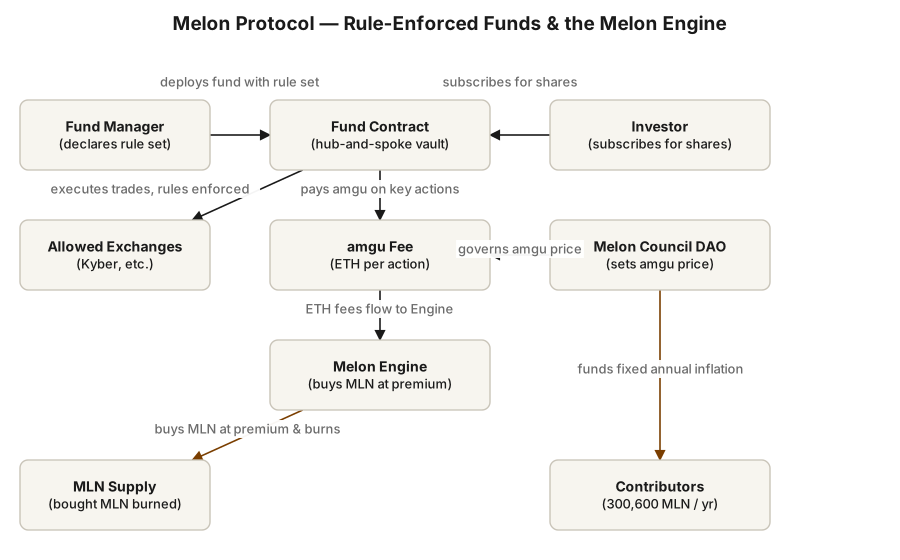
Melon's core primitive was the on-chain fund: a "hub-and-spoke" set of contracts where a manager deploys a fund with a declared rule set — allowed assets, allowed exchanges, max concentration, max positions, investor whitelists, price-tolerance limits — that the contracts enforce at execution time rather than after the fact. Investors subscribed by sending assets and receiving fund shares whose net asset value was computed on-chain from price feeds; management and performance fees were calculated and claimed by contract logic, not by an administrator. The pitch was that a track record becomes cryptographically verifiable and the back office (custody, NAV, audit, compliance) collapses into code, cutting fund setup costs from hundreds of thousands of dollars to nearly nothing.
The token model ("Melonomics") was unusually thoughtful for its era. Instead of forcing users to hold MLN, the protocol charged usage fees in ETH, denominated in "asset management gas units" (amgu) on key functions (setupFund, requestInvestment, executeRequest, claimFees), with the amgu price set by governance. Collected ETH flowed to the Melon Engine, a unidirectional liquidity contract that sold ETH for MLN at a premium to the Kyber-sourced market price and immediately burned the MLN it bought. Meanwhile a fixed annual issuance of MLN (capped at 300,600 per year under the new token, migrated to 0xec67...1892) funded ongoing development via the Melon Council. Usage → ETH fees → MLN buy-and-burn; inflation → maintainers: value accrual tied to network usage, explicitly avoiding high-velocity token pitfalls. Governance was a two-body Melon Council DAO (technical council plus exposed-stakeholder representatives) using multisig-style membership rather than token voting, on the argument that MLN holders' interests need not match users' interests.
Outcome
As an engineering and institutional-design artifact, Melon delivered: v1.0 shipped, the founding company dissolved into the Melon Council as promised (TechCrunch called it "setting a new bar"), and the amgu/Engine machinery worked as specified. As a business, the Melon era was quiet — through 2019–2020 the protocol hosted only a few hundred small funds and assets under management remained tiny (low single-digit millions), constrained by Ethereum gas costs, a clunky v1 architecture, and a thin asset universe. The December 2020 rebrand to Enzyme, alongside a much more gas-efficient V2, marked the end of "Melon Protocol" as a name; MLN rallied ~960% in 2020 into the rebrand. Enzyme subsequently grew into a durable niche asset-management layer (later powering vaults for projects and Avantgarde Finance, El Isa's on-chain fund manager built on top of it). Judged as the Melon experiment: technically successful, commercially modest, but one of the few 2017 ICO projects whose protocol, token, and mission survived intact — hence partial success rather than failure.
Why it worked
- Real domain expertise. El Isa had actually run money at Goldman and a fund afterward; the contracts encoded genuine fund-administration workflows (NAV, fee crystallization, mandate enforcement) rather than a trader toy.
- Credible decentralization with a deadline. Melonport pre-committed to dissolving after v1.0 and did it. That handover — company to council DAO — preserved the protocol through the bear market and gave the rebrand/V2 legitimacy.
- Usage-linked token economics. Charging fees in ETH (no forced token friction) while routing value to MLN via the Engine's buy-and-burn was an early, clean answer to the "why does this token exist" question, and funding maintainers by bounded inflation avoided treasury-dump dynamics.
- Enforced-at-execution risk rules. Making mandates unbreakable by construction (not by post-hoc audit) was a genuinely new capability versus traditional funds.
Where the design broke
- Too early for its market. In 2019 there were few on-chain assets worth managing, no institutional on-ramps, and DeFi composability (lending, AMMs, derivatives) barely existed, so "a fund that can only touch a handful of ERC-20s on a few DEXes" had limited appeal.
- Gas and UX costs. Every fund action was an L1 transaction; v1's hub-and-spoke deployment was expensive, and amgu fees added friction precisely on the actions the protocol needed to encourage.
- Fee-burn flywheel needs volume. The Melon Engine only accrues value if usage is high; with negligible AUM, burns were symbolic and MLN traded mostly on narrative.
- Brand and structural drag. The name collision with BNY Mellon, the ICO-era baggage, and a council DAO with limited resources (bounded inflation, small treasury) slowed iteration until the Enzyme reset.
Lessons
- Sunsetting the founding company can be a feature. Melonport's planned dissolution is still one of the cleanest founder-to-DAO handovers on record, and it is arguably why the protocol outlived its brand.
- Denominate fees in what users hold, accrue value to the token separately. The ETH-fee → buy-and-burn pattern (later echoed by many "real yield" designs) beats forcing users to acquire the native token, but it is only as strong as underlying usage.
- Constraint-enforcing vaults are the durable primitive. The idea that a mandate is enforced by the contract at execution time became the template for Enzyme, Set, dHEDGE, and later vault standards — infrastructure outlives the first business built on it.
- Being first costs a cycle. Melon shipped before DeFi's asset universe existed; the same design, relaunched as Enzyme V2 into DeFi summer's aftermath, found product-market fit the original never could.
Redesign (EDITORIAL — hypothesis, not fact)
This is editorial speculation, not a factual claim. A modern Melon would launch on an L2 (or app-rollup) so that fund operations cost cents, keep the ETH-denominated amgu fee but stream it to a fee switch that splits between burning and an insurance backstop for depositors, and replace the closed council with a council-plus-tokenholder-veto hybrid to answer the legitimacy critiques the Melon Council drew. The biggest missed opportunity was distribution: Melon built infrastructure and waited for managers. A redesigned version would ship a flagship first-party fund (as Avantgarde later did on Enzyme) from day one to bootstrap AUM, seed a track-record registry as a public good, and integrate lending/LP/staking adapters at launch so a "fund" can express real strategies. Finally, the 300,600 MLN/year maintainer inflation could be made usage-contingent — inflation only mints when burns exceed it — turning the Engine into a genuine net-deflation commitment rather than a narrative.
Sources
- Melon Protocol: A Blockchain Protocol for Digital Asset Management (whitepaper draft) — primary (docs)
- Melon documentation — The Melon Engine — primary (docs)
- Melonomics Part 2: The Melon Engine (Mona El Isa) — primary (retrospective)
- Introduction to the Melon Governance System (Jenna Zenk) — primary (governance)
- From Melon to Enzyme (Melon Council) — primary (governance)
- Melonport dissolves in favor of its protocol (TechCrunch, Feb 11 2019) (news)
- MLN token (Etherscan) — primary (contract)
- Melon Protocol Rebrands to Enzyme Finance (BeInCrypto) (news)
- Interview with Mona El Isa, CEO and Co-Founder at Melonport (DeFi Prime) (analysis)
Related experiments
Last verified: 2026-07-27 · Spot an error? Suggest a correction