Votium
A vote-incentive ('bribe') marketplace that let protocols pay vlCVX and veCRV holders to direct Curve gauge emissions, becoming core infrastructure of the Curve Wars.
▶ Run interactive simulation animated mechanism with editable parameters
How it works onchain
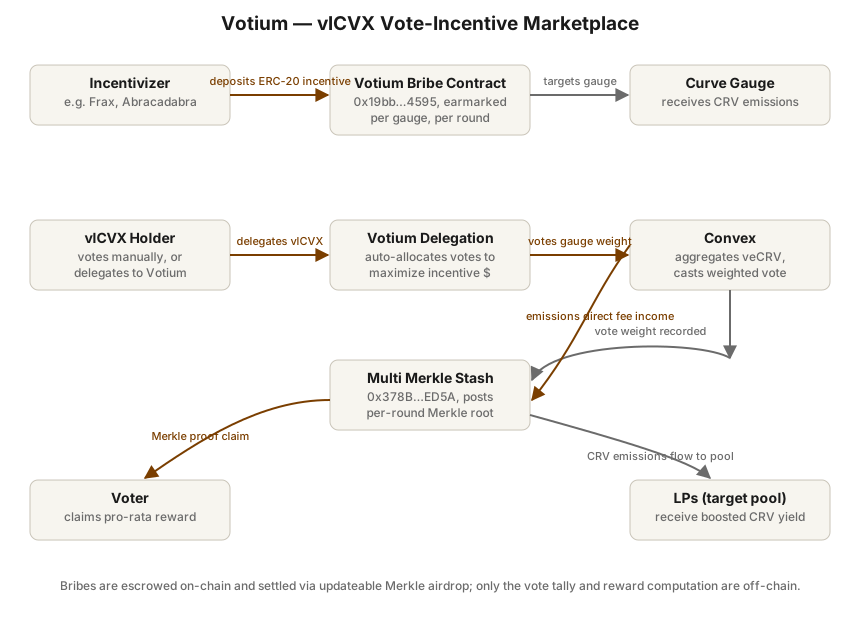 Open full-size diagram
Summary
Votium is a vote-incentive marketplace on Ethereum, launched on September 15, 2021, at the height of the "Curve Wars." Curve's gauge-weight system lets veCRV (and, via Convex, vlCVX) holders vote biweekly on which liquidity pools receive CRV emissions. Protocols that need deep liquidity — stablecoin issuers especially — discovered it was often cheaper to pay voters directly than to buy voting power themselves. Votium formalized that market for Convex's vlCVX (and later veCRV gauge votes): buyers ("incentivizers") deposit whitelisted ERC-20 tokens attached to a gauge; voters either vote themselves or delegate to Votium, which automatically allocates delegated votes to maximize incentive revenue; rewards are distributed via an updateable Merkle airdrop contract (the "Multi Merkle Stash," a pattern reused from Sushi). Built by a pseudonymous team closely aligned with the Convex ecosystem, Votium became the dominant venue for Convex vote incentives — by late 2023 it controlled roughly a third of all vlCVX via delegation and had passed over $300M in cumulative value to voters — and it remains operational, expanding beyond Curve to Frax, Prisma, and f(x) (FXN) gauge votes with a V2 upgrade in September 2023.
Design (Mechanism)
- The underlying asset: gauge votes. Curve emits CRV to pools according to gauge weights set by veCRV voters every two weeks. Convex aggregates a majority-scale veCRV position and passes its gauge-voting power to vlCVX (vote-locked CVX) holders. A gauge vote therefore has quantifiable cash value: it directs future CRV emissions to a pool.
- Buyer side. A protocol deposits an incentive (any whitelisted ERC-20, in a chosen amount) into the Votium Bribe contract (0x19bb…4595), earmarked for a specific gauge in a specific voting round. Buyers set total budgets; V2 (Sept 2023) added multi-deposit zaps, optional per-vote max-payment caps, and exclusion addresses.
- Voter side. vlCVX holders can vote manually and claim their pro-rata share, or delegate to Votium's delegation address, which "always chooses the best incentives" across proposals — turning passive lockers into yield earners with zero active management. veCRV holders can vote incentivized Curve gauges directly (delegation is not possible for veCRV; Curve's 10-day gauge-weight cooldown applies).
- Settlement. After each round, rewards are computed off-chain pro-rata to vote weight and posted as a Merkle root to the Multi Merkle Stash contract (0x378B…ED5A) for claiming. Fees are minimal (a small maintenance fee on incentives; no withdrawal fees); Votium has no native token. Admin functions sit behind a multisig.
- The economic loop. Buyers pay $X in incentives, voters direct emissions worth more than $X to the buyer's pool, LPs get yield, and lockers get paid — a market that prices governance power per round in $/vlCVX terms.
Outcome
Ongoing. Votium became the canonical vote-incentive venue of the Curve/Convex ecosystem. In its first week (~3M vlCVX delegated), voters claimed ~$286k, annualizing near 40% APR on delegated vlCVX. During the late-2021/early-2022 peak, single two-week rounds distributed over $20M, with Frax, Abracadabra, and Terra (UST) among the biggest spenders. The bear market of 2022–2023 sharply shrank round sizes (round-over-round declines of ~30% were recorded as new voters diluted per-vote returns and buyers cut budgets), and competitors emerged (Redacted's Hidden Hand, Paladin's Quest, StakeDAO's Votemarket). Still, by late 2023 Votium had delivered over $300M cumulatively to vlCVX voters, held roughly 34% of vlCVX via delegation, launched V2, and added Prisma and FXN markets. It has operated since 2021 without a recorded exploit of its own contracts. Its fortunes remain leveraged to the relevance of Curve/Convex emissions, which are far below their 2021–22 peak.
Why it worked
- It monetized an existing externality. Gauge votes already had cash value; Votium simply built the clearing house, so both sides had immediate, measurable reasons to show up (buyers: liquidity per dollar cheaper than owning CVX; voters: passive yield).
- Delegation collapsed coordination costs. Most lockers don't want to evaluate dozens of gauges biweekly. One-click delegation aggregated a huge, price-sensitive vote bloc, which in turn guaranteed buyers execution — a classic marketplace liquidity flywheel.
- Minimal trust surface. Escrowed deposits, Merkle-claim distribution, a battle-tested distributor pattern, no token, and negligible fees made participation nearly costless and non-custodial for voters.
- Ecosystem alignment. Convex publicly embraced voting incentives (November 2021 update), and Votium's team operated inside that community, giving it default-venue status during the Curve Wars land grab.
Limitations and criticisms
- Beta on a fading war. Votium's volume is a derivative of CRV emission value and stablecoin liquidity wars; when CRV price and the bribe meta declined post-2022 (and Terra, a major spender, collapsed), round sizes fell dramatically.
- Mercenary equilibrium. Vote incentives arguably converted governance into pure cash-flow arbitrage: emissions flowed to the highest bidder rather than the healthiest pools, subsidizing some low-quality or ultimately-failed assets (UST pools being the canonical example).
- Centralization and opacity. Off-chain reward calculation, a multisig admin, delegation concentrating ~a third of vlCVX in one strategy, and an anonymous team are persistent trust criticisms, even without an incident.
- No moat became visible. Hidden Hand, Quest, and Votemarket copied the mechanism with variations (fee models, per-vote pricing), commoditizing the marketplace layer.
Lessons
- Governance power with measurable cash value will be priced and sold; design for it. Vote-escrow systems that ignore this get an external bribe market anyway — better to decide deliberately whether to internalize it.
- Delegation is the killer feature of vote markets. The marketplace that aggregates passive voters into guaranteed execution wins the buyers; listing incentives alone is not enough.
- A no-token, low-fee, escrow-plus-Merkle design maximizes trust and adoption for a market whose users are professionally paranoid — but off-chain computation and multisig control remain the residual trust bottleneck.
- Marketplace revenue tied to one emissions schedule is cyclical, not secular. Diversifying to new gauge systems (Frax, Prisma, FXN) is survival, not growth, if the underlying emissions decay.
- Cheap votes cut both ways: the same market that efficiently bootstraps liquidity also lets fragile projects (e.g., UST) rent legitimacy and depth right up until failure.
Redesign (EDITORIAL — hypothesis, not fact)
This section is editorial hypothesis, not a factual account. A redesigned Votium could attack its three structural weaknesses. First, move settlement fully onchain: compute pro-rata rewards from vote snapshots verifiably (or via ZK-proven off-chain computation) so the multisig/Merkle-root trust assumption disappears — the strongest differentiator versus commodity competitors. Second, price votes as a real market rather than pro-rata pools: an onchain order book or per-vote clearing price (as later competitors partially did) would let buyers cap cost-per-vote and let voters see marginal price, reducing the round-to-round APR whiplash that came from naive pro-rata splits. Third, mitigate the "mercenary emissions" externality that ultimately degrades the host protocol: incentives could carry protocol-set quality gates (e.g., gauges must pass risk parameters, or a portion of every incentive streams to the underlying DAO treasury), converting bribes from a pure extraction channel into a taxed, sanctioned revenue line for Curve/Convex governance itself. Finally, the delegation bloc — Votium's core asset — could be decentralized into voter-configurable strategies (yield-max, whitelist-only, DAO-aligned) so that one operator no longer steers a third of vlCVX by default; this trades some efficiency for durability against the governance-capture critique that shadows all vote markets.
Sources
- Votium docs — Why Votium — primary (docs)
- Votium docs — Buyer Manual — primary (docs)
- Votium: Bribe contract (Etherscan) — primary (contract)
- Votium: Multi Merkle Stash contract (Etherscan) — primary (contract)
- Convex Finance — November Update: Voting Incentives, Community Contributions, Next steps — primary (governance)
- Curve Substack — LTO: Votium (team interview) — primary (retrospective)
- Votium Upgrades to V2 with New Features (Binance Square, Sept 2023) (news)
- Field Guide to the Curve Wars (Every) (analysis)
- Magnus Capital — Gauge Wars: The Convex Governance Blackhole & The Removal of the Bribe Ceiling (analysis)
- DeFiSafety — Votium detailed report (audit)
- Exponential DeFi — What is Votium? (analysis)
Related experiments
Last verified: 2026-07-27 · Spot an error? Suggest a correction