Decentraland
Ethereum-based virtual world where scarce LAND NFTs, a burn-to-mint MANA economy, and a token-governed DAO were used to bootstrap a user-owned metaverse that outlived its hype cycle but never matched its valuation with usage.
▶ Run interactive simulation animated mechanism with editable parameters
How it works onchain
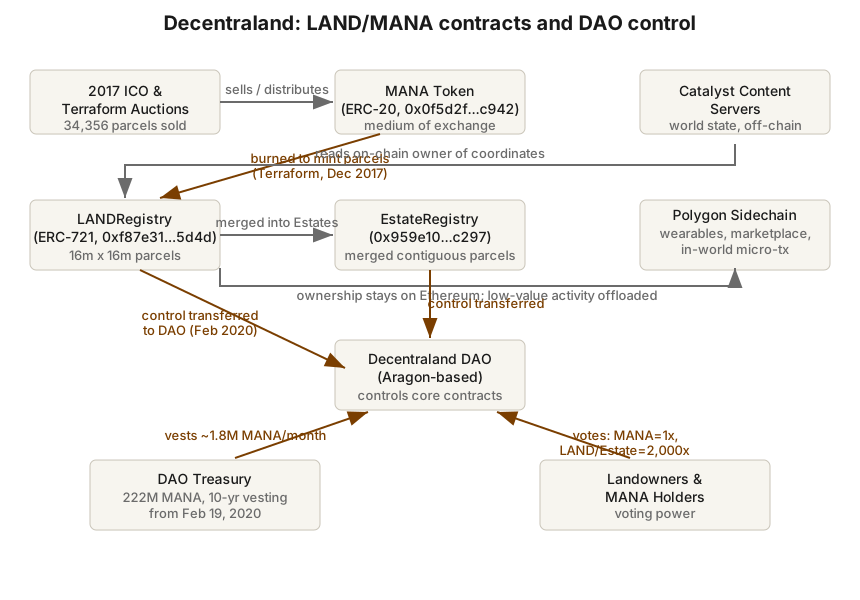 Open full-size diagram
Summary
Decentraland is the longest-running large-scale experiment in tokenized virtual real estate: a browser/desktop 3D world whose map is a fixed grid of LAND parcels recorded as ERC-721 tokens on Ethereum, purchased by burning the ERC-20 currency MANA. Conceived by Argentine developers Ari Meilich and Esteban Ordano (with whitepaper co-authors Yemel Jardi and Manuel Araoz) after prototypes dating to 2015, it raised roughly $24–26M (86,000+ ETH) in an August 2017 ICO that sold out in under a minute. The world itself opened to the public in February 2020, simultaneously handing control of its core smart contracts and a 222M-MANA, 10-year vesting treasury to a DAO. Decentraland became the emblem of the 2021 metaverse mania — including a record ~$2.4M single LAND purchase — and then the emblem of its deflation, when a 2022 CoinDesk report counted only 38 "daily active users" against a ~$1.3B token capitalization (later recalculated by DappRadar to ~650 daily unique active wallets after tracking more contracts). The platform persists in 2025–26 with a rebuilt client, mobile apps, and a leaner DAO that has wound down its grants program and executive committee.
Design (Mechanism)
- Scarce land as NFTs. The world is a finite grid of 16m×16m parcels. Each parcel is an ERC-721 token in the LANDRegistry (proxy at 0xf87e31...5d4d), with adjacency mattering: parcels near plazas and roads command premiums, importing real-estate location economics into a digital map. Contiguous parcels can be merged into Estates (EstateRegistry, proxy 0x959e10...c297).
- Burn-to-mint sink. MANA (0x0f5d2f...c942) is the medium of exchange; original LAND was acquired by burning MANA — the December 2017 "Terraform" auction sold 34,356 parcels for ~161M MANA, permanently reducing supply and mechanically linking land demand to currency scarcity.
- ICO distribution. 40% of MANA sold in the 2017 ICO, 20% community incentives, 20% team/early contributors, 20% foundation.
- DAO governance. From February 2020, the LAND, Estate, and Marketplace contracts came under a DAO (initially on Aragon). Voting power is multi-asset: MANA (originally wrapped as wMANA at 1 vote each) plus LAND and Estates at 2,000 votes per parcel — deliberately over-weighting landowners as the stakeholders with sunk, illiquid commitment. The DAO's treasury vests from a 222M MANA, 10-year contract started February 19, 2020 (~1.8M MANA/month).
- Two-tier chain architecture. Ownership of high-value assets (LAND, Estates) stays on Ethereum mainnet; wearables, marketplace activity, and in-world micro-transactions run on a Polygon sidechain for near-free, fast transactions — an early production example of value-tiered L1/sidechain separation.
- Content off-chain, ownership on-chain. Scenes and assets are served from content servers (Catalyst network); the chain records who controls which coordinates, not the world state itself.
Outcome
The ICO and Terraform auctions were spectacular fundraising successes, and the February 2020 launch drove over $1M of LAND purchases within days. During the 2021 Facebook-to-Meta metaverse wave, MANA reached a multi-billion-dollar capitalization and Tokens.com's Metaverse Group paid a record ~$2.4M for a LAND estate; brands, fashion houses (Metaverse Fashion Week), and celebrities piled in. Usage never followed valuation: the October 2022 DappRadar/CoinDesk episode (38 on-chain "daily active users," revised to ~650 daily unique active wallets; Decentraland countered with ~8,000 daily logins, most of which never touch the chain) crystallized the gap between speculative land value and actual foot traffic. LAND and MANA prices fell more than 90% from peaks. Yet the project did not die: the Foundation shipped a rewritten desktop client and mobile apps (400,000+ downloads claimed), while the DAO — facing treasury drawdown and grant-program dysfunction — paused new grants (2022, again February 2024), formally deprecated the grants program (October 2024), diversified its treasury, and in late 2025 voted to dissolve the paid DAO Committee in favor of a 3-of-5 multisig. Outcome: a partial success — a pioneering, still-operating mechanism suite whose economic layer wildly overshot its social layer.
Why it worked
- Credible scarcity plus composability. Putting land title on Ethereum made ownership provable, sellable on open marketplaces, and usable as a governance stake — none of which Second Life-style predecessors offered.
- The burn-to-mint auction was a genuinely clever cold-start: it converted speculative currency demand into permanent supply reduction and distributed the map widely before the product existed.
- Real decentralization follow-through. Unlike most "progressive decentralization" promises, both founders actually stepped back to advisory roles in April 2020 and the core contracts genuinely sit under DAO control — a large treasury with a 10-year vesting stream funded years of community operations.
- Value-tiered chain design (Ethereum for title, Polygon for commerce) kept the in-world economy usable through gas spikes.
Where the design broke
- Land speculation preceded — and substituted for — fun. The product had to justify prices set in 2017–2021 mania; buyers were investors, not players, so the world filled with empty branded plots rather than living content.
- Artificial scarcity of coordinates is not a demand driver. Digital worlds compete on experiences, which are infinitely replicable; scarce adjacency only matters if there is foot traffic to be adjacent to.
- Landowner-weighted governance entrenched speculators, directing DAO spending toward asset-value defense and a grants program that repeatedly failed cost-benefit review, requiring pause, freeze, and eventual deprecation.
- On-chain metrics cut both ways: transparent activity data made emptiness undeniable in a way traditional games never face.
- Clunky client and Web3 onboarding friction kept mainstream users out during the exact window when attention peaked.
Lessons
- A token economy can bootstrap capital and distribution years before a product exists, but the resulting price sets expectations the product must then service; overshoot converts early success into a permanent credibility deficit.
- Burn-to-mint land auctions are an effective one-time distribution and sink mechanism, but they seed a governance base of financially motivated landholders whose interests diverge from players'.
- Weighting votes by illiquid asset holdings (2,000 votes per LAND) is defensible in theory (skin-in-the-game) but in practice concentrates power in speculators when the asset's value is itself the object of governance.
- DAO treasuries with long vesting streams buy time but not judgment; Decentraland's grants program shows that undirected community funding degrades into rent-seeking without milestone-based accountability — its own DAO concluded as much by deprecating it.
- Separating ownership (L1) from activity (sidechain) worked technically and is now standard; the harder unsolved problem is making on-chain ownership matter to users who just want to play.
Redesign (EDITORIAL — hypothesis, not fact)
This section is editorial speculation, not a record of fact. A redesigned Decentraland would sever land price from platform success: issue non-transferable or slowly-decaying "leases" on coordinates earned by foot traffic and content quality (a Harberger-tax or use-it-or-lose-it regime), so location value accrues to active creators rather than 2017 auction winners. Governance would weight verified active users and creators (attested via in-world activity proofs) alongside capital, capping landholder voting share. The DAO treasury would fund only retroactive rewards tied to measured engagement, replacing prospective grants. Finally, launch sequencing would invert: ship a compelling free game loop first, introduce scarce tradable assets only after organic demand exists, and keep the currency's sink tied to consumption (cosmetics, names, events) rather than to the map itself.
Sources
- Decentraland official contract address registry (addresses.json) — primary (contract)
- Decentraland Docs — Ethereum essentials (LAND/MANA contracts, Polygon sidechain) — primary (docs)
- Decentraland Docs — About Decentraland (history, DAO, LAND) — primary (docs)
- Introducing the Decentraland White Paper — Ari Meilich (Medium) — primary (docs)
- Decentraland Docs — How does the DAO work — primary (docs)
- Governance: Deprecation of the current Grants program — primary (governance)
- Governance: DAO Committee Deprecation & Replacement (2025) — primary (governance)
- CoinDesk — Decentraland's 38 'Daily Active' Users in a $1.3B Ecosystem (news)
- CoinDesk — DappRadar Says Decentraland Has 650 Daily Active Users (news)
- Cointelegraph — Users Pay $1M for Digital Land as 2017 ICO Finally Opens Virtual World (news)
- Aragon — Decentraland: Securing a treasury with battle-tested Aragon OS (analysis)
Related experiments
Last verified: 2026-07-27 · Spot an error? Suggest a correction