Terraforms
Fully on-chain, owner-writable generative land art: ~9,900 animated ASCII parcels of a 20-level 'Hypercastle' whose rendering code, data, and even user-drawn art live entirely in Ethereum contract storage.
▶ Run interactive simulation animated mechanism with editable parameters
How it works onchain
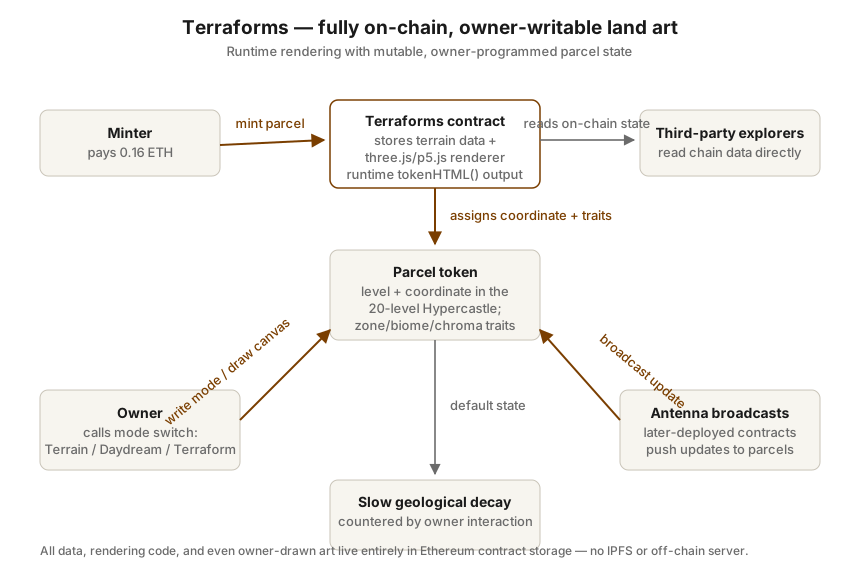 Open full-size diagram
Summary
Terraforms is the genesis project of Mathcastles, a two-person pseudonymous studio (0x113d and xaltgeist). Minted on Ethereum on December 17, 2021 at a flat 0.16 ETH, it is a collection of roughly 9,905–9,911 minted parcels (sources vary slightly; the conceptual structure comprises 11,104 parcels) of animated, text-based "land art." Each token is a 32x32 grid of Unicode glyphs representing a parcel of terrain at a specific level and coordinate of a fictional 20-level megastructure called the Hypercastle. Unlike almost all 2021 NFT projects, everything — terrain data, color palettes, glyph sets, animation logic, and the HTML/JS renderer itself — is stored and executed from Ethereum contract storage: the art is generated at read time by the contract ("runtime art"), with no IPFS or off-chain server dependency. The public mint raised roughly 1,568 ETH (~$6M at the time). Terraforms is now widely cited as a canonical work of fully on-chain art, and Mathcastles extended the experiment in September 2022 by writing the three.js and p5.js libraries into EVM storage as composable public infrastructure.
Design (Mechanism)
- Fully on-chain runtime rendering.
tokenURI/tokenHTMLcalls assemble an animated HTML/SVG artwork from data held entirely in contract storage. Traits include ~75 "zones" (color palettes), ~92 "biomes" (glyph/character sets), "chroma" (animation cadence), and fluctuating "topography" (height values), all deterministic outputs of on-chain data rather than pointers to files. - Spatial structure. Every parcel occupies a coordinate on one of 20 levels of the Hypercastle; the collection is a coherent 3D map, not independent one-offs. This invited community tooling (e.g., the Unity-based Hypercastle Explorer) that renders the whole structure from chain data.
- Owner-writable state (mode system). Each token has modes: default Terrain (dynamic topographic animation); Daydream, which blanks the parcel into a canvas the owner can draw on by writing character data through the contract; and Terraform, which commits the owner's drawing permanently on-chain. The NFT is thus a mutable, owner-programmable artwork, not a static image.
- Antenna / broadcast upgrades. A later "Terraforms 2.0" enhancement added an Antenna mode allowing parcels to receive broadcasts from newly deployed contracts — an extensibility channel that lets the artwork evolve without migrating the token contract.
- Slow decay. The terrain embeds an extremely long-horizon decay process (spanning thousands of years) that owner interaction (mode changes) counteracts — a deliberately geological-timescale engagement incentive.
- Flat-price open mint. 0.16 ETH per token, sold in a single public mint; ~9,900 sold for ~1,568 ETH.
Outcome
The December 2021 mint sold out its public allocation (~$6M raise), and the collection briefly became a top-trending project in early 2022. It has since settled into a durable niche as blue-chip on-chain art rather than a mass-market PFP: as of mid-2026, aggregators show a floor around 0.23–0.35 ETH — above the 0.16 ETH mint in ETH terms four and a half years later, but far below its speculative peaks. Its cultural outcome exceeds its market outcome: Terraforms is routinely cited (Bankless, Outland, Le Random) as among the most important fully on-chain artworks on Ethereum, it seeded an active builder/scholar community (explorers, wikis, visualizers built purely from chain data), and it catalyzed on-chain infrastructure work, notably Mathcastles' September 2022 write of three.js and p5.js into EVM storage for anyone to reuse. The contract remains live and self-contained; no exploit or migration has been needed. Precise ATH floor figures: Unknown / not found from reliable sources.
Why it worked
- Radical self-containment as a credible claim. "The art lasts as long as Ethereum" was verifiable in the contract, not marketing copy — attracting collectors who valued permanence over roadmaps.
- The token is an instrument, not a picture. Daydream/terraform modes gave owners real authorship; the mode system converted holders into participants and generated ongoing on-chain activity.
- Composability by construction. Because all state is readable on-chain, third parties could build explorers, maps, and derivative tooling without permission — the community became the roadmap.
- Coherent fictional topology. The Hypercastle's shared 3D structure gave individual tokens context and relational meaning (level, coordinate, neighbors), which pure trait-lottery collections lack.
Why it failed or underperformed
- Commercial ceiling of difficulty. ASCII terrain animations and a lore-heavy conceptual frame are illegible to casual NFT buyers; demand concentrated in a small on-chain-art collector base, so secondary prices retraced hard from 2022 peaks.
- No sustained emission of value to holders. Beyond the art itself, there is no yield, game loop, or utility flywheel; engagement depends on aesthetic conviction, which thins in bear markets.
- Opaque supply framing. The 11,104-parcel structure vs ~9,905–9,911 minted tokens confused observers, and sources still disagree on exact counts.
- Pseudonymous, low-communication team. Mathcastles' sparse official presence (the official site is nearly contentless) preserved mystique but limited broader adoption and institutional legibility.
Lessons
- Full on-chain storage is a mechanism, not just a storage choice: it makes composability, permanence, and third-party tooling credible properties that communities will build on.
- Giving owners write access to token state (owner-programmable art) creates durable engagement and a sense of stewardship that static metadata cannot.
- Artistic canon status and market performance are decoupled outcomes; a project can become historically canonical while its floor round-trips.
- Extensibility channels designed in advance (antenna/broadcast patterns) let an immutable contract evolve without migrations.
- Shared spatial structure (coordinates, adjacency, levels) gives tokens relational meaning and spawns emergent cartography communities.
Redesign (EDITORIAL — hypothesis, not fact)
This section is editorial hypothesis, not fact. A redesign might keep the fully on-chain renderer and mode system but address the engagement cliff: (1) make the decay mechanism legible and slightly faster (decades, not millennia), so stewardship has visible consequences within a collector's horizon; (2) formalize the antenna channel into a permissionless "broadcast registry" with holder-curated allowlists, turning the collection into a standing canvas for other on-chain artists and generating recurring cultural events; (3) publish a minimal spatial-query interface (neighbors, level slices) in the core contract to lower the cost of third-party world-building; and (4) allocate a portion of mint proceeds to an endowment that pays bounties for open-source tooling, converting the community roadmap from volunteerism into a funded commons. The risk of such changes is over-instrumenting an artwork whose austerity is part of its value; any added mechanics should remain optional overlays on an unchanged aesthetic core.
Sources
- Terraforms by Mathcastles contract (Etherscan) — primary (contract)
- Mathcastles official site — primary (docs)
- Terraforms Explained: Is This Ethereum's Best Onchain Art? (Bankless, William M. Peaster) (analysis)
- Mathcastles — Artist Profile (Le Random) (analysis)
- The Map Is the Territory (Outland Art) (analysis)
- Terraforms Are Trending, Here's Why You Should Be Paying Attention (nft now) (news)
- Terraforms — IQ.wiki (archive)
- Terraforms floor/market data (NFT Price Floor) (analysis)
Related experiments
Last verified: 2026-07-26 · Spot an error? Suggest a correction