Lyra Finance
The first fully on-chain options AMM, which priced options via a market-adjusted Black-Scholes model and hedged LP risk with perps, before abandoning the AMM design for an app-chain orderbook and rebranding to Derive.
▶ Run interactive simulation animated mechanism with editable parameters
How it works onchain
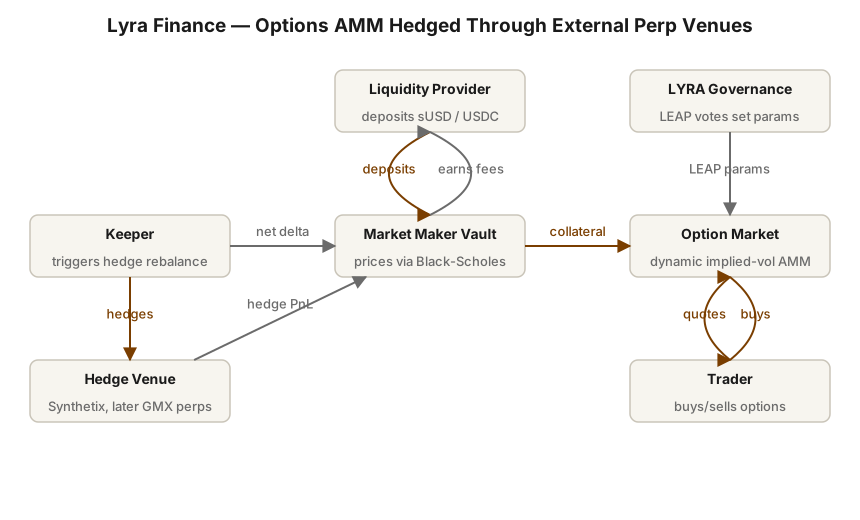 Open full-size diagram
Summary
Lyra Finance was the first fully on-chain options automated market maker, launched on Optimism mainnet on August 25, 2021 by an Australian team — Nick Forster (ex-Susquehanna equity options trader), Michael Spain (ex-Synthetix engineer), Jake Fitzgerald, and Dominic Romanowski. Options are notoriously hard to put on-chain: pricing requires a volatility surface, and market-making them leaves LPs with dangerous non-linear exposures (delta, vega, gamma). Lyra's core experiment was an AMM that priced European cash-settled options with a Black-Scholes engine whose implied-volatility inputs moved dynamically with trade flow, while hedging the pooled LPs' delta exposure using external perpetual/spot venues (initially Synthetix, later GMX on Arbitrum). The protocol processed over $1 billion in notional volume by January 2023, but the AMM model's capital inefficiency in a bear market led the team to abandon it: Lyra V2 (Q4 2023) moved to a gasless central-limit orderbook on a dedicated OP Stack rollup, and in August 2024 the project rebranded to Derive with a LYRA→DRV token migration. The AMM experiment itself was retired; the team and protocol live on in a different architecture.
Design (Mechanism)
- Market-adjusted Black-Scholes pricing. The AMM quoted option prices from a Black-Scholes model, but instead of a static volatility input, each strike/expiry had a baseline IV plus skew parameters that adjusted with net supply and demand: buying options pushed IV (and prices) up, selling pushed it down. This let a formula-driven AMM approximate a live volatility surface without off-chain market makers.
- Pooled liquidity vaults (MMVs). LPs deposited sUSD (later USDC) into market-maker vaults that took the other side of every trade, initially in discrete "rounds" with locked liquidity, later continuously. LPs earned trading fees, including a vega-utilization fee that charged traders more as the pool's aggregate volatility exposure grew — an explicit on-chain risk-pricing mechanism.
- Delta hedging via external perps. The pool's net delta was periodically hedged by keepers using Synthetix synths/shorts on Optimism (hedging was not live at launch, pending Synthetix's SIP-135 shorting mechanism), so LPs bore volatility risk but not raw directional risk. Vega risk was managed by fees and parameter caps rather than hedged directly.
- Newport upgrade (Jan 2023). V1's "Avalon" release required collateralizing calls with the underlying spot asset; Newport allowed partial cash (stablecoin) collateralization and outsourced delta hedging to GMX perpetuals, cutting hedging fees an estimated 10–20x and making the AMM modular enough to deploy on Arbitrum against any perp venue.
- Governance and token. The LYRA token (airdropped December 14, 2021) governed parameters through LEAPs (Lyra Enhancement Action Proposals), e.g., LEAP-38 authorized GMX hedging and the Arbitrum deployment.
- V2 pivot. Lyra V2 replaced the AMM entirely with a self-custodial, on-chain-settled central limit orderbook with portfolio margin and cross-collateral, running on "Lyra Chain," a dedicated OP Stack rollup with an off-chain matcher.
Outcome
Partial success. The AMM demonstrably worked: it generated, priced, and settled over $1.5 billion in notional options volume across Optimism and Arbitrum, was among the first protocols live on Optimism, and became the reference design for on-chain options AMMs. But it never achieved sustainable scale — DeFi options volumes remained a rounding error next to Deribit, LP returns were mediocre after hedging costs, and the pooled-vault AMM structure could not offer the spreads, strikes, or capital efficiency of professional market makers. The team's own conclusion was architectural: in late 2023 they shipped V2 as an orderbook app-chain, and in August 2024 rebranded to Derive (token migration to DRV began September 4, 2024), positioning as options infrastructure with integrations (EtherFi, Swell, Kelp, Veda). The original experiment — a formulaic options AMM — was effectively retired by its own creators, while the company survived it.
Why it worked
- Right primitive, right venue. Cash-settled European options with pooled collateral fit L2 constraints; launching early on Optimism gave cheap gas that made frequent IV updates and hedging economically feasible.
- Honest risk decomposition. Separating delta (hedged externally), vega (priced via utilization fees), and fee income gave LPs a legible risk product rather than a black box — a genuine advance over "sell options and pray" vault designs of the era.
- Composability as a hedging strategy. Outsourcing hedging to Synthetix and later GMX meant Lyra didn't have to bootstrap its own perp liquidity; Newport's cash-collateral redesign made the AMM portable across chains and hedge venues.
- Experienced options DNA. A founder from Susquehanna's options desk meant the vol-surface mechanics were financially literate, not improvised.
Where the design broke
- AMMs are a poor fit for options at scale. A formula cannot compete with professional market makers on spreads across hundreds of strikes and expiries; the AMM's passive LPs were structurally the adversely-selected side of every informed vol trade.
- Capital inefficiency. Fully or partially collateralized short options tied up large amounts of LP capital per dollar of premium, capping returns; hedging costs (Synthetix/GMX fees, keeper gas) ate much of the fee income before Newport, and plenty after.
- Market too small, timing bearish. On-chain options demand collapsed with the 2022 bear market; $1B notional in ~17 months is minimal for an options venue.
- Dependency risk. Reliance on Synthetix sUSD and later GMX for hedging imported those protocols' liquidity limits and fee regimes into Lyra's LP economics.
- The pivot is the verdict. The team's replacement of the AMM with a CLOB app-chain is the clearest evidence the AMM design underperformed its goals.
Lessons
- Derivatives with multi-dimensional risk (delta/vega/gamma) strain the AMM paradigm. AMMs excel where risk is one-dimensional (spot swaps); options AMMs must either hedge externally, tax users via risk fees, or push risk onto LPs — Lyra did all three and still couldn't reach competitive pricing at scale.
- Explicitly pricing pool risk (vega-utilization fees) is a reusable mechanism. Charging traders more as pool exposure concentrates is a general defense for any pooled-counterparty design.
- Composability cuts both ways. External hedge venues saved Lyra from bootstrapping perp liquidity but coupled its unit economics to other protocols' fees and depth.
- A successful experiment can still be the wrong product. Lyra proved on-chain options settlement works and then rationally discarded its own signature mechanism; teams that treat mechanisms as experiments rather than identities can survive their failure.
- App-chains are where latency-sensitive mechanisms retreat to. Like dYdX before it, Lyra concluded that an orderbook needs a dedicated execution environment — general-purpose L2s weren't enough even in 2023.
Redesign (EDITORIAL — hypothesis, not fact)
This section is editorial hypothesis, not fact. A redesigned Lyra-style options AMM might survive as a quoter of last resort rather than the primary venue: run the market-adjusted Black-Scholes engine as a backstop liquidity layer inside an orderbook (posting wide, risk-priced quotes at all strikes), so passive LP capital earns the spread only when professional makers withdraw — inverting the adverse-selection problem. Second, vega risk could be recycled instead of merely taxed: the pool could auction off its net vega exposure periodically (a "vol RFQ") to sophisticated desks, converting its structural short-gamma position into a priced product. Third, LP tranching (senior fee-earning vs. junior vol-bearing) would have let risk-averse capital scale the pool without demanding options literacy. Whether any of this beats simply running a CLOB — as Derive chose — is unproven; the honest reading of Lyra's history is that hybrid designs would still be competing against the same professional market makers who made the pure AMM obsolete.
Sources
- Lyra OΞ Mainnet Launch (official blog) — primary (docs)
- Lyra V1: Newport Upgrade (official blog) — primary (docs)
- Announcing Lyra V2 (lyra.eth on Mirror) — primary (docs)
- Lyra is now Derive (official blog) — primary (docs)
- Derive.xyz — About (team and history) — primary (docs)
- LEAP-38: GMX hedging and deploy on Arbitrum (governance) — primary (governance)
- Lyra: Option Market contract (OP Mainnet Etherscan) — primary (contract)
- Lyra Finance: The Leading Onchain Options Protocol (Synthetix blog) (analysis)
- Options AMM Lyra Deploys to Arbitrum Network (CoinDesk via Yahoo) (news)
- Lyra V2 app-chain coverage (CoinDesk Protocol Village) (news)
Related experiments
Last verified: 2026-07-26 · Spot an error? Suggest a correction