Panoptic
An oracle-free perpetual-options protocol that reinterprets Uniswap v3/v4 concentrated-liquidity positions as short options, letting anyone mint, trade, and market-make never-expiring puts and calls on any token.
▶ Run interactive simulation animated mechanism with editable parameters
How it works onchain
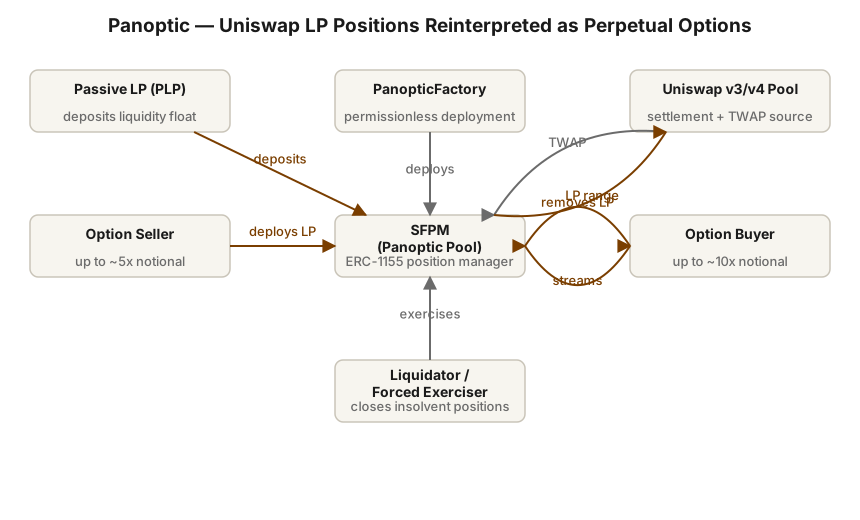 Open full-size diagram
Summary
Panoptic is a perpetual, oracle-free options protocol built on top of Uniswap v3 (and later v4). Its central insight, formalized in a 2022 arXiv whitepaper by Guillaume Lambert (then an applied-physics professor at Cornell) and co-founder Jesper Kristensen (ex-head of research at incubator Advanced Blockchain AG), is that a Uniswap v3 concentrated-liquidity position has the payoff profile of a short put/covered call — so LP positions can serve as the settlement primitive for options, with no expiry, no order book, no counterparty matching, and no price oracle. The project raised a $4.5M seed in late 2022 (Gumi Cryptos, Uniswap Labs Ventures, Coinbase Ventures, Jane Street) and a further $7M in 2024, went through repeated Code4rena audit competitions, and launched publicly on Ethereum mainnet in December 2024. V1 traction was modest (peak TVL roughly $4M in mid-2025 per DefiLlama), and in June 2026 the team relaunched as Panoptic V2, repositioned as a "DeFi yield platform" with curator-managed vaults (gamma scalping, volatility harvesting) that abstract options away from end users.
Design (Mechanism)
- LP positions as options. In Uniswap v3, a concentrated-liquidity range converts entirely to one asset when price crosses the range — the same "sold optionality" payoff as writing an option. Panoptic wraps LP positions via a SemiFungiblePositionManager (ERC-1155): selling an option deploys liquidity into the Uniswap pool at a strike (tick range); buying an option removes that liquidity, inverting the payoff into a long put or call.
- Perpetual, with streaming premia ("streamia"). There is no expiry. Instead of an upfront Black-Scholes premium, option buyers continuously accrue owed premium equal to the fees the underlying Uniswap liquidity would have earned, plus a spread that scales with pool utilization. Pricing is therefore path-dependent and set by realized trading activity, not by an oracle or implied-volatility quote.
- Oracle-free margining. Collateral requirements and solvency checks are computed from Uniswap's own internal TWAP/median tick rather than external oracles, allowing permissionless markets on any token pair.
- Three roles. Passive Liquidity Providers (PLPs) deposit tokens into Panoptic pools to earn commission-based yield and provide the leverage float; option sellers borrow that liquidity to write positions (up to ~5x notional); option buyers take the opposite side (up to ~10x), with portfolio-aware cross-margining. Liquidators and "forced exercisers" keep far-out-of-range or insolvent positions closable, earning bounties.
- Permissionless market creation. Anyone could deploy a Panoptic market on any Uniswap v3 pool via the singleton PanopticFactory (0x0000...bb01 on Ethereum).
- V2 (June 2026). Adds a vault layer — e.g., a USDC "Unicorn" gamma-scalping vault and an ETH PLP options-market-making vault — plus lending-market integration and RFQ-style custom quotes, turning the raw options engine into packaged yield products, including markets on tokenized equities such as SpaceX.
Outcome
Technically, Panoptic shipped what the whitepaper promised: a live, audited, oracle-free perpetual options engine on Ethereum mainnet (public launch December 2024), with permissionless markets quickly created for long-tail assets like PEPE and COW. It survived multiple public audit competitions (Code4rena April/June/September 2024; Cantina bounty) with no known exploit of deployed contracts as of mid-2026. Commercially, adoption has been thin relative to funding and ambition: DefiLlama shows TVL starting near zero at the December 2024 launch, peaking around $3.9M in July 2025, and sitting near $1.8M by July 2026 — small against DeFi options incumbents and tiny against perps venues. The June 2026 V2 relaunch as a yield/vault platform is an explicit repositioning away from expecting traders to use options directly. Status: ongoing — the V1 thesis of mass perpetual-options trading underperformed, but the team is well-capitalized and iterating, and V2 is too recent to judge.
Why it worked
- Genuinely novel primitive. "LP position = short option" is one of the cleanest mechanism-design insights of the Uniswap v3 era; it removed the two hardest problems in on-chain options (expiry fragmentation and oracle dependence) in one move.
- Credible research-first execution. A peer-style whitepaper, public repos, and repeated competitive audits built unusual technical credibility; top-tier backers (Uniswap Labs Ventures, Jane Street, Coinbase Ventures) and Uniswap Foundation grants validated the approach.
- Composability with existing liquidity. By settling into Uniswap pools rather than bootstrapping its own order flow, Panoptic could offer options on any token from day one — permissionless listing that centralized options venues cannot match.
Limitations and criticisms
- Options are a niche instrument on-chain. Even on centralized venues, crypto options volume is a fraction of perps volume; the audience that understands gamma, streamia, and range-based strikes is small, and Panoptic's UX remains more complex than Deribit-style options, not less.
- Path-dependent pricing is unfamiliar. Streamia means a buyer's total cost is unknowable in advance and depends on how often price crosses the strike — intellectually elegant, but alien to traders trained on upfront premia and IV surfaces.
- Thin liquidity constrains the two-sided market. Options buyers need sellers and PLP depth; with TVL still in the low single-digit millions, spreads and forced-exercise risk cap the size traders can comfortably put on, which in turn limits the fees available to attract more liquidity — a classic two-sided-market cold-start problem that has not fully resolved.
- Long time-to-market. ~2.5 years passed between the whitepaper (April 2022) and public mainnet (December 2024); by launch, Uniswap v3 LP mindshare had faded and attention had moved to points, restaking, and memecoins — a reminder that even a sound design can arrive after its most receptive audience has moved elsewhere.
Lessons
- A mathematically beautiful equivalence (LP = short option) does not automatically create demand; mechanism elegance solves the supply/settlement side, but the demand side still needs a product ordinary users want.
- Oracle-free design is a real security and permissionlessness win — Panoptic avoided the oracle-manipulation exploits that hit lending/derivatives peers — and is worth the pricing unfamiliarity it introduces.
- When a sophisticated instrument fails to find direct users, wrapping it in managed vaults (sell the yield, not the mechanism) is the natural second act — but doing so only after 18 months of thin traction costs momentum; shipping the packaged product alongside the primitive is likely better.
- Long audit-heavy timelines protect users but risk shipping into a different market regime than the one that inspired the design.
Redesign (EDITORIAL — hypothesis, not fact)
This section is editorial hypothesis, not established fact. A redesigned Panoptic would launch the vault layer first: most users should never see a strike or a streamia accrual — they should see "volatility yield on ETH/USDC," with the options engine as invisible plumbing (the 2026 V2 pivot implicitly concedes this; doing it in 2024 might have captured the restaking-era appetite for packaged yield). Second, quote a familiar interface over the unfamiliar mechanism: display an estimated annualized premium / effective IV derived from recent streamia, so traders can compare Panoptic to Deribit pricing at a glance. Third, seed the two-sided market deliberately — protocol-owned PLP liquidity or an options-market-maker partnership (a Jane Street-style backer was on the cap table) to guarantee tight effective spreads for the first year. Fourth, deploy on a cheap L2 at launch rather than Ethereum mainnet only, since streaming-premium positions require frequent management. Finally, lean into the one thing no one else can do — permissionless options on long-tail and newly launched tokens — as the wedge market, where there is no incumbent venue at all.
Sources
- Panoptic: the perpetual, oracle-free options protocol (whitepaper, arXiv 2204.14232) — primary (docs)
- Panoptic official site and docs — primary (docs)
- panoptic-labs/panoptic-v1-core (V1 smart contracts) — primary (contract)
- Code4rena audit competition: Panoptic (April 2024) — primary (audit)
- Panoptic V2: The Vault Suite (official blog, 2026-06-29) — primary (docs)
- Uniswap-based DeFi protocol Panoptic raises $4.5 million (The Block, 2022) (news)
- Panoptic raises $7 million to build perpetual options platform for DeFi (The Block, 2024) (news)
- Panoptic Launches Perpetual Options on Uniswap (Amberdata, Dec 2024 mainnet launch) (news)
- Builder Stories: Guillaume Lambert (Uniswap Foundation) (analysis)
- DefiLlama: Panoptic protocol TVL (analysis)
Related experiments
Last verified: 2026-07-26 · Spot an error? Suggest a correction