Whales Market
Collateralized peer-to-peer pre-market DEX on Solana that let traders buy and sell pre-TGE token allocations and airdrop points, turning the 2024 'points meta' into an on-chain forward market.
▶ Run interactive simulation animated mechanism with editable parameters
How it works onchain
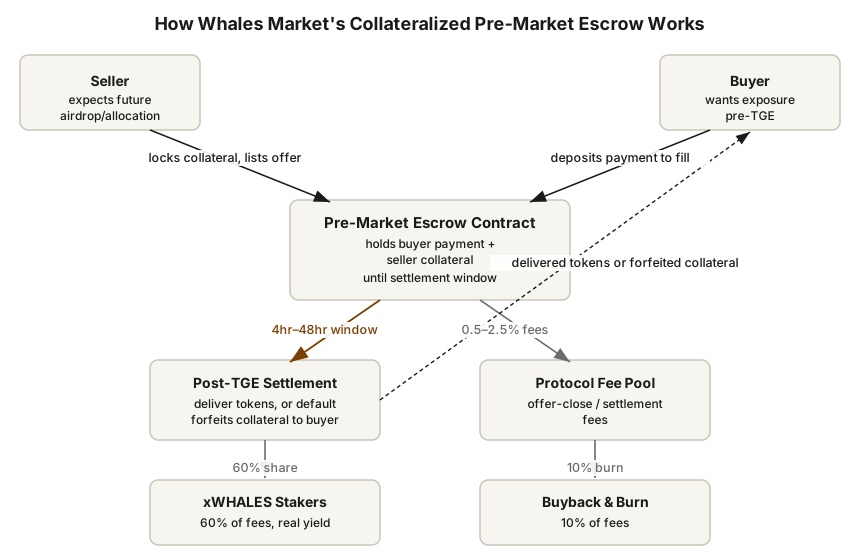 Open full-size diagram
Summary
Whales Market is a decentralized OTC and "pre-market" exchange, launched on Solana mainnet in January 2024 by the pseudonymous team behind LootBot (led by "Dexter," @dexter_cap), that lets users trade assets which do not yet exist on-chain: pre-TGE token allocations and airdrop "points" from protocols like EigenLayer, Jupiter, friend.tech, Magic Eden, and Hyperliquid. Its core innovation was replacing trust-based Telegram OTC deals with a smart-contract escrow in which both sides post collateral and a defaulting seller forfeits that collateral to the buyer. Riding the 2024 points meta, the platform escrowed tens of millions of dollars within weeks (over 20,000 users and ~$48.7M escrowed on Solana per Dune data cited in early coverage) and has since claimed over $300M in cumulative volume across many chains. The WHALES token briefly reached a ~$264M FDV before collapsing more than 99%; the platform itself remains live, but the category it pioneered was largely absorbed by centralized-exchange pre-markets and perp pre-launch listings.
Design (Mechanism)
Whales Market runs three linked markets on a common escrow primitive:
- Pre-Market (pre-TGE allocations). A seller who expects to receive tokens (e.g., from an airdrop or allocation) lists an offer at a fixed price. A buyer fills it by depositing payment; the seller locks collateral (typically comparable in value to the deal) in the smart contract. After the token generation event, a settlement countdown begins (originally ~24 hours, later a 4-hour settle phase with an up-to-48-hour "extended settlement" toggle for claim-portal or bridge outages). If the seller delivers the tokens, they receive the buyer's payment plus their collateral back; if the seller defaults, the buyer reclaims their payment plus the seller's collateral as compensation. Crucially, defaulting is an explicit, priced-in option: pre-market is price discovery, not a guaranteed forward, and a seller may rationally default and forfeit collateral if the token lists far above the agreed price.
- Points Market. The same structure applied to loyalty/airdrop points before conversion ratios are known. Orders are struck in points; when the protocol announces its token and points-to-token ratio, positions convert automatically and settle within the window. This exposed sellers to ratio risk, since the final conversion was unknown at trade time.
- OTC Market. Simple P2P escrow for already-issued tokens (including vested/locked deals) at 0.1% fees, versus roughly 0.5% offer-close and 2.5% settlement/cancellation fees in the pre- and points markets.
The WHALES token (100M supply on Solana, mint GTH3wG3...JAS1) had no presale; initial liquidity was bootstrapped by the LootBot treasury, with 5% airdropped to LOOT/xLOOT holders, 9.5% to the team (9-month cliff, 36-month vesting), and 65% to four-year incentive emissions. Protocol fees were split roughly 60% to xWHALES stakers, 20% to development, 10% to buyback-and-burn, and 10% to LOOT holders — a Blur/GMX-style real-yield design.
Outcome
Whales Market was the breakout venue of the early-2024 points meta. Within weeks of the January 2024 launch it drew tens of thousands of wallets and tens of millions in escrow, with EigenLayer, Jupiter, Wormhole, and friend.tech-adjacent markets driving activity; WHALES ran to an all-time high around $4.41 (FDV in the hundreds of millions) by March 2024. The platform expanded from Solana to Ethereum, Arbitrum, Base, BNB Chain, Blast, and other networks, added cross-chain settlement, and claims over $300M in cumulative volume. But the token round-tripped: by 2025–2026 WHALES traded around $0.01 with a market cap in the low hundreds of thousands of dollars and negligible daily volume — a >99% drawdown. A separate token from the same pseudonymous team, GM.AI, illustrates the mechanism risk of shared identity: it raised $30M (150,000 SOL) in a March 2024 presale but launched in August 2024 with only ~$2M of liquidity, and its price fell ~80% within an hour of listing — a presale-to-liquidity ratio that left little cushion for post-launch selling. The Whales Market platform itself continues to operate and publish, so the venue survives even as its token and the wider LootBot-linked token cluster faded.
Why it worked
- It monetized a real, unserved need. In 2023–24, points and unvested allocations were valuable but untradeable except via handshake OTC deals rife with scams. Collateralized escrow made the counterparty risk explicit and bounded.
- Symmetric collateral is a simple, credible enforcement mechanism. No oracles, no legal recourse needed: the worst case for a buyer is receiving the seller's collateral instead of tokens.
- Perfect timing and distribution. It launched into the EigenLayer/Jupiter airdrop mania with an existing LootBot community of airdrop farmers — exactly the sellers such a market needs — and a fair-launch token with real fee-sharing that bootstrapped attention.
Where the design broke
- The default option capped what buyers actually bought. Because sellers could rationally default and forfeit collateral when tokens listed above the strike, buyers held something closer to a bounded option than a firm forward, weakening pre-market prices as forecasts and disappointing buyers in hot launches.
- Category dependence on the points meta. Volume was a derivative of airdrop mania; when points programs lost credibility in late 2024–2025, the addressable market shrank sharply.
- Centralized competition. CEX pre-markets (Binance, Bybit, etc.) and perp pre-launch markets (Aevo, Hyperliquid) offered leverage and deeper liquidity without dual-collateral capital lockup, commoditizing the niche Whales pioneered.
- Reputational contagion across a shared pseudonymous identity. Because WHALES, LOOT, and GM.AI were all traceable to the same pseudonymous team with no separable, verifiable track records, a liquidity shortfall in one associated launch (GM.AI) repriced trust in the others; WHALES' incentive-heavy emissions then met collapsing demand with no independent reputation to fall back on.
Lessons
- Collateralized two-sided escrow is a powerful trust-minimizing primitive for trading claims on future assets, but collateral equal to the deal size only bounds — never eliminates — default risk; pre-markets price like capped options, not forwards.
- Markets whose underlying asset class is a meta (points, allocations) inherit that meta's lifecycle; a venue that wants to outlive the meta needs a durable second act (Whales' OTC/vesting markets never matched pre-market volume).
- Capital efficiency wins: once centralized and perp-based pre-launch venues offered the same exposure without locking dual collateral, the fully on-chain version lost flow despite being more trustless.
- Pseudonymous founder reputation functions as a shared balance sheet across projects; a liquidity mismatch in one associated launch (GM.AI) can reprice every other associated token, regardless of the flagship product's own soundness.
Redesign (EDITORIAL — hypothesis, not fact)
This section is editorial hypothesis, not fact. A stronger design would convert the seller's "default option" into an explicitly priced instrument: quote every pre-market trade as a collateral-backed call spread with the forfeiture amount as the cap, so buyers see the true payoff instead of discovering it at settlement. Collateral requirements could be dynamic — scaling with implied volatility of comparable launches or topped up via margin calls as pre-market prices move — to keep forwards firm through hot TGEs. To outlive any single meta, the venue could generalize the escrow primitive into a standing marketplace for all contingent claims (locked vesting positions, SAFT resales, validator rewards, revenue shares) with a compliance-light attestation layer for larger OTC blocks. Finally, decentralizing the settlement-extension toggle (currently an operator decision) into a token-holder or committee process would remove a central point of discretion in exactly the moments — chaotic TGEs — when disputes are most likely.
Sources
- Whales Market Docs — Pre-Market and Settlement Rules — primary (docs)
- Whales Market Docs — $WHALES Tokenomics — primary (docs)
- About Whales Market (official) — primary (docs)
- WHALES token on Solscan — primary (contract)
- Whales Market Announces the Launch of Its Dapp and $WHALES Token on Solana (press release) (news)
- Whales Market: Points OTC Marketplace — Shoal Research (Pavel Paramonov) (analysis)
- A new Solana protocol lets you trade points — DL News (news)
- How to Buy and Sell Points With Crypto Pre-Markets — CoinGecko Learn (analysis)
- The Rise and Fall of $GM (GM.AI) — Medium deep dive on founder Dexter (analysis)
- Whales Market (WHALES) price — CoinGecko (analysis)
Related experiments
Last verified: 2026-07-27 · Spot an error? Suggest a correction