Hegic
Pseudonymous solo-dev options protocol that pioneered the peer-to-pool model — buyers trade against a pooled counterparty instead of an order book — surviving a launch-day bug, multiple full rewrites, and a bear market to remain the largest on-chain options AMM.
▶ Run interactive simulation animated mechanism with editable parameters
How it works onchain
 Open full-size diagram
Summary
Hegic is an on-chain options trading protocol created by the pseudonymous solo developer "Molly Wintermute" (a mashup of two Neuromancer characters). Announced in February 2020 and launched on Ethereum mainnet on 23 April 2020, it was one of the first serious attempts to make options — a liquidity-hungry, market-maker-dependent instrument — work without order books. Its core invention was the peer-to-pool model: liquidity providers deposit into a single pooled counterparty that automatically writes (sells) every option buyers request, with premiums flowing back to the pool. Hours after launch a typo-class bug permanently locked roughly $48,000 of user funds; Wintermute reimbursed users, redeployed in May 2020, got a PeckShield audit in June, and kept shipping. The HEGIC token launched via a novel 72-hour "Initial Bonding Curve Offering" (IBCO) in September 2020 in which all buyers received the same settlement price. Through successive rewrites (v888 in late 2020, v8888 in 2021, HardCore, and the Herge upgrade that moved the protocol to Arbitrum in October 2022), Hegic evolved into a "one-click strategies" platform where HEGIC stakers collateralize option selling via a Stake & Cover pool. As of late 2025 it remained the largest options AMM by TVL (~$28.5M), though far below its early-2021 peak.
Design (Mechanism)
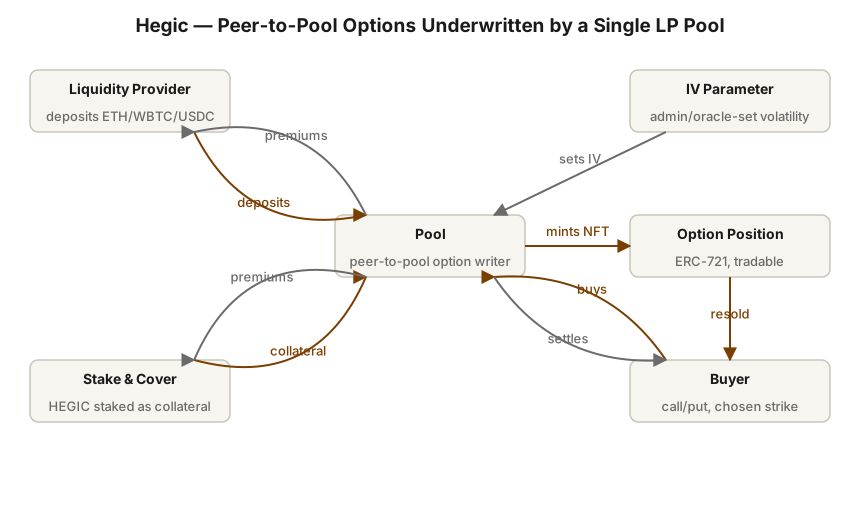
- Peer-to-pool option writing. Instead of matching individual buyers and sellers, LPs deposit assets (originally ETH, later WBTC and USDC) into a shared pool. Any buyer can purchase an American-style, cash-settled call or put with a chosen strike and duration; the pool locks collateral against it and collects the premium. LPs collectively earn premiums and collectively bear the payout risk — effectively a tokenized, mutualized options-selling fund.
- Simplified pricing. Premiums were computed from a simplified model with implied volatility set as a parameter (updated by the team from external sources) rather than discovered by a live market — a deliberate trade of pricing precision for permissionless availability and guaranteed quotes in any size the pool could collateralize.
- Options as tokens. Positions are represented on-chain (in current versions as ERC-721 NFTs, tradable on secondary markets like OpenSea) and settle in cash (USDC in the Herge version).
- IBCO token launch (Sept 9–12, 2020). 25% of the fixed 3,012,009,888 HEGIC supply was sold on a bonding curve where all contributions in the window settled at one uniform final price — explicitly designed to prevent whale front-running and pump-and-dump dynamics of fixed-price sales. 40% of supply was reserved for liquidity-mining and "utilization" rewards paid to LPs and active traders.
- Staking → Stake & Cover. Originally, staking "lots" of HEGIC earned a share of settlement fees. The October 2022 Herge upgrade (Arbitrum-only) merged stakers and LPs: HEGIC staked in the Stake & Cover pool is the collateral backing options and one-click strategies (straddles, strangles, spreads, condors, etc.), and stakers receive net premiums — aligning the token directly with underwriting P&L.
Outcome
Hours after launch, a bug in the initial contract locked $48k of funds — an early, costly test of the "mainnet-first, no-testnet" ethos Wintermute had championed. She reimbursed affected users from her own resources, relaunched, and the project recovered remarkably. The IBCO sold out, v888's liquidity mining drove TVL to roughly $100M at its early-2021 peak (per DefiLlama), and Hegic became the reference implementation of pooled options — inspiring successors like Dopex, Lyra, Premia, and Ribbon (which originally composed on top of Hegic). LP returns were mixed: pooled sellers were systematically short volatility with admin-set IV, and in trending or volatile markets pools took losses. Activity fell hard in the 2022 bear market; the Herge upgrade consolidated everything onto Arbitrum. As of December 2025, an independent academic survey counted Hegic as the largest option AMM by TVL ($28.5M of ~$100M across DeFi options), still operating six years after launch — a survivor, though on-chain options overall never approached perps' product-market fit.
Why it worked
- It solved the cold-start liquidity problem for options. Order-book options need professional market makers quoting thousands of strike/expiry combinations; a pooled counterparty offers instant, always-on liquidity for arbitrary strikes and durations from day one.
- Radical simplicity and shipping speed. One anonymous developer with a memorable persona shipped faster than venture-backed teams, and the honest handling of the launch bug (full reimbursement) converted a catastrophe into credibility.
- Token design tied to the machine. The IBCO's uniform settlement price was a genuinely fair-launch-flavored innovation, and later making staked HEGIC the underwriting collateral gave the token a real job rather than a governance fig leaf.
Limitations and criticisms
- Pooled sellers bear adverse selection. With IV set as a parameter rather than by markets, sophisticated buyers could purchase options whenever the fixed IV was cheap relative to realized volatility, transferring wealth from passive LPs to informed traders. This structural LP-loss problem dogs every Hegic-style AMM.
- Mainnet-first cost real money early on. The unaudited launch locked user funds permanently; Wintermute herself said she was "paying a high price for the mainnet-first approach."
- On-chain options remain a niche relative to perps. Ethereum gas costs, capital-inefficient full collateralization, and retail preference for perpetual futures kept DeFi options small; Hegic's TVL fell from ~$100M at its 2021 peak to the tens of millions and has stayed there since.
Lessons
- Peer-to-pool is a general pattern for bootstrapping two-sided markets: mutualize the sell side into a pool and you get instant liquidity — but you must then solve the pool's adverse-selection problem (dynamic pricing, caps, or hedging), or LPs quietly subsidize traders.
- How a founder handles the first exploit defines the project. Full, fast reimbursement of the $48k loss bought Hegic years of community trust; the same bug with a defensive response would likely have killed it.
- Uniform-price bonding-curve sales (IBCO) are an underused fair-launch mechanism that removes timing games and whale front-running from token offerings.
- "Ship on mainnet, iterate publicly" has real tail risk: audits and testnets are cheap relative to permanently locked user funds and reputational damage.
- Giving the native token an underwriting function (Stake & Cover) is a stronger value link than fee-sharing alone — but it also concentrates protocol risk onto token holders.
Redesign (EDITORIAL — hypothesis, not fact)
This section is editorial analysis — a hypothesis, not established fact. The fatal flaw of Hegic-style pools is static, admin-set implied volatility. A redesign would make pricing reflexive: IV per strike/expiry adjusts automatically with pool utilization and recent realized-vs-implied P&L (as later protocols like Lyra attempted), so informed flow raises prices instead of draining LPs. Second, the pool should delta-hedge programmatically on a perp DEX, converting LPs from naked short-vol takers into approximate variance sellers with bounded drawdowns. Third, keep the IBCO but escrow a portion of proceeds as a first-loss insurance tranche junior to LP capital, aligning the founder/treasury with underwriting outcomes. Finally, retain the ERC-721 position tokens but add a built-in secondary AMM for reselling options, since resale (rather than early exercise) is what most retail buyers actually need.
Sources
- Hegic official site — primary (docs)
- Hegic documentation (GitBook) — primary (docs)
- HEGIC token contract on Etherscan — primary (contract)
- HEGIC Initial Bonding Curve Offering announcement (Hegic Medium) — primary (docs)
- Hegic's Molly Wintermute: 'I'm paying a high price for the mainnet-first approach to building' (Decrypt / The Defiant interview) — primary (retrospective)
- Molly Wintermute Releases Hegic V8888 (The Block) (news)
- Hegic Completes Herge Upgrade on Arbitrum (TokenInsight) (news)
- Hegic TVL on DefiLlama (analysis)
- Pricing of wrapped Bitcoin and Ethereum on-chain options (arXiv, Dec 2025) (analysis)
Related experiments
Last verified: 2026-07-26 · Spot an error? Suggest a correction