Flash Loans
Uncollateralized loans of arbitrary size that exist only within a single atomic transaction — prototyped by Marble in 2018, productionized by Aave and dYdX in 2020, and now a canonical DeFi primitive for arbitrage, liquidations, and, notoriously, exploits.
▶ Run interactive simulation animated mechanism with editable parameters
How it works onchain
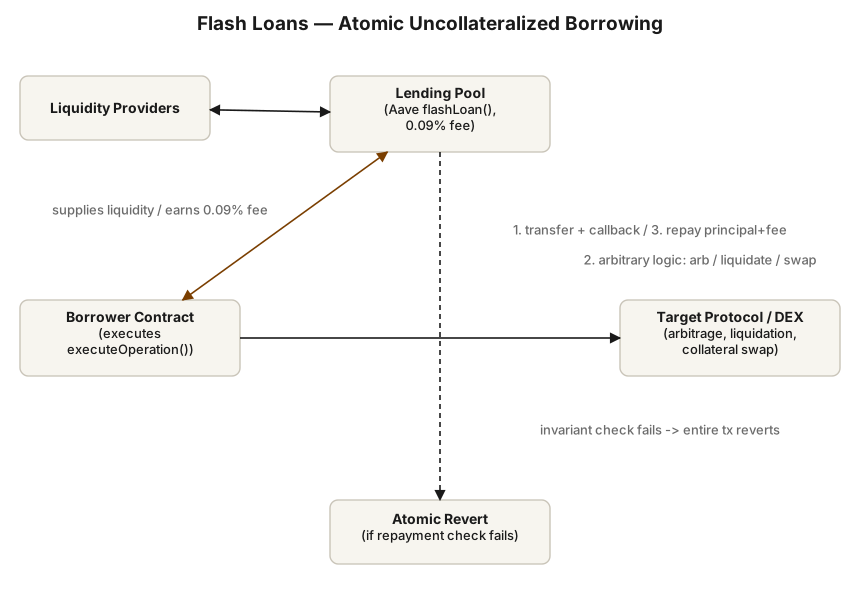 Open full-size diagram
Summary
A flash loan is an uncollateralized loan that is borrowed and fully repaid inside a single blockchain transaction. If the borrower fails to repay principal plus fee before the transaction ends, the entire transaction reverts as though the loan never happened — so the lender takes essentially no credit risk. The concept was first shipped as open-source "flash lending" contracts by Marble Protocol, announced by Max Wolff on July 16, 2018 as part of a "smart contract bank" on Ethereum. It was productionized and popularized in January 2020 when Aave V1 launched pooled flash loans at a 0.09% fee (dYdX offered a similar pattern via its Solo margin contracts, and Uniswap V2 later added "flash swaps"). Flash loans became a canonical DeFi primitive — democratizing whale-scale capital for arbitrage, liquidations, and collateral swaps — and simultaneously became the signature amplifier of DeFi exploits, beginning with the bZx oracle-manipulation attacks of February 2020.
Design (Mechanism)
The mechanism exploits transaction atomicity on Ethereum-style chains:
- A borrower contract calls the lender (e.g., Aave V1
LendingPool.flashLoan()at0x398eC7346DcD622eDc5ae82352F02bE94C62d119), specifying asset and amount up to the pool's entire available liquidity. - The lender transfers funds and then invokes a callback (
executeOperationin Aave;onFlashLoanin the later ERC-3156 standard) on the borrower contract, which can run arbitrary logic — DEX arbitrage, liquidating undercollateralized positions, refinancing debt between protocols, swapping collateral. - At the end of the callback, the lender checks that principal plus fee has been returned (Aave V1 charged 0.09%; Marble's prototype charged zero). If the invariant fails, the whole transaction reverts.
Because repayment is enforced by the EVM's all-or-nothing execution rather than by collateral or reputation, the loan is riskless to the lender (modulo contract bugs and read-only reentrancy subtleties) and permissionless to the borrower — anyone who can write a contract can wield the pool's full liquidity for the duration of one transaction. ERC-3156 (authored by Alberto Cuesta Cañada, Fiona Kobayashi, fubuloubu, and Austin Williams; created November 2020, now Final) standardized the lender/borrower interfaces so integrators need not special-case Aave vs. dYdX vs. Uniswap-style implementations.
Outcome
Major success as a primitive. Aave processed roughly $2 billion in flash loans in its first year (2020), with daily volumes exceeding $100 million by mid-2020, and the mechanism spread across essentially every EVM lending protocol and DEX (Aave V2/V3, Uniswap V2/V3 flash swaps, Balancer, dYdX, MakerDAO's ERC-3156 flash mint module). Flash loans are now embedded infrastructure for liquidation bots, MEV searchers, collateral-migration UX, and DAO treasury operations.
The mechanism's dark twin arrived almost immediately: the two bZx attacks (February 14–18, 2020, ~$954k combined) used flash-borrowed ETH from dYdX to manipulate thin DEX oracles, an event CoinDesk called "the attack that changed everything." "Flash loan attack" became a standing category: Harvest Finance (2020), PancakeBunny (2021), and — most instructively — Beanstalk (April 17, 2022), where an attacker flash-borrowed over $1B of tokens to gain a governance supermajority and pass a malicious proposal via an emergencyCommit function in one transaction, extracting ~$76–80M of a $182M total loss. Crucially, in nearly all of these, the flash loan itself worked exactly as designed; the victims' oracles or governance were the broken component.
Why it worked
- Atomicity as collateral. The EVM's revert semantics substitute perfectly for credit assessment: the lender cannot lose principal to default, so underwriting is unnecessary and the loan can be permissionless and instant.
- Riskless yield for LPs. Fees (0.09% on Aave V1) are nearly pure profit for liquidity providers, so pools happily enabled the feature.
- Capital democratization with real demand. Arbitrage, liquidations, and collateral swaps are legitimate, high-frequency use cases that previously required whale capital; flash loans let a solo developer act with nine-figure balance sheets, tightening prices and making liquidation markets more competitive.
- Composability and standardization. The callback pattern plugs into any DeFi protocol in one transaction, and ERC-3156 reduced integration friction across lenders.
Limitations and criticisms
Flash loans externalize costs onto the rest of DeFi: collapsing the capital barrier for attacks means any exploit previously feasible only for whales (spot-oracle manipulation, governance-token vote buying within one block, economic attacks on thin AMM pools) becomes available to anyone for a ~0.09% fee. bZx, Harvest, PancakeBunny, and Beanstalk are canonical examples. This forced an ecosystem-wide (and costly) hardening: TWAP and Chainlink oracles over spot prices, vote-locking and timelocks in governance, and same-block action restrictions. Fee revenue is also thin and competitive (Uniswap flash swaps and Balancer undercut Aave), so flash loans are strategically important infrastructure but not a large direct revenue line for lenders.
Lessons
- Any invariant checkable at end-of-transaction can replace collateral. Atomic reversion is a general trust substitute; flash loans are the purest demonstration that blockchains enable financial primitives with no off-chain analog.
- Design every protocol as if every attacker is a whale. Flash loans permanently invalidated security models that assumed capital was scarce. Spot-price oracles and same-block governance execution are unsafe by default in a flash-loan world.
- Governance must be slower than a transaction. Beanstalk showed that voting power acquirable and exercisable within one transaction converts token governance into a purchasable admin key. Timelocks between vote and execution, and snapshot-based voting power, are mandatory.
- A neutral primitive gets blamed for its callers' bugs. "Flash loan attacks" were almost always oracle or governance failures; the loan merely supplied leverage. Mechanism designers should expect their primitives to be judged by worst-case composition.
Redesign (EDITORIAL — hypothesis, not fact)
This section is editorial analysis and hypothesis, not established fact. The core mechanism is close to optimal, so a redesign should target the externality surface rather than the loan itself. Plausible directions: (1) a standardized, opt-in "flash-loan-aware" flag — an on-chain registry or transient-storage signal (post-EIP-1153) letting integrators cheaply detect that the current transaction context holds flash-borrowed funds, so oracles and governance modules can apply stricter rules without banning composability outright; (2) tiered fees that price systemic risk — near-zero fees for whitelisted liquidation/arbitrage callbacks, higher fees for arbitrary calldata, set by LP governance; (3) protocol-level "same-transaction voting power = zero" as an ERC-level governance default, generalizing the post-Beanstalk fix; and (4) cross-domain flash liquidity via shared sequencers or atomic bundles, which would extend the primitive across rollups — though this reintroduces settlement risk and should be treated as a research problem, not a roadmap. The main open question is whether flash-loan detection flags would simply push attackers toward multi-transaction, capital-backed variants of the same manipulations, which no loan-side redesign can prevent.
Sources
- Introducing Marble: A Smart Contract Bank (Max Wolff, July 16, 2018) — primary (retrospective)
- marbleprotocol/flash-lending — FlashLender.sol (first open-source flash lending contracts) — primary (contract)
- Aave: Lending Pool V1 (Etherscan verified contract) — primary (contract)
- aave/aave-protocol — LendingPool.sol (flashLoan implementation) — primary (contract)
- ERC-3156: Flash Loans (final standard) — primary (docs)
- CoinDesk: Everything You Ever Wanted to Know About the DeFi 'Flash Loan' Attack (bZx, Feb 2020) (news)
- Immunefi: Hack Analysis — Beanstalk Governance Attack, April 2022 (analysis)
- Crowdfund Insider: Flash Loans Worth $2B Processed Via Aave in 2020 (news)
Related experiments
Last verified: 2026-07-26 · Spot an error? Suggest a correction