Copper / Fjord Foundry (LBPs)
A launchpad built on Balancer's Liquidity Bootstrapping Pools that turned falling-price Dutch-auction-style token sales into a mainstream fair-launch primitive, raising over $1B across hundreds of sales.
▶ Run interactive simulation animated mechanism with editable parameters
How it works onchain
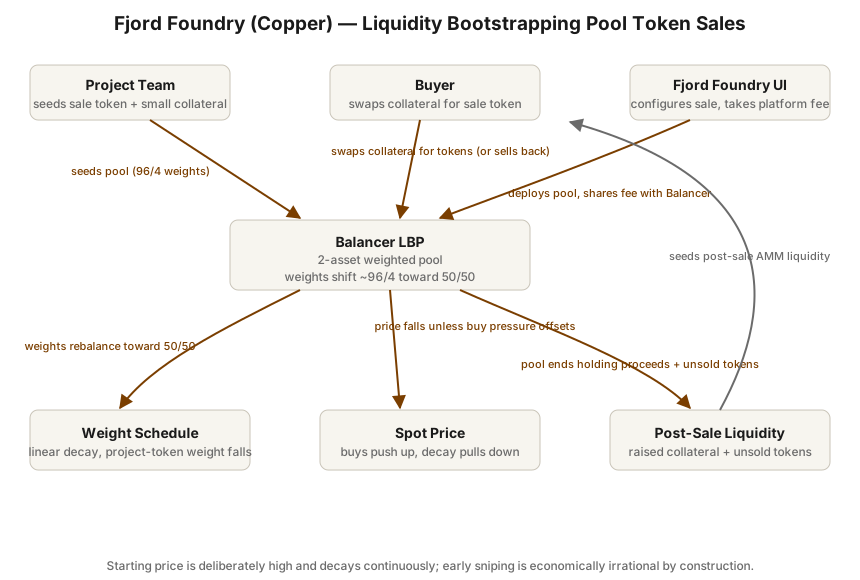 Open full-size diagram
Summary
Copper Launch — rebranded to Fjord Foundry in September 2022 — is the platform that made Balancer's Liquidity Bootstrapping Pools (LBPs) the default "fair launch" mechanism of the 2021–2024 cycles. Incubated within the Alchemist community in 2021, Copper built a consumer-grade frontend over Balancer's weighted-pool contracts so any project could run a multi-day, falling-price token sale without writing code. The mechanism inverts the usual launch dynamic: the sale starts at a deliberately high price that decays continuously unless buy pressure pushes back, punishing snipers and bots and rewarding patience. The platform hosted landmark sales (Merit Circle's $105M raise in November 2021, Autonolas/OLAS, RSS3) as well as the era's largest reported LBP loss (AnubisDAO, ~13,556 ETH lost mid-sale in October 2021 when the raised funds left the project's multisig within hours of the sale ending). By 2024–2026 Fjord reported over $1B raised and 100k+ participants across Ethereum, major L2s, and Solana, and completed the loop by selling its own FJO token via an LBP on its own platform ($15.35M, April 2024).
Design (Mechanism)
An LBP is a two-asset Balancer weighted pool whose weights shift over the sale's duration:
- Start weights heavily favor the sale token (commonly ~96/4 or 99/1 project-token/collateral), which sets an artificially high initial spot price with minimal collateral seeded by the team.
- Weights linearly rebalance toward the collateral (e.g., ending 50/50 or lower) over the sale window (typically 2–3 days). Absent trades, the spot price falls continuously — a smooth Dutch-auction analogue implemented as an AMM.
- Buys push price up, decay pulls it down. Equilibrium emerges where marginal-buyer willingness to pay meets the decay curve, producing genuine price discovery rather than an oversubscribed fixed price.
- Anti-sniping by construction: buying in the first blocks means paying the maximum price, so gas wars and bot sniping are economically irrational rather than merely prohibited.
- Because sales are AMM pools, participants can also sell back into the pool during the event (projects can optionally restrict this), and the pool ends holding the raised collateral plus unsold tokens, which can seed post-sale liquidity.
Copper monetized via a platform fee on raised proceeds and, after a 2022 agreement formalizing terms with Balancer Labs, shared revenue with the underlying protocol. The rebranded Fjord expanded the menu: NFT LBPs ("Fjord Drops," 2022), fixed-price and tiered sales, permissionless "Community Sales" alongside curated "Partnered Sales," multichain deployment (Ethereum, Arbitrum, Base, Optimism, Avalanche, BNB, Blast, Polygon, Solana), and cross-chain participation via Axelar. In 2024 Fjord added its own token (FJO) with staking that routes a share of platform fees to stakers; the token/staking contracts were put through a Cyfrin CodeHawks audit contest (Aug 2024).
Outcome
Ongoing. The platform survived two brand identities, a bear market, and reputational shrapnel from third-party rugs. Verified markers: Merit Circle's ~$105M LBP (largest of the 2021 cycle); AnubisDAO's ~$60M loss on a Copper-hosted LBP (the failure was the project's key management, not the pool mechanism — Copper published a statement distancing the permissionless platform from the incident); the September 2022 rebrand; a $4.3M seed round (Mechanism Capital, Lemniscap, March 2024); the FJO LBP raising ~$15.35M in April 2024 — then the largest LBP of that year; and site-reported cumulative stats of $1B+ raised and $1.5B+ volume. The LBP format Copper popularized became standard infrastructure copied by many launchpads.
Why it worked
- It solved a real, painful problem: fixed-price IDOs in 2021 were bot-sniped lotteries. LBPs' start-high/decay-down curve made front-running self-defeating, so distribution actually reached patient humans.
- Capital efficiency for founders: teams could bootstrap a sale with a tiny collateral seed (2–4% of pool value) instead of pre-funding deep liquidity.
- Composability leverage: Copper didn't build an AMM; it wrapped audited Balancer contracts with UX, letting a small team ship a category-defining product and later negotiate an aligned revenue split rather than compete with its dependency.
- Honest price discovery as marketing: a multi-day public auction where "the market picks the price" was legible and defensible to communities burned by insider pricing.
Limitations and criticisms
- Permissionlessness imports bad outcomes: AnubisDAO's ~$60M loss and other low-quality dog-coin LBPs made "Copper launch" briefly synonymous with counterparty risk; the platform can host price discovery but cannot underwrite counterparty honesty, which pushed a later shift toward curation ("Partnered Sales").
- LBPs price fairly but don't guarantee upside: many tokens (including FJO itself, which closed its sale at $2.32 versus a $5.36 start) have traded below sale clearing prices afterward, since LBPs extract close-to-maximum willingness-to-pay at launch.
- Mechanism literacy tax: naive buyers who buy early at peak prices systematically overpay, inverting the "fair to retail" narrative for anyone who doesn't understand weight decay.
- The 2022 rebrand resolved a naming collision with the custodian Copper.co — a branding overlap external to the LBP mechanism itself, not a mechanism flaw.
Lessons
- Auction mechanisms can neutralize bots economically instead of technically: making early purchase the worst strategy is more robust than allowlists or captchas.
- A launch platform's reputation is hostage to its worst customer. Permissionless infrastructure plus fundraising means bad-faith or poorly-secured projects get distribution unless curation, escrow, or accountability layers are added; Copper learned this via AnubisDAO.
- Fair price discovery and buyer profit are different promises. Clearing at the market's true price means little post-listing upside; platforms should set that expectation or face churn.
- Building atop someone else's audited contracts is a legitimate moat if you own the demand side — but formalize the economic relationship early (Copper/Balancer terms came only after the platform was already significant).
- Dogfooding is the strongest credential: Fjord selling FJO through its own LBP was both a stress test and a marketing proof.
Redesign (EDITORIAL — hypothesis, not fact)
This section is editorial hypothesis, not established fact. A modern redesign would keep the weight-decay auction but attack the two failure surfaces: counterparty risk and post-sale price collapse. First, make rug-resistance structural: raised collateral streams to the project via a vesting escrow (e.g., 0xSplits/Sablier-style) with a community-triggerable clawback during an initial window, so an AnubisDAO-style multisig compromise or exit cannot drain proceeds in one transaction. Second, smooth the "winner's curse": commit a fixed share of proceeds into a locked post-sale AMM position at the clearing price, and refund buyers pro-rata from a reserve if TWAP falls more than X% below clearing within 30 days — converting the platform's fee from a toll into partial underwriting. Third, replace binary curation with staked reputation: listers (including third-party scouts) bond FJO that is slashed on verified fraud, creating a decentralized underwriting market instead of a trust-us "Partnered" label. The open question is whether founders would accept escrowed proceeds; in bull markets, capital is impatient and the least-restrictive venue tends to win flow.
Sources
- Fjord Foundry official site — primary (docs)
- Fjord Foundry Docs — Liquidity Bootstrapping Pools (LBPs) — primary (docs)
- Discovery Starts Here — Fjord Foundry (rebrand announcement, Sept 2022) — primary (retrospective)
- Fjord, a project incubated by Alchemist (Alchemist docs) — primary (docs)
- Copper and Balancer Align On Terms (Copper Medium) — primary (governance)
- A statement from the Copper team regarding the AnubisDAO LBP on Copper — primary (retrospective)
- Record-Breaking Liquidity Bootstrapping Pool by Merit Circle (Balancer Medium) — primary (analysis)
- AnubisDAO's rug-pulled 13.5K ETH washes away on Tornado Cash (Cointelegraph) (news)
- Token launchpad Fjord Foundry raises over $15 million in its token pre-sale (Crypto Briefing) (news)
- Fjord Foundry raises $15m for its FJO token (DL News) (news)
- Cyfrin CodeHawks audit repo — Fjord token & staking contracts (2024) — primary (audit)
- FJO token contract (Etherscan) — primary (contract)
- Copper Rebrands to Fjord Foundry, Launches NFT LBP Product Fjord Drops (TokenInsight) (news)
Related experiments
Last verified: 2026-07-26 · Spot an error? Suggest a correction