Basis Cash
A seigniorage-shares algorithmic stablecoin that revived the shut-down Basis (Basecoin) design on Ethereum using a three-token bond/share mechanism to hold a $1 peg.
▶ Run interactive simulation animated mechanism with editable parameters
How it works onchain
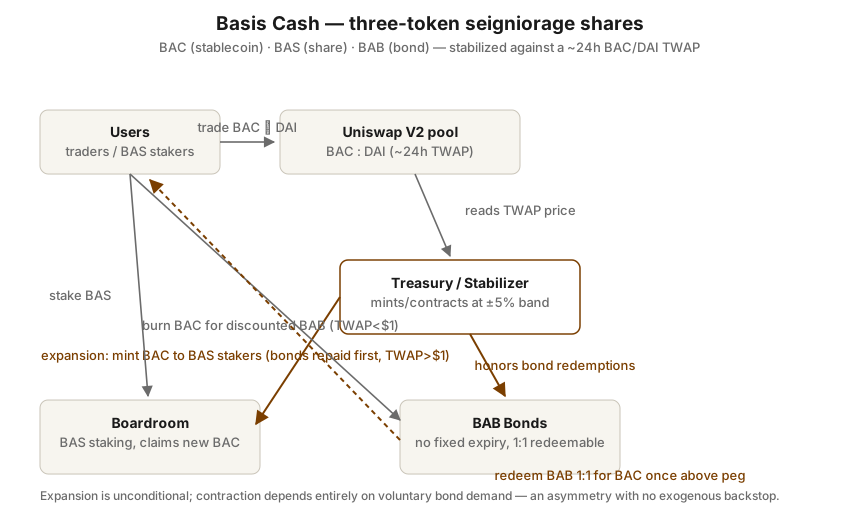 Open full-size diagram
Summary
Basis Cash was an algorithmic (undercollateralized) stablecoin that launched on Ethereum on 29–30 November 2020. It was an open, permissionless revival of the original Basis project (formerly Basecoin), a venture-funded stablecoin that raised roughly $133M before shutting down in late 2018 and returning capital when U.S. securities regulators signaled that its bond and share tokens would be treated as securities. Basis Cash reimplemented that "seigniorage shares" design as an ownerless smart-contract system with no VC funding and no pre-mine, distributed entirely through liquidity mining. It rode DeFi Summer momentum to roughly $159.5M in TVL within two days of launch. The protocol was built by pseudonymous developers using the "Rick and Morty" aliases "Rick Sanchez" and "DeFi Morty"; CoinDesk later reported (via ex-Terraform Labs colleagues, including engineer Hyungsuk Kang) that Terra's Do Kwon operated as "Rick" and proposed the core token model. Basis Cash never durably held its $1 peg, broke down in early 2021, and its BAC token subsequently traded far below peg — an early, instructive failure of the pure seigniorage-shares stablecoin design.
Design (Mechanism)
Basis Cash used a three-token seigniorage model designed to expand and contract stablecoin supply algorithmically rather than by rebasing balances:
- BAC (Basis Cash) — the stablecoin, targeted at 1 DAI (a proxy for $1). Supply is elastic.
- BAB (Basis Bonds) — debt instruments used to contract supply. No fixed expiry; priced at a discount when BAC is below peg.
- BAS (Basis Share) — the equity/seigniorage-capture token. Holders stake BAS in the "Boardroom" to claim newly minted BAC during expansions.
A ~24-hour Uniswap v2 BAC–DAI time-weighted price was the oracle. The stabilizer acted when price left a band of (1 ± ε) DAI, with ε initially 0.05:
- Above peg (BAC > $1): the protocol mints new BAC. Minted supply first repays outstanding bonds, then the remainder is distributed to BAS stakers in the Boardroom. Recipients are expected to sell BAC, adding sell pressure to push price back toward $1.
- Below peg (BAC < $1): BAC holders may buy BAB bonds using BAC (which burns BAC, contracting supply). Each bond is redeemable 1:1 for BAC later — but only once price is back above peg and only while the treasury has enough newly minted BAC to honor redemptions. Buying discounted bonds is the incentive to remove BAC from circulation during contractions.
Distribution was fully "fair-launch": ~50,000 BAC seeded over five days to depositors of DAI/yCRV/USDT/sUSD/USDC, and 1,000,000 BAS farmed via Uniswap pools (750k to BAC–DAI, 250k to BAC–BAS). There was no admin premine and no allocated founder/VC stake, which the team framed as "basis.io without regulatory risk." (A later BASv2 share token at 0x1065… was deployed as part of subsequent iterations.)
Outcome
Outcome status: failed. After an explosive launch (TVL peaking near $159.5M around 1 December 2020), Basis Cash could not sustain its peg. The core weakness surfaced quickly: during prolonged periods below $1, the only mechanism to contract supply was bond issuance, and bonds are worthless unless the market believes BAC will return above peg. Once confidence eroded, few wanted to buy bonds, redemptions could not be honored, and BAS (the seigniorage-capture token) collapsed because there were no expansions to reward. BAC de-pegged in early 2021 and drifted to a small fraction of a cent over time; BAS lost the overwhelming majority of its value. The protocol was never exploited in the smart-contract sense — it failed economically. Its design directly influenced a wave of imitators (Empty Set Dollar, Dynamic Set Dollar, and the "Tomb" fork family), most of which met similar fates, cementing seigniorage-shares as a cautionary pattern. The reported Do Kwon linkage later gained significance as a design lineage predating Terra/UST's much larger 2022 collapse.
Why it worked
For a brief window, Basis Cash "worked" as a coordination and incentive engine:
- Credible fair launch. No premine, no VC allocation, and open contracts attracted DeFi-native capital and gave the token an egalitarian narrative during a yield-hungry market.
- Attractive early yields. Boardroom seigniorage during above-peg expansions and rich BAS farming APRs pulled in liquidity fast, bootstrapping deep Uniswap pools and $150M+ TVL almost overnight.
- Reflexive upside phase. While BAC traded above $1, the flywheel was self-reinforcing: high share price → more staking → more seigniorage claims → more attention and liquidity.
Where the design broke
- Asymmetric stabilization. Expansion (minting to shareholders) is easy and reflexive; contraction depends entirely on people voluntarily buying bonds — a bet on recovery that evaporates precisely when it's needed most.
- Reflexivity cuts both ways. The same feedback loop that inflated BAS on the way up destroyed it on the way down; below peg, there were no seigniorage rewards, so shareholders had no reason to defend the system.
- No exogenous collateral / lender of last resort. Purely endogenous value meant nothing backstopped BAC in a confidence crisis — a "death spiral" was always latent.
- Mercenary liquidity. Capital chased APR, not peg stability, and exited immediately once expansions stopped.
- Weak peg proxy and band design. Using DAI-denominated Uniswap TWAP plus a 5% dead-band tolerated meaningful drift and was gameable relative to a true $1 target.
Lessons
- Seigniorage-shares stablecoins are structurally fragile. A design whose contraction mechanism relies on speculative demand for its own future recovery has no defense in a crisis of confidence; the peg is only as strong as belief in eternal growth.
- Reflexive incentives are a bull-market illusion. Yields that look like organic demand are often just capital rotating into inflationary reward tokens; when expansion halts, the incentive structure inverts and accelerates collapse.
- Endogenous-only backing invites death spirals. Robust pegs need exogenous collateral, redemption guarantees, or circuit breakers — not merely a companion "equity" token that is itself worthless when most needed.
- Fair launches earn attention but not durability. No premine and open governance built trust, but decentralization did not substitute for sound monetary mechanics.
- Lineage matters. Basis Cash was an early rehearsal of the same class of failure that later destroyed a multi-billion-dollar system (Terra/UST); the pattern was legible in 2020–21 for anyone reading the mechanism.
Redesign (EDITORIAL — hypothesis, not fact)
The following is the researcher's editorial hypothesis, not established fact.
If rebuilt today, the most defensible version of Basis Cash would abandon the pure endogenous seigniorage loop in favor of a collateral-anchored, reflexivity-dampened design. Concretely: (1) introduce a partial exogenous collateral reserve (e.g., a growing fraction backed by DAI/USDC or a diversified basket), evolving from the fractional-algorithmic model that Frax pioneered, so BAC has a hard floor and a credible redemption path rather than only speculative bond demand. (2) Replace unbounded bonds with capped, time-decaying redemption claims priced by a mechanism that cannot promise more redemption than reserves plus realistic future seigniorage can honor — removing the implicit infinite-liability that fuels death spirals. (3) Add automatic circuit breakers: if BAC trades below a hard threshold for a sustained window, expansion privileges and share rewards pause and reserves are deployed to buy back and burn BAC directly, converting shareholder subsidy into peg defense. (4) Use a manipulation-resistant multi-source oracle (Chainlink plus TWAP, priced against USD not just DAI) with a tighter band. (5) Redesign share economics so BAS accrues real fee revenue (mint/redeem fees, reserve yield) rather than pure inflation, so the equity token retains value in contractions and shareholders are structurally motivated to defend the peg. The honest conclusion, however, is that these changes converge toward well-collateralized or hybrid stablecoins — which suggests the original pure seigniorage-shares thesis may simply be unsalvageable, and the redesign's real lesson is knowing when a mechanism should be retired rather than patched.
Sources
- 'Basis Cash' Launch Brings Defunct Stablecoin Into the DeFi Era (CoinDesk) (news)
- UST's Do Kwon Was Behind Earlier Failed Stablecoin, Ex-Terra Colleagues Say (CoinDesk) (news)
- An interview with Basis Rick, the anon developer resurrecting DeFi protocol Basis (CryptoSlate) (retrospective)
- Basis Cash official website — primary (docs)
- BAC Token Contract (Etherscan) — primary (contract)
- BAS Token Contract (Etherscan) — primary (contract)
- Basis Cash - IQ.wiki (analysis)
Related experiments
Last verified: 2026-07-26 · Spot an error? Suggest a correction