Echo (Sonar)
Cobie's Echo launched Sonar, a self-hosted public token-sale ('ICO 2.0') product with configurable compliance and attested-KYC privacy, whose debut Plasma (XPL) sale raised over $370M against a $50M target.
▶ Run interactive simulation animated mechanism with editable parameters
How it works onchain
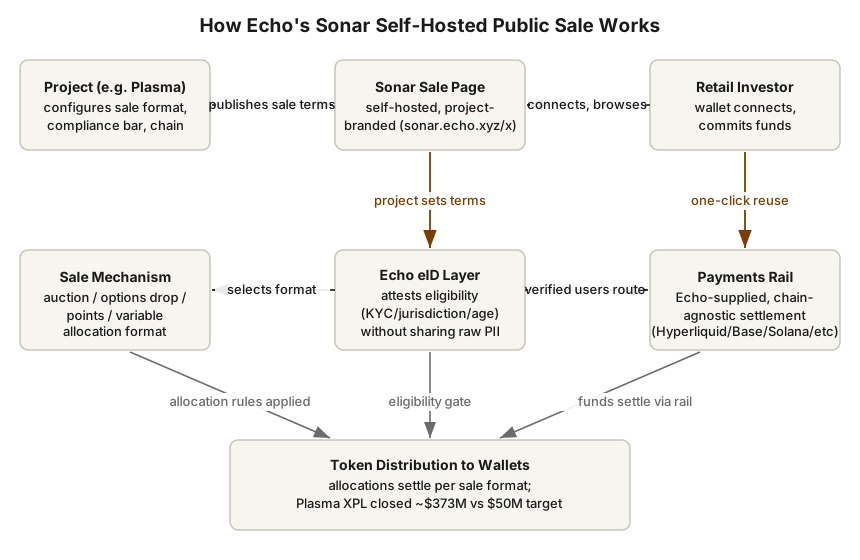 Open full-size diagram
Summary
Echo is an onchain capital-formation platform founded by crypto trader/influencer Jordan "Cobie" Fish, best known for letting founders raise "community rounds" directly from their X/Discord followings without a traditional VC syndicate. On May 27, 2025, Echo launched Sonar, a self-hosted public token sale ("ICO 2.0") product that lets any project run its own compliant public offering — choosing the sale format, compliance bar, and chain — while Echo supplies the underlying attestation and payments rails. Sonar's flagship launch was the Plasma (XPL) stablecoin-chain sale in June 2025, which targeted $50M and closed with roughly $373M in commitments, more than 7x oversubscribed, selling out its $500M valuation cap in around 40 minutes. Echo (including Sonar) was acquired by Coinbase in October 2025 for approximately $375M, about 18 months after Echo's founding.
Design (Mechanism)
Sonar is positioned as the complement to Echo's original "Rounds" product: Rounds are for founders without an existing audience (Echo helps source investors), while Sonar is for founders who already have a large community and want to run their own public sale without needing Echo's curation or approval. Key mechanism elements:
- Self-hosting: any project can spin up a public sale page under its own branding (e.g., sonar.echo.xyz/plasma) and configure the terms itself, rather than applying to a gatekept launchpad.
- Configurable sale formats: Sonar supports multiple sale primitives out of the box — Dutch/English-style auctions, "options drops," points-based allocation systems, and sales with variable valuations and allocation sizes — letting founders pick a format suited to their community and token-economics goals.
- Chain-agnostic: sales can be run for tokens on Hyperliquid, Base, Solana, Cardano, and other chains rather than being locked to one settlement layer.
- Configurable compliance: founders set their own risk tolerance for KYC/AML and jurisdictional restrictions (e.g., excluding U.S. persons) rather than a one-size-fits-all compliance policy.
- eID attestation for privacy: Echo's "eID" identity-attestation layer lets Sonar attest that a user meets a project's eligibility bar (age, jurisdiction, accreditation, sanctions screening) without necessarily handing the user's underlying personal data to the project itself. Users who already have an Echo account can reuse that identity to register for a new sale with one click, rather than repeating KYC per project.
This design tries to thread a needle: give projects a "compliant ICO" mechanism for raising from the retail public directly (something that mostly disappeared after the 2017-18 ICO boom), while preserving some of the low-friction, permissionless spirit of the original ICO era and protecting investor privacy from data-hungry project teams.
Outcome
Sonar's debut sale, for the Plasma stablecoin-focused L1 (XPL token), launched in June 2025 targeting $50M at a $500M fully-diluted valuation. Demand vastly exceeded the target: the sale was oversubscribed roughly 20x by some reports, hit its subscription cap of $500M in about 40 minutes, and ultimately recorded around $373M in total commitments from over 1,000-2,900 participating wallets (reports vary on wallet count), with a median allocation near $35,000. Plasma had already lined up backers including Peter Thiel's Founders Fund and Tether's CEO ahead of the public round. The launch was widely covered as a signal that "ICO 2.0" — compliant, self-hosted public sales — had real retail demand again. Roughly 18 months after Echo's 2024 founding, Coinbase acquired Echo (Sonar included) for approximately $375M in October 2025, with Sonar's infrastructure being folded toward Coinbase's broader onchain capital-markets push while Echo continued operating with some independence.
Why it worked
- Existing distribution and trust: Cobie's personal following and Echo's prior track record (helping projects raise across hundreds of deals, including a notable MegaETH community round) gave Sonar instant credibility and an audience of engaged crypto-native investors.
- Genuine unmet demand: retail crypto investors had had very limited low-friction ways to buy into hot new tokens pre-listing since the end of the 2017-18 ICO era; Sonar reopened that channel with compliance guardrails, and Plasma's marquee backers (Thiel, Tether) created FOMO.
- Privacy-preserving compliance: the eID attestation model reduced a major friction point (repeated KYC data handovers) that hurt earlier public-sale platforms, making participation feel closer to a one-click experience for repeat users.
- Flexible tooling: letting each project choose its own sale mechanic (auction, points, fixed-price) meant Sonar could fit varied token-economics strategies rather than forcing one format.
Limitations and criticisms
Structural critiques worth noting: extreme oversubscription (20x+) meant most participants received only a small fraction of the allocation they requested, generating frustration comparable to gas-war/FCFS launchpad sales it was meant to improve on; and the long-run success of subsequent (non-Plasma) sales run through Sonar is less documented publicly, making it hard to judge whether the Plasma result generalizes or was a one-off driven by a uniquely hyped project and backers.
Lessons
- Reputation and existing community trust (a known operator with a track record) can substitute for a traditional VC-vetting layer as a demand-generation and quality-signaling mechanism for token sales.
- Identity attestation (proving eligibility without transferring raw personal data) is a workable middle path between "no KYC" (regulatory risk) and "full KYC handed to every project" (privacy risk, data-breach surface).
- Massive oversubscription is itself a design problem, not just a marketing win — allocation mechanisms (auctions, points, lockups) matter as much as the compliance layer in determining whether a "successful" sale actually produces a healthy, fairly distributed token holder base.
- A single high-profile, well-backed launch (Plasma) can validate an entire platform's thesis fast enough to attract a strategic acquirer (Coinbase) within about 18 months of the company's founding.
Redesign (EDITORIAL)
EDITORIAL — hypothesis, not fact. If oversubscription and skewed allocation are the main residual problem, a redesigned Sonar could default new sales to a Dutch-auction or clearing-price mechanism (rather than fixed-price, first-come-first-served-adjacent points systems) so price discovery absorbs excess demand rather than allocation lottery/rationing doing so. Pairing that with reputation-weighted allocation caps (e.g., higher per-wallet caps for eID-attested long-time Echo/Sonar participants, lower caps for brand-new wallets) could reduce Sybil-driven demand inflation while still keeping the sale genuinely open to newcomers. A second hypothesis: publish standardized, comparable post-sale disclosures (allocation distribution, fill rates, wallet concentration, time-to-cap) across all Sonar sales, not just the headline ones, so the "compliant ICO market" claim can be evaluated on aggregate data rather than one viral outlier like Plasma.
Sources
- Introducing Sonar — Echo's Substack — primary (primary)
- Sonar by Echo — Your eID for public sales — primary (primary)
- Coinbase Buys Startup Fundraising Firm Echo for $375M — CoinDesk (news)
- Founders Fund, Peter Thiel Back Plasma as Cobie's Sonar Kicks Off $50M XPL Token Sale — CryptoRank (news)
- Plasma Public Sale Ends With $373 Million in XPL Commitments — Unchained (news)
- Coinbase acquires Echo: Unlocking the future of onchain capital formation — primary (primary)
Related experiments
Last verified: 2026-07-27 · Spot an error? Suggest a correction