Aragon Fundraising (ABC)
Aragon Black's DAICO-style continuous-fundraising suite for Aragon DAOs — a batched Bancor bonding curve plus a governable 'tap' — that was deprecated as a product but powered Aavegotchi's $30M+ GHST token sale for 2.5 years.
▶ Run interactive simulation animated mechanism with editable parameters
How it works onchain
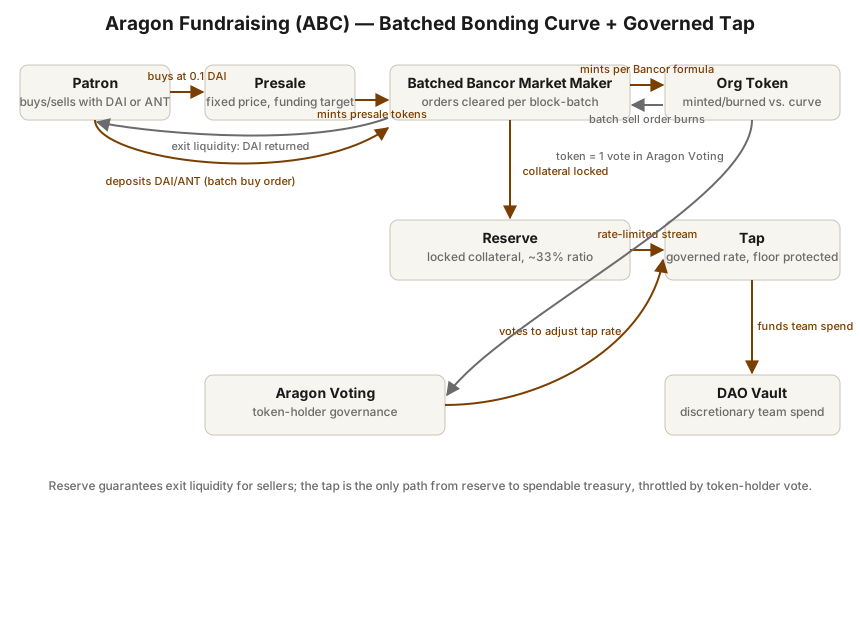 Open full-size diagram
Summary
Aragon Fundraising (earlier codename "Apiary," widely associated with the Augmented Bonding Curve / "ABC" design) was a suite of Aragon apps that let a DAO run continuous, accountable fundraising instead of a one-shot ICO. It was built by Aragon Black — the third Aragon "Flock" team, formed from the Pando Network team after their AGP-34 Flock proposal was approved in Aragon Network Vote #2 (2019), with roughly $450k DAI + 125k ANT requested for two quarters of work. The design explicitly implemented Vitalik Buterin's DAICO concept and Luke Duncan's "emergent organizations" research: patrons buy an org-specific token from a bonding-curve automated market maker, most collateral stays locked in a reserve guaranteeing exit liquidity, and the team can only draw funds through a token-holder-governed "tap." The code was audited by ConsenSys Diligence (November 2019) and reached Ethereum mainnet as an Aragon template. As a product it never found broad adoption — Aragon Black wound down after withdrawing its funding renewal, the repo was archived in October 2021, and the template was deprecated — but its single flagship deployment, Aavegotchi's GHST launch (September 14, 2020), ran for two and a half years, took in roughly $30M DAI, and remains one of the most complete real-world DAICO executions on record.
Design (Mechanism)
The suite composed four Aragon apps on aragonOS's permission system:
- Presale. A fixed-price initial period with a fundraising target; Aavegotchi, for example, presold 500,000 GHST at 0.1 DAI before the curve opened at 0.2 DAI.
- Batched Bancor market maker (the bonding curve). An AMM that mints the org token when users deposit collateral (DAI and/or ANT supported) and burns it on exit, priced by the Bancor formula against a reserve with a configurable reserve ratio (Aavegotchi used ~33%). Crucially, buy and sell orders were batched over a parametrizable number of blocks and cleared at a common price — a deliberate anti-front-running measure, years before MEV mitigation was standard vocabulary.
- Tap. The DAICO element. The curve's reserve cannot be spent by the team; a tap contract streams a token-holder-adjustable rate (with a protective floor on the reserve) into a discretionary vault the DAO controls. Patrons therefore hold two levers: sell into the curve (exit with guaranteed liquidity) or vote the tap down (throttle the team).
- Controller/API app tying the pieces to Aragon Voting, so tap changes and parameter updates were on-chain governance actions.
The split between a liquidity-guaranteeing reserve and a rate-limited discretionary pool was the core accountability invariant: funders were structurally protected from a rug or a spend-it-all team for the entire life of the curve.
Outcome
Mixed, and best read on two levels. Product level: Aragon Black shipped the suite, passed a ConsenSys Diligence audit (Nov 2019), and launched on Rinkeby and mainnet, but the team withdrew its Flock funding renewal and dissolved; the GitHub repo was archived on October 22, 2021 and Aragon's legacy docs list the Fundraising template as deprecated and unmaintained. Adoption beyond a handful of orgs never materialized (though forks such as galtproject's, and spiritual descendants like Commons Stack/1Hive ABCs, carried the idea forward). Deployment level: Aavegotchi's GHST DAICO was a genuine success — presale plus curve raised roughly $30.3M DAI, GHST holders voted monthly on the tap to Pixelcraft Studios, the mechanism was never exploited, and the DAO closed the curve by vote on March 10–11, 2023 ("GHST Independence Day," coincidentally the day DAI depegged during the USDC/SVB crisis), redistributing the ~$33M reserve to liquidity, the DAO, Pixelcraft, and protocol rewards. Hence: technically successful, commercially unsuccessful as a product.
Why it worked
- The mechanism delivered its promises where deployed: continuous liquidity, no front-running scandals, no treasury rug, and a real, exercised accountability channel (Aavegotchi holders repeatedly voted on the tap).
- Building on aragonOS meant governance, permissions, and voting came free and composable; the tap was enforced by the same permission system as everything else.
- Batched order matching was a thoughtful, early answer to front-running on curves, and the reserve-ratio design guaranteed exit liquidity better than an orderbook listing would have.
- A serious audit and a credible flagship adopter (Aavegotchi, backed by Aave's ecosystem) gave the design legitimacy.
Where the design broke
- Team funding was upstream of product survival. Aragon Black depended on ANT-holder Flock grants; when it withdrew from renewal amid Aragon's fractious 2019–2020 governance era (the same period as the Autark/Aragon One dispute), maintenance ended regardless of the code's quality.
- Market timing. By 2020–2021, projects raised via Uniswap listings, IDOs, and liquidity mining — faster, more familiar, and without a tap constraining the team. A mechanism that deliberately limits founder access to funds is a hard sell to founders, who are the buyers of fundraising tooling.
- Complexity and UX. Four interlocking Aragon apps, batch-based trading, and curve parameters (reserve ratio, tap rate, floor) demanded sophistication from both teams and buyers; Aavegotchi had to build a custom UI on top.
- Bonding-curve reflexivity and collateral risk. A DAI-only reserve concentrated stablecoin risk — Aavegotchi's stated reason for closing the curve was to "derisk from DAI," dramatized by closing on the exact day of the depeg.
Lessons
- A mechanism can outlive its maker. The product died with its team's funding, yet its one big deployment ran flawlessly for 2.5 years — infrastructure success and vendor success are separate outcomes, and public-goods tooling needs sustainability plans beyond grant cycles.
- Accountability tech must be demanded by buyers, not just admired by designers. DAICO taps protect investors, but founders choose the fundraising stack; without regulatory or investor pressure requiring it, the market defaulted to unconstrained raises.
- Guaranteed exit liquidity changes holder behavior. The curve's always-on buyback floor let Aavegotchi weather bear markets without a liquidity death spiral — a property later "pool 2" token launches conspicuously lacked.
- Batching orders to a common clearing price was prescient MEV resistance (2019), anticipating the batch-auction logic later popularized by CoW-style protocols.
- Collateral choice is a hidden systemic dependency: a curve is only as safe as its reserve asset, as the DAI-depeg-day closure illustrated.
Redesign (EDITORIAL — hypothesis, not fact)
This section is editorial analysis — a hypothesis, not fact. A modern revival would keep the two load-bearing ideas — reserve-backed exit liquidity and a governance-throttled tap — and shed the 2019 stack. Implement the curve as a single audited contract (or a Uniswap v4 hook maintaining a protocol-owned floor position) rather than four coupled DAO apps; replace block-batching with an established batch-auction or intent layer for MEV resistance. Diversify the reserve (e.g., a basket of stables plus ETH LSTs with caps per asset) and publish the reserve policy on-chain to avoid single-collateral depeg risk. Make the tap a streaming primitive (Superfluid/Sablier-style) with a token-holder-adjustable rate and an automatic circuit breaker tied to reserve health. Finally, fix the adoption incentive: target the mechanism at contexts where funders have leverage to demand it — grants programs, public-goods rounds, and RWA/community raises — and offer founders a carrot, such as reputational certification and cheaper liquidity bootstrapping, so choosing accountability is not purely altruistic. The failure was distribution and incentives, not the curve math; a redesign should spend most of its effort there.
Sources
- Introducing Aragon Fundraising (Aragon blog) — primary (docs)
- AragonBlack/fundraising (archived source repo) — primary (contract)
- Bonding curve component docs (batched Bancor market maker) — primary (docs)
- ConsenSys Diligence audit: AragonBlack Fundraising (Nov 2019) — primary (audit)
- Aragon Flock proposal: Aragon Black (AGP-34, approved ANV#2) — primary (governance)
- Announcing pando's AGP proposal: Aragon Black — primary (governance)
- How Aavegotchi Used Aragon to Create a Metaverse Gaming Protocol — primary (analysis)
- GHST Token docs (Aavegotchi) — launched via Aragon Fundraising bonding curve — primary (docs)
- Aavegotchi wiki: The Curve (33% reserve ratio, closure 2023) — primary (docs)
- Cointelegraph: Aavegotchi bonding curve closes on exact day of DAI depeg (news)
- Aragon legacy docs: Fundraising template deprecated / not maintained — primary (docs)
Related experiments
Last verified: 2026-07-26 · Spot an error? Suggest a correction