Mastercoin / Omni Layer
The first ICO in crypto history — a 2013 crowdsale funding a metaprotocol layered on Bitcoin that later became the original home of Tether (USDT).
▶ Run interactive simulation animated mechanism with editable parameters
How it works onchain
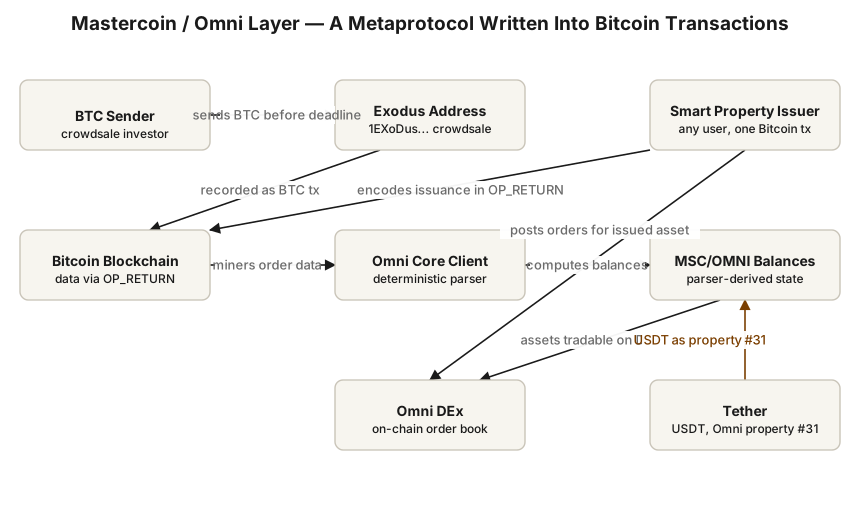 Open full-size diagram
Summary
Mastercoin was the project that invented the ICO. In January 2012, Seattle software engineer J.R. Willett published "The Second Bitcoin Whitepaper," arguing that new protocol features — user-issued currencies, savings wallets, decentralized exchange — could be built as a data layer on top of Bitcoin rather than as new altcoins, and that development could be funded by selling the layer's native token to the public. In July–August 2013 he did exactly that: anyone who sent BTC to a published "Exodus" address (1EXoDusjGwvnjZUyKkxZ4UHEf77z6A5S4P) before August 31, 2013 received 100 MSC per BTC (plus early-week bonuses). Roughly 500 participants sent in about 5,000+ BTC — around $500,000 at the time — making it the first token crowdsale in crypto history. The protocol was renamed Omni Layer in 2015, and its lasting claim to relevance is that Tether (USDT) — originally Realcoin, launched in 2014 — was issued as an Omni Layer asset on Bitcoin, making Omni the plumbing beneath the largest stablecoin for its first several years.
Design (Mechanism)
Mastercoin/Omni is a metaprotocol: it writes no smart contracts and changes nothing about Bitcoin consensus. Instead, Omni transactions are ordinary Bitcoin transactions carrying extra encoded data — originally stuffed into bare multisig outputs and fake addresses, later cleanly embedded via OP_RETURN. Bitcoin miners order and timestamp these transactions but are oblivious to their meaning; the Omni state (who owns which tokens) exists only in the eyes of Omni-aware software (the Omni Core client, a fork of Bitcoin Core, and services like Omniwallet and Omni Explorer) that scans the chain and applies the protocol's rules deterministically. Consensus is therefore "consensus-by-parser": every honest client applying the spec to the same blockchain must derive the same balances.
Key mechanisms:
- The Exodus crowdsale. BTC sent to the Exodus address before the deadline minted MSC at 100:1, with a declining time bonus rewarding early buyers. An additional 10% "Dev MSC" vested to the founding team over years to fund development — a template for nearly every token sale that followed.
- Smart properties. Anyone could issue a named, fixed-or-managed-supply token with a single Bitcoin transaction — years before ERC-20.
- Crowdsale-as-a-feature. Issuers could run their own token sales natively; MaidSafeCoin's April 2014 sale ran on Mastercoin, an ICO hosted on the ICO-inventing protocol.
- Decentralized exchange (DEx). On-chain order publication and matching for Omni assets against BTC — a functioning DEX design in 2013–14, executed entirely through Bitcoin transactions.
- Tether integration. USDT was issued as Omni property #31; for years, "sending USDT" meant sending a Bitcoin transaction with Omni data attached.
Outcome
Technically, the system worked and worked for a long time: the crowdsale completed, the protocol shipped, and Omni carried billions of dollars of USDT — it was the only USDT rail from 2014 until Ethereum issuance began in 2017, and the dominant one until ERC-20 USDT overtook it around 2019. Commercially and competitively, it lost. MSC/OMNI token value collapsed and never mattered again; Ethereum (whose crowdsale copied Mastercoin's playbook, and whose creator Vitalik Buterin briefly worked on Mastercoin ideas before concluding a general-purpose VM was better) captured the entire token-issuance market that Mastercoin pioneered. Bitcoin fees and slow confirmation made Omni USDT uncompetitive with Tron and Ethereum rails. Tether announced the wind-down of Omni USDT support (first in 2023, with a final halt of remaining legacy-chain support set for September 1, 2025), closing the protocol's last major use case. The 2015 rename from Mastercoin to Omni followed the wind-down of the original Mastercoin Foundation, whose 10% "Dev MSC" allocation had no on-chain vesting schedule or spending constraints, leaving fund use entirely to foundation discretion. Willett, notably, never became a crypto mogul — he returned to a day job, a fact he discusses openly in retrospectives.
Why it worked
- The ICO mechanism itself was a genuine invention: permissionless, global, non-dilutive protocol funding. It raised real money in 2013 and became the template for Ethereum (2014) and the entire 2017 cycle.
- Piggybacking on Bitcoin's security was free and real. Omni inherited Bitcoin's censorship resistance and uptime without needing its own validator set — which is exactly why Tether chose it as a credible-neutral issuance rail in 2014.
- Deterministic parser consensus was simple and auditable: no new chain, no new trust assumptions beyond running the reference client.
Where the design broke
- Bitcoin as a host was hostile ground: no expressiveness beyond fixed transaction types, data-embedding that bloated the UTXO set via bare multisig and drew objections from Bitcoin developers, high fees, and 10-minute blocks.
- Fixed-function vs. general-purpose: Ethereum's VM let developers invent mechanisms Mastercoin's spec authors hadn't enumerated. A metaprotocol whose feature set requires spec updates cannot compete with a platform whose feature set is user-defined.
- The native token had no durable value capture. Omni transactions pay fees in BTC to Bitcoin miners; MSC/OMNI was needed for almost nothing after the crowdsale, so the token — and the funding model — decayed.
- Fragile client monoculture: with state defined by the parser, any implementation divergence is a consensus failure, discouraging alternative clients and ossifying the project around one small team.
Lessons
- Distribution mechanisms outlive their inventors' platforms. Mastercoin's lasting contribution is the ICO itself, not the protocol; the copy (Ethereum) captured the value of the original's idea.
- Build where your users' next feature request can be satisfied. Fixed-function metaprotocols lose to programmable platforms because every new use case is a governance/spec negotiation instead of a deployment.
- A protocol token must be load-bearing. If fees flow to the host chain's miners and the token gates nothing, the token price — and with it the development treasury — goes to zero regardless of protocol usage.
- Being the rail for a killer app is not defensible if the app can migrate. Omni hosted Tether for years, but stablecoin issuers are multi-chain by nature; when fees rose, USDT simply left.
Redesign (EDITORIAL — hypothesis, not fact)
This section is editorial speculation. A modern redesign would (1) keep Bitcoin as the settlement/data layer but make the token load-bearing — e.g., fee-burn or bonding requirements for asset issuance denominated in the native token; (2) replace the informal parser monoculture with a formally specified state-transition function plus validity proofs (a BitVM-style or client-side-validation design à la RGB/Taproot Assets, which are effectively Omni's intellectual descendants); (3) fund development via ongoing protocol revenue rather than a one-shot crowdsale, avoiding the treasury-in-a-volatile-token failure mode that hollowed out the Mastercoin Foundation; and (4) launch with one anchor asset under contract (as Tether accidentally was) but with migration friction engineered in — issuer staking, redemption windows — so the anchor tenant cannot exit costlessly the moment a cheaper chain appears.
Sources
- Omni Layer official site — primary (docs)
- Omni Protocol Specification (GitHub) — primary (docs)
- Omni Core reference client (GitHub) — primary (contract)
- Omni Foundation blog archive (Mastercoin era, Nov 2013) — primary (archive)
- Bitcoin Magazine: Mastercoin — A Second-Generation Protocol on the Bitcoin Blockchain (Vitalik Buterin, Nov 2013) (analysis)
- Cointelegraph Magazine: J.R. Willett launched the first ICO… but still has a day job (retrospective)
- Forbes: Here's The Man Who Created ICOs (2017) (news)
- CoinDesk: Tether to Halt USDT on Omni, BCH, Kusama, EOS, Algorand (July 2025) (news)
- Omni Explorer — primary (docs)
Related experiments
Last verified: 2026-07-27 · Spot an error? Suggest a correction