Polkadot Parachain Crowdloans
Polkadot's trustless crowdfunding pallet let DOT/KSM holders lend tokens to back parachain candle-auction bids, locking billions of dollars for multi-year leases before the model was deprecated in favor of Agile Coretime.
▶ Run interactive simulation animated mechanism with editable parameters
How it works onchain
 Open full-size diagram
Summary
Parachain crowdloans were Polkadot's answer to a hard resource-allocation problem: relay-chain block space was scarce (a limited number of parachain "slots"), slots were sold via auction for leases of up to 96 weeks, and winning bids required locking tens of millions of DOT. Rather than let only VC-funded teams compete, the protocol shipped a native crowdloan pallet that let any token holder lend — not donate — DOT or KSM to a project's bid. If the project won, contributors' tokens stayed locked in a protocol-controlled account for the full lease and were returned automatically at expiry; teams compensated lenders with their own reward tokens. The mechanism debuted on Kusama in June 2021 (Karura won the first slot with over 500,000 KSM from 15,000+ contributors) and on Polkadot in November 2021, where Acala's winning crowdloan drew 32.5M DOT ($1.3B at the time) from over 81,000 contributors. By Q1 2022, 13 Polkadot auctions had locked roughly 127.8M DOT (~$2.9B, about 11% of supply). Demand and reward-token prices then faded, and in 2024 the entire auction/crowdloan model was deprecated in favor of Agile Coretime.
Design (Mechanism)
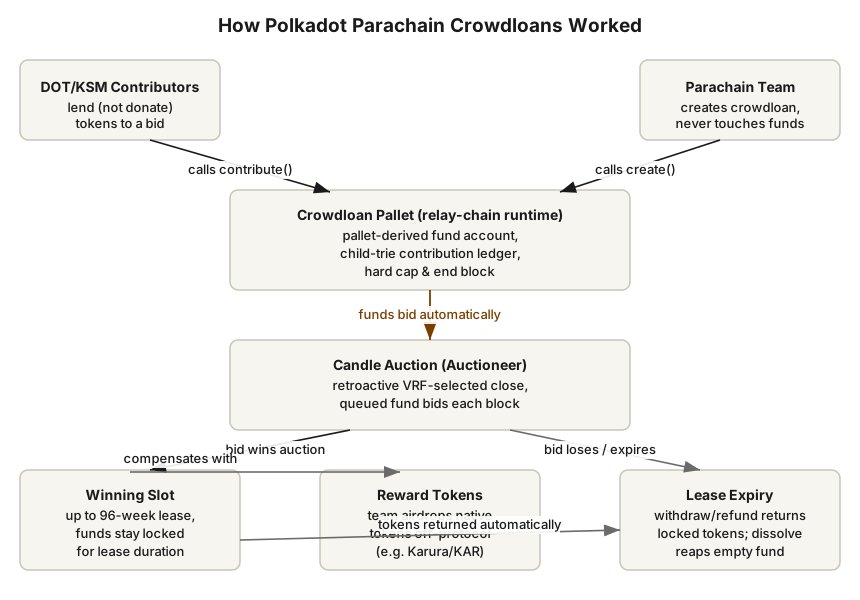
Trustless lending, not an ICO. A parachain team calls create on the crowdloan pallet, specifying a lease-period range, an end block, and a hard cap. Contributors call contribute; funds move into a pallet-derived fund account and each contributor's balance is recorded in a child trie for efficient later redistribution. The team never has custody. A protocol-enforced minimum contribution prevents dust accounts; optional signature gating let teams restrict contributors (e.g., for KYC).
Candle auctions. Slots were sold in repeated auctions (on Kusama: 7 days, a 2-day opening phase plus a 5-day "ending" phase). The true closing block was chosen retroactively using on-chain randomness — a digital version of the 17th-century candle auction — so bidders could not snipe at the last second and had to commit their best bid early. The crowdloan pallet implements an Auctioneer interface: queued funds bid automatically each block during the ending period.
Leases, not ownership. Winners received a lease of up to 8 lease periods (96 weeks on Polkadot at 12 weeks each; 48 weeks on Kusama at 6 weeks each). Locked crowdloan funds counted as the bid. At lease expiry, withdraw/refund return tokens to contributors (callable by anyone, batched under weight limits), and dissolve reaps the empty fund. Losing crowdloans unlock after the auction window closes.
Reward layer (off-protocol). Compensation for the lock-up was left entirely to teams: parachains airdropped native tokens on their own chains (e.g., Karura's minimum 12 KAR per KSM; Acala, Moonbeam, Astar, Parallel and others ran similar schemes, some with vesting and referral bonuses).
Outcome
The mechanism worked exactly as engineered: no crowdloan funds were stolen or lost at the protocol layer, refunds executed as designed, and dozens of parachains launched — the first five Polkadot parachains (Acala, Moonbeam, Parallel, Astar, Clover) went live together on December 17, 2021. Peak numbers were spectacular: ~$3.5B in DOT committed across the first wave of Polkadot auctions and 127.8M DOT locked by Q1 2022.
But economically it decayed. Most crowdloan reward tokens fell far below contributors' implied opportunity cost (foregone ~14% staking yield for up to two years, plus DOT's own drawdown through 2022). Later auctions attracted a fraction of early participation, some slots went barely contested, and teams increasingly self-funded bids. Gavin Wood proposed replacing the model at Polkadot Decoded in June 2023; RFC-1 "Agile Coretime" (merged August 12, 2023) swapped auctioned multi-year leases for monthly bulk coretime sales plus on-demand purchase. Coretime went live on Kusama and then Polkadot in 2024; crowdloans and slot auctions are formally deprecated, with legacy funds unlocking as their leases expire. Verdict: partial_success — a technically flawless mechanism whose economic premises (scarce slots, long leases) were themselves retired.
Why it worked
- Custody-free crowdfunding: the pallet held funds and guaranteed return, removing rug-pull risk at the fundraising layer — a genuine improvement on the 2017 ICO model.
- Candle auctions extracted honest bids and resisted sniping, while crowdloans converted community conviction directly into bidding power, letting community-heavy teams beat treasury-heavy ones.
- Aligned bootstrap: contributors became locked, long-horizon token holders of the parachains they backed, seeding user bases of 15k–81k+ wallets per chain at launch.
Where the design broke
- Opportunity cost was priced by teams, not the market: reward tokens routinely underperformed staking yield plus DOT beta, so rational participation collapsed after the first auction batch.
- Fixed 96-week leases misallocated capital: projects had to prepay (in locked community capital) for two years of block space regardless of actual usage, and faced a "lease cliff" refinancing problem.
- Slot scarcity taxed the ecosystem: billions in DOT sat idle as auction collateral instead of securing the network or funding development — the explicit motivation Wood cited for Agile Coretime.
- Winner-take-all auctions excluded small teams, pushing experimentation away from the ecosystem the mechanism was meant to grow.
Lessons
- Trustless, refundable crowdfunding is achievable at the protocol layer; the failure mode moved up the stack to the reward token's economics, which the protocol left unpriced.
- Selling long-duration leases via auction forces speculative capital lock-up; renting compute/block space close to time-of-use (coretime, rollup-as-a-service) prices it far more efficiently.
- Candle auctions are a practical, on-chain-verifiable anti-sniping design and remain one of the few production deployments of randomized-close auctions.
- A mechanism can be a technical success and still be retired: measure outcome against capital efficiency and sustained demand, not launch-day headlines.
Redesign (EDITORIAL — hypothesis, not fact)
This section is editorial hypothesis, not fact. Keep the trustless-lending pallet but shorten the commitment: contributors fund a rolling coretime-purchase escrow (renewed monthly) instead of a 96-week lock, with a per-epoch exit queue so capital reprices continuously. Require teams to post reward terms on-chain as enforceable vesting schedules (escrowed tokens released pro-rata to lenders), turning "trust the airdrop" into a protocol guarantee. Add an underwriting market: third parties could sell lenders insurance against reward-token underperformance versus staking yield, making the true cost of capital visible before the auction. Finally, replace winner-take-all slots with fractional coretime bids so smaller teams can buy partial throughput — essentially what Agile Coretime did, plus the retained crowdfunding layer that coretime dropped entirely.
Sources
- Crowdloan pallet source (polkadot-sdk, runtime/common/src/crowdloan) — primary (contract)
- Polkadot Support: Crowdloans FAQ (deprecation notice) — primary (docs)
- RFC-1: Agile Coretime (Gavin Wood, Polkadot Fellowship) — primary (governance)
- Polkadot blog: Overview of the First Five Parachain Slot Auctions on Kusama — primary (docs)
- Gavin Wood: Polkadot 2023 Roundup (coretime rationale) — primary (retrospective)
- CoinDesk: Acala Wins First Polkadot Parachain Auction, With $1.3B in DOT Committed (news)
- CryptoPotato: Almost 130 Million DOT Locked in Parachains as of Q1 2022 (analysis)
- Blockworks: Polkadot rethinks the economics of parachain auctions (news)
Related experiments
Last verified: 2026-07-27 · Spot an error? Suggest a correction