Reality.eth
A crowd-sourced on-chain oracle that resolves real-world questions through a bonded escalation game backstopped by a pluggable arbitrator.
▶ Run interactive simulation animated mechanism with editable parameters
How it works onchain
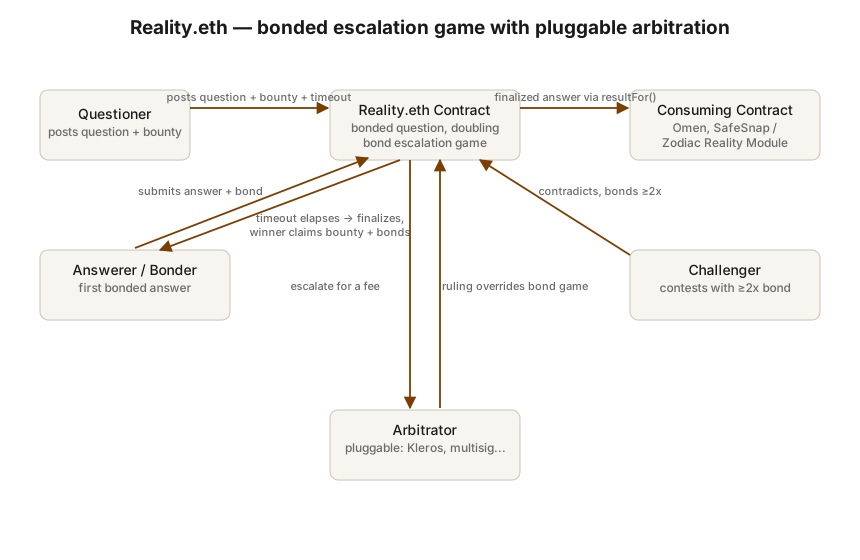 Open full-size diagram
Summary
Reality.eth (originally launched as "Reality Check," and formerly branded Realitio) is a crowd-sourced on-chain oracle that answers arbitrary real-world questions for smart contracts. It was announced on mainnet on 10 October 2017 by Edmund Edgar, operating through his Japanese company Social Minds Inc. (KK), and grew out of his earlier "Reality Keys" service, which he described as a "certificate authority for facts."
Rather than relying on a trusted price feed or a hard-coded data source, Reality.eth builds a cryptoeconomic game in which anyone can ask a question (attaching a bounty and a timeout), anyone can propose an answer by posting a bond, and any disagreement is resolved by an escalating auction of bonds — with a pluggable "arbitrator" contract as the ultimate backstop. This general-purpose design let it become foundational plumbing for prediction markets (Gnosis/Omen), Kleros-arbitrated disputes, and — most consequentially — optimistic DAO governance via SafeSnap and the Zodiac Reality Module, which let off-chain Snapshot votes trigger on-chain execution on a Gnosis Safe.
Design (Mechanism)
The core object is a bonded question. A questioner posts a question (encoded to a template — boolean, single-select, multi-select, uint, etc.), a bounty, and an answer-finalization timeout.
- Answering with a bond. Anyone can submit an answer accompanied by a bond. To contradict the current answer, a challenger must submit a different answer with at least double the previous bond. Each new answer resets the finalization timeout.
- Escalation (doubling) game. Bonds keep doubling as parties disagree. Because overturning the current answer always costs strictly more than the bond already at risk, an honest majority (or a well-capitalized honest party) can make it economically irrational to keep pushing a false answer. The mechanism assumes truth is a Schelling point that rational bonders converge on.
- Finalization. If the timeout elapses with no higher bond, the last answer becomes final and is readable on-chain by any consuming contract. Whoever gave the final answer collects the bounty plus all the bonds posted by people who gave different (losing) answers; losers forfeit their bonds.
- Arbitration backstop. Any question can name an arbitrator contract. For a fee, a party can escalate to the arbitrator, whose ruling overrides the bond game. The arbitrator is deliberately pluggable: it can be a single trusted account, a multisig, or a decentralized court — Kleros became the canonical decentralized arbitrator, reporting jury verdicts back into Reality.eth.
The contract stores only compact state (current answer, current bond, history hash, timeout) and exposes read functions like resultFor, so downstream contracts consume finalized answers cheaply. Over time the contract evolved through versions (Realitio → RealityETH-2.x → RealityETH-3.0, with the ERC-20-bond variant used by DAOs); the RealityETH-3.0 mainnet instance is at 0x5b7dD1E86623548AF054A4985F7fc8Ccbb554E2c.
Outcome
Reality.eth is one of the longest-lived, still-operating pieces of Ethereum oracle infrastructure. It has been deployed across many chains (Ethereum, Gnosis Chain, Polygon, Arbitrum, Optimism, BNB Chain, Base, Celo, Avalanche, Polygon zkEVM and others), with per-chain and per-bond-token instances.
Its adoption came less from being a headline consumer product and more from becoming embedded middleware:
- Prediction markets: Gnosis's Omen used Reality.eth for market resolution, with Kleros as optional final arbitrator.
- Dispute resolution: the Reality.eth + Kleros pairing became a standard "oracle with a decentralized court behind it."
- DAO governance: SafeSnap (Gnosis) and the Zodiac Reality Module (Gnosis Guild) use Reality.eth so that a passing Snapshot vote can be committed on-chain and, after a challenge/cooldown window, executed by a Gnosis Safe — enabling gas-free voting with trust-minimized execution.
There is no publicly known catastrophic exploit of the core Reality.eth escalation contract. The project ran a bug bounty and published audits. Given its longevity, multi-chain deployment, and role underpinning other major protocols, its outcome is best classified as major_success as infrastructure — while noting it was never a token-driven or revenue-maximizing venture.
Why it worked
- Generality. By answering arbitrary templated questions instead of a fixed data type, it served prediction markets, insurance, and governance from one primitive.
- Pluggable arbitration. Decoupling the bond game from the final judge let integrators choose their own trust model (trusted key, multisig, or Kleros), which massively widened adoption.
- Right composability at the right moment. SafeSnap/Zodiac made it the default optimistic-execution layer for DAOs exactly as Snapshot-based off-chain voting exploded.
- Simple, legible economics. The doubling-bond rule is easy to reason about and cheap to store on-chain.
Limitations and criticisms
- Little direct value capture. Reality.eth has no protocol token and the escalation game generates no protocol fee, so its economic footprint is far smaller than its systemic importance.
- Subjectivity and latency at the edges. For fuzzy questions ("did the proposal do what it says?"), correctness depends on human interpretation, and honest parties must actively watch and re-bond. Finalization timeouts add latency unsuitable for high-frequency data.
- Capital-attack surface for high-value questions. The security of any single question is bounded by how much honest capital will show up to double the bond; a well-funded attacker can, in principle, out-bond a lightly watched high-value question before arbitration kicks in — which is why serious integrations lean on Kleros and cooldown windows.
Lessons
- Separate the game from the judge. Making the arbitrator a pluggable contract turned one oracle into an ecosystem primitive; the "who decides finally" question should be a configuration, not a hard-coded assumption.
- Escalation-game security scales with attention and capital, not just code. Bond-doubling only produces truth if honest watchers are economically motivated and present; designers must budget for who will actually challenge, and add courts/cooldowns for high-stakes questions.
- Infrastructure value and captured value diverge. Reality.eth became critical plumbing for DAOs and prediction markets while capturing almost none of the value it enabled — durable public-good infrastructure and lucrative tokenomics are different games.
- Generic templated questions beat bespoke feeds for long-term reuse; a small, legible on-chain state that any contract can read cheaply is more composable than a rich but specialized oracle.
Redesign (EDITORIAL — hypothesis, not fact)
This section is the researcher's editorial hypothesis, not established fact.
A modern redesign would attack the two weakest points: attention and high-value capital attacks. First, I would add native keeper/watcher incentives — a small standing reward pool that pays honest challengers who successfully overturn a wrong finalizing answer, so security no longer depends on integrators or altruists happening to watch a question. Second, for high-value questions I would make court escalation the default rather than an opt-in fallback, with dynamically scaling arbitration and a bond floor pegged to the value-at-risk of the consuming contract, closing the "out-bond a sleepy question" window.
Third, latency: a fast-path/slow-path split, where uncontested answers can be consumed optimistically after a short window but remain reversible (with clawback) during a longer challenge period, would better serve both governance execution and time-sensitive markets. Finally, given that the protocol demonstrably created value it never captured, a sustainable version might route a thin, opt-in resolution fee into the watcher-reward and arbitration-subsidy pools — funding the very security guarantees that make the oracle trustworthy, without introducing a speculative token. The through-line: keep the elegant bond-doubling core, but stop assuming that honest capital and attention will always show up for free.
Sources
- Reality.eth official documentation — primary (docs)
- reality-eth-monorepo (contracts, UI, deployments) — primary (contract)
- RealityETH-3.0 Ethereum mainnet deployment JSON — primary (contract)
- Snopes meets Mechanical Turk: Announcing Reality Check (launch announcement) — primary (retrospective)
- Reality.eth official site (social links, founder attribution) — primary (docs)
- Zodiac Reality Module (Gnosis Guild / SafeSnap) — primary (docs)
- How to use Reality.eth + Kleros as an oracle (Kleros docs) (docs)
- Introducing SafeSnap (Gnosis) (analysis)
Related experiments
Last verified: 2026-07-26 · Spot an error? Suggest a correction