ERC-4337 Account Abstraction
An Ethereum standard that smuggles smart-contract accounts into the existing protocol via a parallel 'UserOperation' mempool, a singleton EntryPoint contract, bundlers, and gas-sponsoring paymasters — account abstraction without a hard fork.
▶ Run interactive simulation animated mechanism with editable parameters
How it works onchain
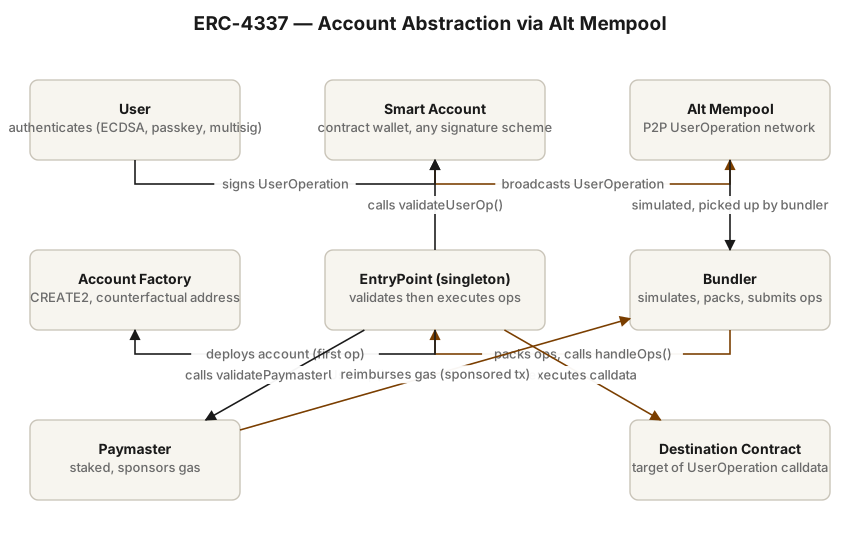 Open full-size diagram
Summary
ERC-4337 is the standard that finally shipped account abstraction on Ethereum — the decade-old goal of making accounts programmable smart contracts rather than key-locked EOAs — without changing the protocol itself. Authored by Vitalik Buterin, Yoav Weiss, Dror Tirosh, Shahaf Nacson, Alex Forshtat, Kristof Gazso, and Tjaden Hess, the proposal was created in September 2021 after earlier consensus-layer attempts (EIP-86, EIP-2938) stalled. Its core trick is to replicate the transaction pipeline one layer up: instead of transactions, users emit "UserOperations" into an alternative mempool; instead of miners, "bundlers" package them; and a single audited EntryPoint contract validates and executes them on-chain. The audited EntryPoint (v0.6) went live on Ethereum mainnet on March 1, 2023, announced by Ethereum Foundation security fellow Yoav Weiss at WalletCon in Denver, deployed at the same address on every EVM chain. It unlocked passkey/social login wallets, gas sponsorship, session keys, batched calls, and paying fees in ERC-20s — and became the substrate for Coinbase Smart Wallet, Safe modules, Alchemy, Pimlico, Biconomy, ZeroDev and most of the "smart account" ecosystem.
Design (Mechanism)
ERC-4337 rebuilds the transaction supply chain in userland:
- UserOperation: a pseudo-transaction struct (sender, nonce, calldata, gas fields, signature, optional factory initCode and paymaster data). Because the "signature" field is opaque bytes interpreted by the account contract, any authentication scheme works — ECDSA, passkeys/WebAuthn, multisig, BLS.
- Alt mempool: UserOperations propagate through a dedicated P2P network with shared validation rules (notably ERC-7562 restrictions on what validation code can touch) so bundlers can simulate ops without being griefed by ops that pass simulation but revert on-chain.
- Bundlers: specialized actors who simulate, order, and pack many UserOperations into one real transaction calling
EntryPoint.handleOps, earning the spread between fees paid by accounts and gas they spend. - EntryPoint: a permissionless singleton that runs a two-phase loop — first calling each account's
validateUserOp(and paymaster'svalidatePaymasterUserOp), then executing calldata — and settles compensation. Concentrating trust in one heavily audited contract (OpenZeppelin audited v0.6) lets thousands of wallet implementations stay simple. - Paymasters: staked contracts that can pay gas for users, enabling sponsored ("gasless") transactions or fee payment in ERC-20 tokens. Staking plus reputation rules deter mempool-DoS attacks.
- Account factories & counterfactual addresses: CREATE2-based factories let a wallet address be known and funded before deployment; the account is deployed lazily with the first UserOperation.
Later revisions tightened the design: EntryPoint v0.7 (0x0000000071727De22E5E9d8BAf0edAc6f37da032, 2024) packed gas fields to cut calldata cost and reworked paymaster postOp semantics.
Outcome
Partial success — enormous as infrastructure, unfinished as a user-facing revolution. Within a year, ERC-4337 accumulated millions of smart accounts and tens of millions of UserOperations, heavily concentrated on cheap L2s (Base, Polygon, Arbitrum, Optimism), with the large majority of operations using paymasters — i.e., apps eating gas costs so users never touch ETH. Coinbase built its Smart Wallet on it; Safe, Alchemy, Pimlico, Biconomy, and ZeroDev built commercial stacks; ecosystem estimates cite tens of millions of accounts and 100M+ operations by 2025. But adoption on Ethereum L1 stayed thin (overhead of ~42k+ extra gas per op matters at L1 prices), much early volume was airdrop-farming or single-app bursts rather than organic wallet migration, and bundler markets remained concentrated among a few providers. In May 2025 the Pectra upgrade shipped EIP-7702, which lets existing EOAs temporarily act as smart accounts — a partial in-protocol answer that complements 4337 (7702 accounts can still use its mempool/paymasters) while conceding that the pure userland path wasn't enough to migrate the installed base of EOAs.
Why it worked
- No hard fork required: by re-implementing the mempool/validation pipeline in contracts and off-chain actors, the team shipped in 18 months what consensus-layer AA proposals failed to ship in seven years.
- Singleton trust concentration: one audited EntryPoint at a deterministic address across all EVM chains gave wallets, bundlers, and paymasters a shared, credibly neutral core.
- Modular economics: bundlers, paymasters, and wallet factories are separate permissionless roles, letting infra companies (Pimlico, Alchemy, Biconomy) compete on each layer.
- It solved real UX pain: gas sponsorship, passkey login, batching, and counterfactual deployment map directly onto the biggest onboarding complaints in crypto, so consumer L2 apps had immediate reasons to adopt.
Where the design broke
- Gas and complexity overhead: the validate/execute loop costs tens of thousands of extra gas per operation — tolerable on L2s, punitive on L1, which is why L1 adoption lagged badly.
- Didn't migrate existing users: 4337 requires a new contract account; the hundreds of millions of existing EOAs (and CEX-integrated wallets) had no cheap migration path — the gap EIP-7702 was created to fill.
- Centralized supply chain in practice: most UserOperations flow through a handful of commercial bundler/paymaster APIs rather than the permissionless P2P mempool, reproducing RPC-style centralization.
- Vanity metrics: paymaster-subsidized ops made raw adoption numbers easy to inflate; sponsored spam and farming episodes muddied the picture, and paymaster edge cases (some fixed in v0.7, others catalogued by auditors like OtterSec) created new risk surface.
Lessons
- Userland beats consensus for shipping speed: if a standard can be deployed as contracts plus off-chain convention, it will outrun any protocol-change proposal — but it will pay a permanent gas/complexity tax for living outside the protocol.
- Concentrate audits, distribute innovation: the singleton-EntryPoint pattern — one hardened core, thousands of thin account implementations — is a reusable template for high-stakes extensibility.
- Subsidized usage is not adoption: when paymasters pay, transaction counts measure marketing budgets as much as demand; evaluate AA-era metrics by retained, self-funding accounts.
- Standards need a migration story for the installed base: 4337 was excellent for new accounts and mute on existing ones; the ecosystem eventually needed 7702 to bridge that gap.
Redesign (EDITORIAL — hypothesis, not fact)
This section is editorial hypothesis, not established fact. A redesign with hindsight would (1) ship the EOA-upgrade path (7702-style delegation) simultaneously with the smart-account standard, so the installed base migrates on day one instead of bifurcating the wallet ecosystem for two years; (2) enshrine minimal protocol hooks early — e.g., native validation-phase gas accounting — to cut the ~40k-gas overhead that kept L1 usage marginal; (3) launch the shared P2P UserOperation mempool before commercial bundler APIs became the default rails, perhaps with protocol-guild-style funding for independent bundlers, to avoid RPC-style centralization; and (4) standardize paymaster reputation and spend-attribution from the start so sponsored-transaction metrics distinguish organic use from subsidy farming. The deepest bet — that account UX, not consensus, was Ethereum's binding constraint — looks correct; the unaddressed gap was that the standard alone had no mechanism to migrate the installed base of EOAs off centralized-infra defaults.
Sources
- ERC-4337: Account Abstraction Using Alt Mempool (EIP specification) — primary (docs)
- ERC-4337 Documentation (eth-infinitism) — primary (docs)
- EntryPoint v0.6 contract on Etherscan — primary (contract)
- CoinDesk: Ethereum Activates 'Account Abstraction' (WalletCon Denver announcement) (news)
- Alchemy: ERC-4337 Statistics Q3 2023 (analysis)
- OtterSec: ERC-4337 paymasters — better UX, hidden risks (audit)
Related experiments
Last verified: 2026-07-26 · Spot an error? Suggest a correction