ERC-6551 Token Bound Accounts
An Ethereum standard that gives every ERC-721 NFT its own deterministic smart-contract account, letting tokens own assets and act onchain without changing existing NFT contracts.
▶ Run interactive simulation animated mechanism with editable parameters
How it works onchain
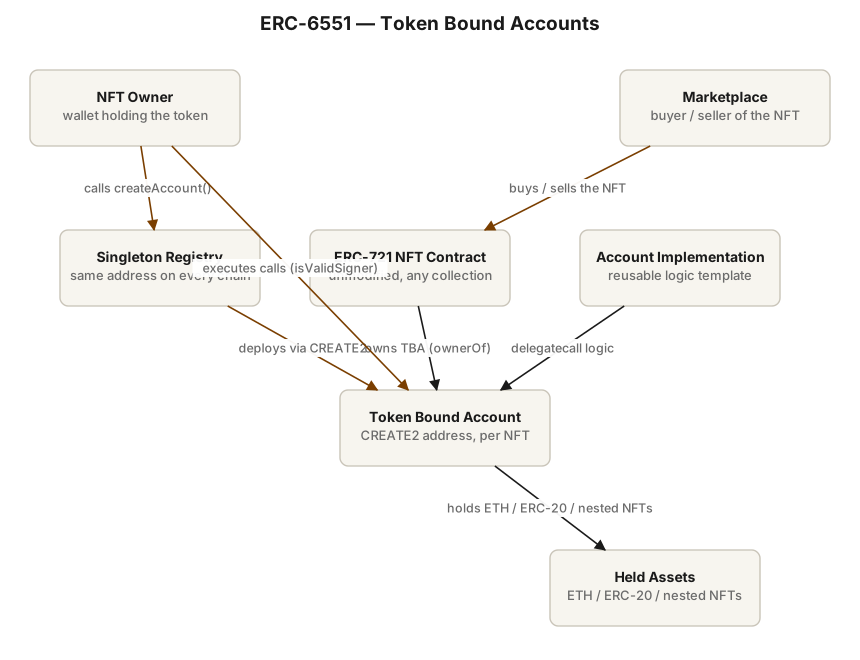 Open full-size diagram
Summary
ERC-6551 ("Non-fungible Token Bound Accounts," created 2023-02-23) is an Ethereum standard that assigns a full smart-contract account to every ERC-721 token. Whoever owns the NFT controls its account; the account can hold ETH, ERC-20s, other NFTs, and interact with any contract. The proposal was drafted by Jayden Windle, Benny Giang, and fifteen co-authors — a group spanning Future Primitive (the studio behind tokenbound.org; Giang was a founding team member of CryptoKitties/Dapper Labs), Gnosis Guild, 1inch, Manifold, Revest, and others. Its core promise was retroactive composability: every existing NFT, from CryptoKitties onward, could gain an inventory and an onchain identity with no changes to its original contract. The standard became one of the most talked-about NFT primitives of 2023 and achieved real cross-chain deployment (a canonical registry at the same address on every EVM chain), but adoption concentrated in niches — NFT gaming inventories, character "backpacks," and later experiments with AI-agent wallets — rather than becoming the universal NFT layer its advocates envisioned.
Design (Mechanism)
The system has two parts:
A singleton, permissionless registry deployed at the same address on every chain (
0x000000006551c19487814612e58FE06813775758). It exposes two functions:createAccount, which deploys an account for a given (implementation, chainId, tokenContract, tokenId, salt) tuple viaCREATE2, andaccount, which computes that address without deploying. Because addresses are deterministic, accounts exist counterfactually: anyone can send assets to an NFT's account address before the account contract is ever deployed.An account interface,
IERC6551Account, that implementations must support alongside ERC-165 and ERC-1271.token()returns which NFT owns the account,isValidSigner()delegates control to the NFT's current owner, andstate()changes on every account mutation — a nonce-like value that lets marketplaces and buyers detect if an account's contents changed between listing and sale.
The elegant trick is inversion of ownership lookup: instead of modifying ERC-721, the account contract asks the NFT contract who its owner is at call time. Selling the NFT atomically transfers control of the account and everything inside it. Any account logic is permitted (the registry is implementation-agnostic), so teams can add session keys, spending limits, or chain-specific execution. Future Primitive shipped a reference implementation (the Tokenbound account proxy/implementation) plus SDKs and an iframe renderer showing an NFT's inventory.
Outcome
ERC-6551 launched to significant enthusiasm in mid-2023 and reached "Review" status as an ERC (still not Final as of early 2025 per secondary reporting). The canonical v3 registry is live at a vanity address on Ethereum, Polygon, Optimism, Base, Linea, Klaytn, and is permissionlessly deployable anywhere. Flagship adopters: Sapienz by Stapleverse (characters whose cosmetics live in the character's own TBA inventory — among the largest ERC-6551 applications), Parallel Colony (AI-driven onchain game where each avatar is an ERC-6551 wallet owning ERC-20/1155 assets), and a long tail of gaming, loyalty, and membership projects; thirdweb, QuickNode, and other infra providers shipped tooling. TBAs also resurfaced in 2024–25 as a substrate for AI-agent wallets (an agent NFT owning its own treasury). Reliable aggregate usage statistics are scarce; secondary sources claim six-figure account activations in the first year, but no authoritative figure was found (Unknown / not found). The standard is technically robust and widely known, yet it did not become a default feature of new NFT collections, and marketplace-level support (rendering inventories, pricing NFT+contents bundles) remained thin. Outcome: partial_success.
Why it worked
- Zero migration cost. Compatibility with every existing ERC-721 — no opt-in from collection creators required — removed the classic new-standard bootstrap problem.
- Deterministic, counterfactual addresses meant assets could be airdropped to NFTs (even holders who never deployed accounts), enabling clever distribution mechanics.
- Credible authorship and a working product. The EIP shipped with a live demo (tokenbound.org), SDKs, audited reference contracts, and authors with ERC-721/CryptoKitties pedigree, which drove fast mindshare.
- Genuine product fit in gaming: character-with-inventory is a natural object, and selling a character with all its gear in one transaction is a real UX win.
Why it failed or underperformed
- Demand was narrower than the vision. Most NFT holders had no pressing need for their JPEGs to own things; the "every NFT is a wallet" framing outran actual use cases, and the 2023–24 NFT bear market shrank the addressable audience.
- Marketplace and wallet UX lag. Without first-class support for displaying TBA contents, verifying
state()before purchase, and bundle pricing, buyers faced scam risk (e.g., sellers draining a TBA between listing and sale) and friction that infra never fully solved. - Footguns: ownership cycles (transfer an NFT into its own TBA and both are bricked forever), unclear cross-chain semantics for accounts tied to an NFT on another chain, and gas costs of per-token accounts on L1.
- Standard-process drag: the ERC lingered in Review for years, and competing account-abstraction narratives (ERC-4337 smart wallets) absorbed much of the ecosystem's attention.
Lessons
- Backwards compatibility is the single strongest adoption lever a token standard can have — ERC-6551's retroactive applicability to all ERC-721s got it further, faster, than any opt-in NFT extension of its era.
- A primitive is not a product: without marketplace/wallet integration (rendering, bundle pricing, state verification), a composability standard's benefits are invisible to end users and its risks (contents changing before a sale completes) are borne by them.
- Deterministic counterfactual addresses (CREATE2 singletons at vanity addresses on every chain) are a powerful pattern for standards: they make the infrastructure feel like part of the chain itself.
- Design against self-reference explicitly: any system that lets an asset own assets must handle the "asset owns itself" cycle at the protocol level, not in documentation.
- Timing narratives matter — a standard aimed at NFT utility launched into an NFT bear market found its strongest product-market fit later, in an adjacent wave (game inventories, AI-agent wallets) its authors only partially anticipated.
Redesign (EDITORIAL — hypothesis, not fact)
This section is editorial hypothesis, not fact. A redesigned ERC-6551 would (1) build cycle-prevention into the reference account — reject onERC721Received for the account's own controlling token and its ancestors, making the bricking footgun impossible by default; (2) standardize a marketplace attestation flow around state(): listings embed the account state hash, and a thin settlement wrapper reverts if state changed, turning the anti-scam defense from a convention into an enforced invariant; (3) ship a canonical "inventory metadata" extension so wallets and marketplaces can render TBA contents with zero custom integration — the missing demand-side piece; and (4) lean into the agent-wallet use case from day one: session keys, spending policies, and cross-chain execution via a bridging-aware account implementation, positioning TBAs as the identity-and-treasury layer for autonomous agents rather than a general NFT accessory. The bet is that the standard's underperformance was a distribution problem (no default rendering, no enforced sale safety) rather than a mechanism problem, so the redesign spends its complexity budget on the integration surface, not the core registry — which was already close to optimal.
Sources
- EIP-6551: Non-fungible Token Bound Accounts — primary (docs)
- ERC 6551 — Token Bound Accounts (Future Primitive launch post) — primary (retrospective)
- Tokenbound Documentation — Contract Deployments — primary (contract)
- Tokenbound (official site, Future Primitive) — primary (docs)
- ERCs repository — erc-6551.md — primary (docs)
- Web3 Galaxy Brain — EIP-6551 with Jayden Windle and Benny Giang (retrospective)
- Ancient8 Research — ERC-6551: A New Enhancement For Gaming and NFT Projects (analysis)
- thirdweb — What is ERC-6551? Token Bound Accounts Explained (analysis)
- Mundus Security — EIP-6551 Overview: Token Bound Accounts and Its Security Challenges (analysis)
Related experiments
Last verified: 2026-07-26 · Spot an error? Suggest a correction