ERC-404 (Pandora)
An unofficial, experimental hybrid ERC-20/ERC-721 token standard whose flagship token Pandora fused fungible liquidity with NFT ownership — igniting a 12,000% mania in February 2024 before gas costs, edge cases, and better rivals deflated it.
▶ Run interactive simulation animated mechanism with editable parameters
How it works onchain
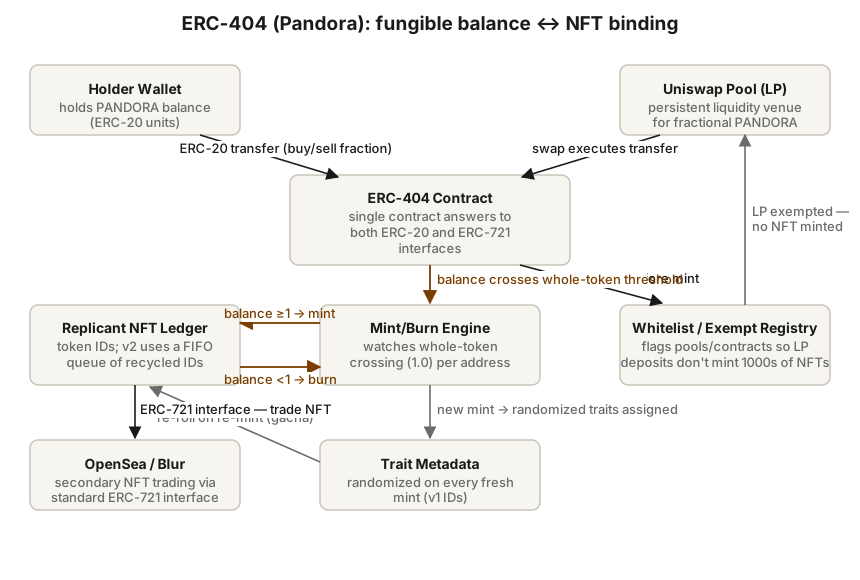 Open full-size diagram
Summary
ERC-404 was an experimental, unofficial token standard launched on February 2, 2024 by a pseudonymous team (publicly known as "ctrl," "Acme," and "Searn," operating as Pandora Labs) that fused ERC-20 and ERC-721 behavior into a single contract. Its flagship deployment, Pandora — 10,000 PANDORA tokens bound to 10,000 "Replicant" NFTs at 0x9E9FbDE7C7a83c43913BddC8779158F1368F0413 — let NFTs trade with the persistent liquidity of a fungible token on Uniswap while still existing as unique collectibles on OpenSea and Blur. The design triggered one of 2024's most violent speculative episodes: PANDORA rose roughly 12,000% in under a week, touching ~$32,000 per token and a market cap near $300 million, and spawned hundreds of copycat "404" tokens. Despite the name, ERC-404 was never a ratified Ethereum standard — the "ERC" label was self-applied without an EIP process. Within weeks the mania faded amid gas-cost criticism, edge-case bugs, and the release of the more efficient rival DN404. By mid-2026, PANDORA trades around $100 (down ~99.7% from peak) with negligible volume, though the hybrid fungible/non-fungible category it pioneered persists.
Design (Mechanism)
ERC-404's core trick is binding a fungible token supply 1:1 to an NFT collection inside one contract:
- 1 token = 1 NFT. An address holding one full PANDORA (10^18 base units) automatically owns one Replicant NFT. Fractional balances hold no NFT.
- Mint/burn on transfer. When an address's whole-token balance drops below an integer threshold (e.g., selling 0.5 tokens from a balance of 1), its NFT is burned. When a balance crosses up through a whole number (buying enough fractions to reach 1.0), a new NFT is minted to the holder. The v1 implementation minted fresh IDs; v2.0-beta moved to a FIFO queue of recycled token IDs.
- Native fractionalization and AMM liquidity. Because balances are ERC-20-compatible, the NFT collection could be pooled on Uniswap and traded in fractions — "persistent liquidity and semi-fungibility," in the project's own framing — eliminating the illiquid-floor problem of conventional NFT markets.
- Trait re-rolling. Since selling and re-buying burns and re-mints an NFT with randomized metadata, holders could "re-roll" Replicant traits by cycling tokens — an accidental gacha mechanic that drove volume.
- Dual-interface hazards. The contract answers to both ERC-20 and ERC-721 tooling, requiring whitelists/exemptions (e.g., for Uniswap pools, so LP positions don't mint thousands of NFTs) and careful integration, since no existing infrastructure anticipated a token that is both.
A PeckShield audit report was published via the project's GitHub, but the repository itself carried explicit warnings that the code was experimental and "not intended to be used in production."
Outcome
Pandora's launch produced an extraordinary reflexive rally: from roughly $250 to an all-time high near $32,800 in under a week, ~$90M in Replicant secondary sales, and a wave of derivative ERC-404 launches (DeFrogs, Monarch, etc.) that CoinGecko still tracks as a distinct category. The frenzy measurably spiked Ethereum gas prices, because every DEX swap could trigger NFT mints and burns. The crash was nearly as fast: ~40–60% drawdowns within days of the peak, deepening as critics (including Solady author Vectorized and developer cygaar, who shipped the rival DN404 two-contract design with ~20% lower gas) detailed the standard's inefficiency and edge-case breakage. Pandora Labs shipped ERC-404 v2 with gas optimizations and EIP-2612 support, and pursued legitimization through the EIP process, but no official standard materialized; the community's efficient successors (DN404, later formalized ideas like ERC-7631) captured the design space. By July 2026 PANDORA's market cap sits near $1M with days of zero trading volume — the token is effectively dormant, while the hybrid-token concept it proved out survives in successor standards.
Why it worked
- Genuine mechanism novelty: native NFT-AMM liquidity without wrappers, vaults, or third-party fractionalizers was a real gap; ERC-404 collapsed the NFT liquidity problem into a single contract primitive.
- Reflexive game design: the burn/re-mint trait re-roll turned trading itself into a lottery, manufacturing volume and attention.
- Perfect meme surface: a fake-official name ("ERC-404" — the HTTP error code), pseudonymous builders, and a first-mover token gave speculators a coordination point during a bullish market window.
- Composability by default: ERC-20 compatibility meant instant Uniswap listing and price discovery, with NFT marketplaces as a second venue for the same asset.
Where the design broke
- No standards legitimacy: "ERC-404" skipped the EIP process entirely; wallets, marketplaces, and indexers had no spec to build against, and the self-applied "ERC" label implied a level of ratified-standard status the token never had.
- Gas-hostile architecture: burning and minting NFTs inside every ERC-20 transfer made swaps several times more expensive than normal, socializing costs onto the whole network during the mania.
- Edge-case fragility: the v1 code broke in corner cases (whitelist handling, lending-market integrations, ID collisions), and the team's own repo warned it was unaudited-in-production experimental code.
- Superior fast-followers: DN404's mirrored two-contract design delivered the same UX ~20% cheaper within two weeks, dissolving Pandora's technical moat.
- No value accrual: PANDORA the token had no revenue, utility, or governance claim — once novelty faded, there was nothing underneath a $300M valuation.
Lessons
- A token standard's legitimacy is social, not just technical: skipping the EIP process bought speed and mystique but guaranteed that infrastructure never standardized around it, leaving the door open for a sanctioned successor.
- Mechanisms that impose per-transfer externalities (NFT mint/burn gas) scale their costs with their own success; congestion pricing turned Pandora's popularity into its indictment.
- First movers in mechanism design capture attention, not moats — an unaudited primitive with obvious inefficiencies invites a fast-follower (DN404) to inherit the category within weeks.
- "Accidental gacha" dynamics (trait re-rolling via transfer) are powerful volume engines but attract flow driven purely by expected re-roll value, which evaporates once the trait lottery stops paying out.
- Binding a speculative asset's price to a mechanism demo conflates two questions — "is this design useful?" and "is this token worth $32,000?" — and the second's inevitable answer discredited the first.
Redesign (EDITORIAL — hypothesis, not fact)
This section is editorial hypothesis, not historical fact. A stronger version of ERC-404 would have (1) launched the mechanism through the EIP process first — as a draft spec with reference implementation and audits — and shipped the flagship collection only after wallet/marketplace feedback, trading name-recognition for durability; (2) adopted the mirror-contract architecture from the start (separate ERC-20 and ERC-721 surfaces sharing state, as DN404 later did), keeping each interface fully standard-compliant and cutting transfer gas; (3) made NFT materialization lazy and opt-in — balances track NFT entitlements, but mints occur only when a holder explicitly claims, moving gas costs off the swap path entirely; (4) replaced random re-rolls with a deterministic, seed-committed reveal to keep the collectible dynamic without incentivizing wash-cycling; and (5) attached the flagship token to something with an actual claim — protocol fees from a native NFT-AMM router, for instance — so the demonstration asset had a valuation anchor beyond novelty. The core insight (fungible-grade liquidity for NFTs as a contract-level primitive) was validated; the packaging burned it.
Sources
- Pandora Labs official site — primary (docs)
- Pandora Labs ERC-404 reference implementation (GitHub) — primary (contract)
- Pandora: PANDORA token contract (Etherscan) — primary (contract)
- Pandora Labs documentation — primary (docs)
- CoinDesk: What Is ERC-404? The Experimental Standard Whose First Token Has Rocketed 12,000% in One Week (news)
- Blockworks: Pandora ERC-404 collection tops $90M in sales, token falls 55% (news)
- BeInCrypto: ERC-404 Tokens Dead? Pandora's 40% Price Plunge Casts Doubt on New Standard (news)
- Decrypt: Pandora ERC-404 Token Rebounds — But a Rival Ethereum Standard Is Coming (DN404) (news)
- Vectorized/dn404 — rival hybrid implementation addressing ERC-404's inefficiencies — primary (contract)
- Cointelegraph: ERC-404 token standard, explained (analysis)
- CoinGecko: Pandora (PANDORA) price and market data (analysis)
Related experiments
Last verified: 2026-07-27 · Spot an error? Suggest a correction