POAP
A protocol for issuing free, non-transfer-oriented ERC-721 badges that cryptographically prove a person attended an event or completed an action.
▶ Run interactive simulation animated mechanism with editable parameters
How it works onchain
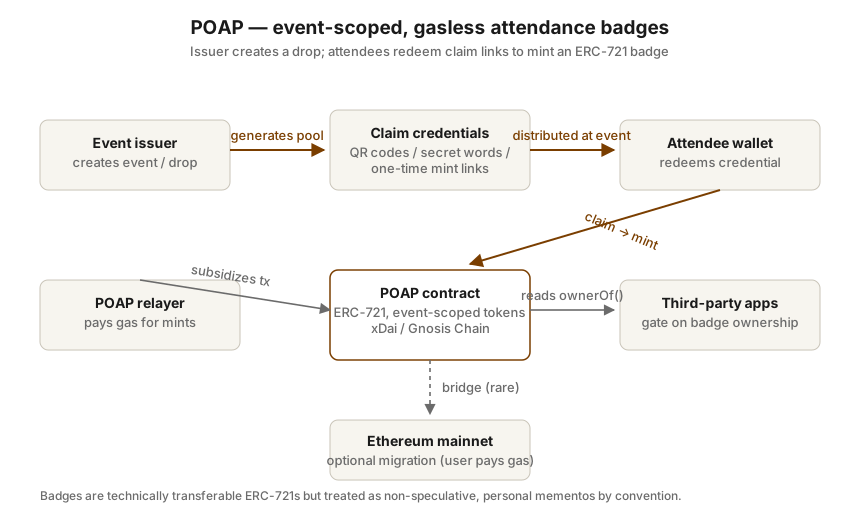 Open full-size diagram
Summary
POAP ("Proof of Attendance Protocol") is one of the earliest and most durable onchain identity/reputation primitives. It lets an event organizer mint a batch of ERC-721 NFT "badges," each tied to a specific event, and distribute claim links (QR codes, secret words, or one-time mint links) so that only people present or eligible can mint one. The result is a wallet-held, timestamped, publicly verifiable record that an address "was there." POAP debuted at the ETHDenver hackathon in February 2019, conceived by Patricio Worthalter, and grew into the de facto standard for onchain attendance and participation proofs across conferences, DAOs, DeFi protocols, and eventually mainstream brands (Adidas, Coinbase, Sotheby's, Porsche, Google Cloud, Spotify, Red Bull, TIME). By mid-2023 more than 6.7 million POAPs had been minted by 37,000+ unique issuers. In early 2026 POAP Inc. announced a transition to "maintenance mode," ending new-issuer onboarding on March 16, 2026, while existing tokens and integrations remain on-chain. The founders framed this as a pivot toward "a standard for open collectibles" rather than a shutdown.
Design (Mechanism)
The core object is an ERC-721 token whose contract lives at 0x22C1f6050E56d2876009903609a2cC3fEf83B415 (deployed on both Ethereum mainnet and, primarily, xDai / Gnosis Chain). Each token references an "event" (a drop) with its own artwork, date, and metadata. The design choices that defined POAP:
- Event-scoped mints. An issuer creates a drop and receives a pool of claim credentials — mint links, a claim website, secret words, or QR codes. Attendees redeem a credential to mint the badge to their address. This binds the "proof" to physical or verified presence rather than open sale.
- Gasless / subsidized minting. Early on, the POAP team paid the gas so that both issuers and collectors received tokens for free — critical to adoption but unsustainable on Ethereum L1. In October 2020 POAP migrated primary minting to xDai (now Gnosis Chain), an EVM sidechain with negligible fees where roughly one dollar covered thousands of mints. POAPs could optionally be bridged/migrated to Ethereum mainnet if a user chose to pay L1 gas; most stayed on xDai.
- Soft non-transferability by social convention. POAPs are technically standard, transferable ERC-721s, but the culture and the app treated them as personal, non-speculative mementos ("bookmarks for your life"). This positioned POAP as a proto-"soulbound"/reputation primitive years before EIP-5114/soulbound-token discourse.
- Composability layer. Because badges are onchain, third parties used POAP holdings as an eligibility signal — gated Discord roles, POAP-based airdrops, governance snapshots, and later native features like token-gated group chats and discounts.
Outcome
Technically and culturally, POAP was a major success: it created and owned a category, became a near-universal fixture at crypto events, and onboarded large Web2 brands. It raised roughly $10M in a 2022 seed round led by Archetype (with Sapphire Sport, Collab+Currency, Protocol Labs, and MetaCartel Ventures). However, monetization lagged the mission. In April 2023 POAP introduced paid commercial access to address sustainability. In early 2026 the company moved to maintenance mode, halting new-issuer onboarding on March 16, 2026. Co-founder Isabel Gonzalez said POAP "found a clear niche" but "did not expand much beyond that niche," and that digital-collectible tooling still reflected system constraints rather than community needs. Existing POAPs remain fully on-chain and readable; integrations keep working but may degrade as resources wind down. The outcome is best read as technically successful, commercially unsuccessful: a widely-adopted, still-live primitive that never found a business model matching its reach.
Why it worked
- Radical low friction. Free, gasless, one-click mints removed every barrier for non-crypto-native attendees — the growth engine that Web2 brands could plug into.
- Right primitive, right moment. It gave "proof you were here / you did this" a clean, composable onchain form before soulbound tokens or onchain reputation were theorized, so it defined the vocabulary others adopted.
- Neutral, brandable canvas. Per-event artwork plus a shared protocol let organizers express identity while collectors accumulated a coherent, cross-event history in one app.
- Network effects among issuers. Once conferences and DAOs standardized on POAP, attendees expected it, pulling in the next cohort of issuers.
Where the design broke
- Free-forever positioning fought monetization. The subsidy that drove adoption made it culturally awkward to charge; paid tiers arrived late (2023) and did not scale revenue to match usage.
- Thin value capture. POAP created enormous value for issuers and downstream tooling but captured little of it; the badges themselves were deliberately non-speculative, foreclosing the NFT-market revenue other 2021-era projects relied on.
- Niche gravity. The product excelled at attendance memorabilia but struggled to expand into a broader identity/loyalty platform, leaving it dependent on event volume.
- Sidechain trade-offs. Anchoring on xDai/Gnosis kept costs near zero but reduced perceived permanence and mainnet composability; migrating to Ethereum cost gas most users declined to pay.
Lessons
- A subsidy that bootstraps a network can become a strategic trap. Free, gasless mints were the reason POAP won the category and the reason it could never comfortably charge — decouple the growth subsidy from the monetization path early.
- Owning a category is not the same as owning a market. POAP defined "onchain attendance" yet captured little of the value it generated for issuers and integrators; a primitive needs a value-capture surface, not just adoption.
- Non-transferable-by-convention was ahead of its time but under-enforced. POAP effectively pioneered reputation-style, non-speculative tokens before soulbound standards existed, showing both the demand for and the fragility of social (vs. protocol-enforced) non-transferability.
- Choose the chain for the promise you're making. Optimizing for cost (xDai) undercut the "permanent onchain memory" narrative; the storage/permanence guarantee and the fee model should be designed together.
Redesign (EDITORIAL — hypothesis, not fact)
The following is the researcher's editorial hypothesis, not established fact.
A POAP redesigned for durability and value capture might: (1) make badges protocol-enforced non-transferable (soulbound / ERC-5114-style or account-bound), removing the ambiguity that let POAPs be sold and aligning the token with a genuine reputation graph; (2) invert the business model so issuers pay for verifiable distribution and analytics, not collectors — e.g., a small per-drop or per-verified-claim fee plus premium APIs for gating, loyalty, and CRM-style engagement, which brands already pay for elsewhere; (3) anchor commitments (Merkle roots of claims) on a rollup or Ethereum L1 while keeping mints on a cheap L2, so the "permanent memory" promise is credibly secured without paying L1 gas per mint; (4) ship a first-class loyalty/rewards layer (streaks, tiers, cross-event reputation scores) turning attendance history into an actionable identity that partners can build against — the expansion beyond the "memento niche" that maintenance-mode acknowledged it never reached. The strategic bet is that onchain attendance is most valuable as an input to reputation and loyalty, not as a collectible, and that issuers, not attendees, are the willing payers.
Sources
- POAP official website — primary (docs)
- POAP Token contract (Ethereum & Gnosis Chain, ERC-721) — primary (contract)
- POAP + Ethereum + xDai: the experiment continues (POAP Medium) — primary (retrospective)
- POAP Moves to Maintenance Mode as Founders Eye Next Generation of Digital Collectibles (The Defiant) (news)
- Patricio Worthalter — People in crypto (IQ.wiki) (analysis)
- POAP contract on GnosisScan — primary (contract)
Related experiments
Last verified: 2026-07-26 · Spot an error? Suggest a correction