Ethena USDe
A 'synthetic dollar' that holds its $1 value not with bank reserves but with a delta-neutral basis trade — long staked crypto collateral, short an equal notional of perpetual futures — passing funding + staking yield to sUSDe stakers.
▶ Run interactive simulation animated mechanism with editable parameters
How it works onchain
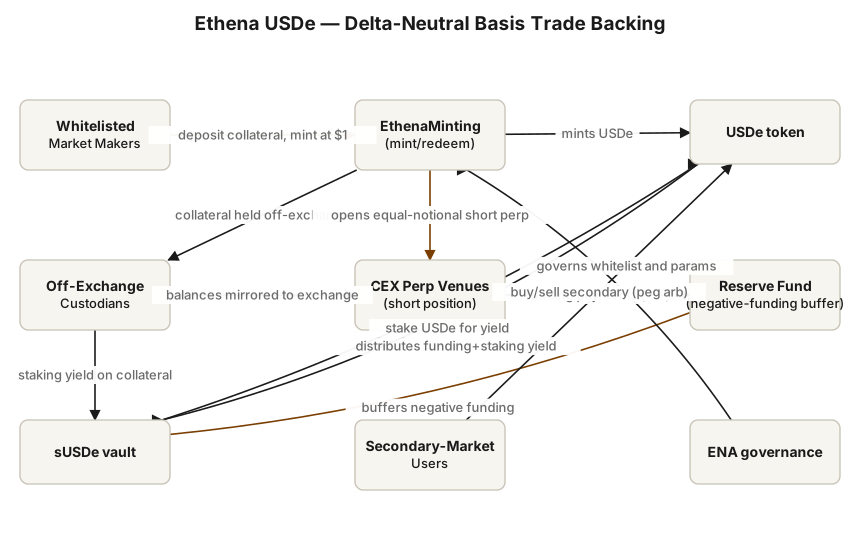 Open full-size diagram
Summary
Ethena's USDe is the largest live experiment in making a dollar out of a hedge rather than a bank account. Founded by Guy Young (ex-Cerberus Capital Management) and launched publicly on Ethereum on 2024-02-19, Ethena mints USDe against staked ETH (later also BTC and liquid stable collateral) while simultaneously shorting an equivalent notional of perpetual futures on centralized exchanges. The price exposure nets to roughly zero; the position throws off cash — perp funding payments plus staking yield — which is distributed to holders who stake USDe into sUSDe. Ethena deliberately calls USDe a "synthetic dollar," not a stablecoin: it is an internet-native, capital-efficient tokenized basis trade. Growth was historically fast — $1B supply within about ten weeks of launch, a peak near $14–15B in late 2025, and roughly $5.5–6B after the Q4 2025 deleveraging — making it one of the most consequential post-Terra experiments in non-fiat-backed dollars.
Design (Mechanism)
- Delta-neutral backing. For every USDe minted, the protocol holds spot collateral (originally stETH/LSTs, later BTC, liquid stables like USDtb) and an offsetting short perpetual futures position of equal notional. If ETH falls 20%, spot loses ~20% but the short gains ~20%; net dollar value is preserved without overcollateralization.
- Yield engine. Two revenue legs: (1) staking/restaking yield on the spot collateral, and (2) funding payments earned by the short perp side, which in crypto bull regimes are persistently positive (longs pay shorts). Yield accrues only to those who stake USDe into sUSDe (an ERC-4626-style vault, contract 0x9d39...3497); unstaked USDe earns nothing, which lets the protocol concentrate yield.
- Whitelisted mint/redeem. Only KYC'd approved market makers mint and redeem atomically at $1 of collateral value via the EthenaMinting contract (V2: 0xe349...62D3); everyone else buys USDe on secondary markets, with arbitrageurs holding the peg.
- Off-exchange custody. Collateral is not deposited on exchanges; it sits with custodians using off-exchange settlement (e.g., Copper ClearLoop, Ceffu-style solutions) that mirror balances to exchanges, reducing—but not eliminating—counterparty exposure to venues like Binance or Bybit.
- Reserve fund. A protocol-owned reserve absorbs periods of negative funding so USDe backing does not erode below par.
- Governance/incentive token. ENA (April 2024) governs and captures upside; a points ("shards/sats") campaign bootstrapped early deposits.
Outcome
Ongoing, and by adoption metrics unusually successful for a novel dollar design: fastest stablecoin ever to $1B (ten weeks), $14B+ peak supply in 2025 (third-largest stablecoin, near 5% of the stablecoin market), sUSDe yields that at times exceeded 25% APY, and deep integrations across CEXs and DeFi. It has also survived real stress: the October 10–11, 2025 market crash printed USDe at $0.65 — but only on Binance, where a thin local order book and Binance's own oracle/collateral handling failed; on-chain mint/redeem held at ~$1.00 and the protocol remained fully collateralized (Binance later reimbursed users ~$283M). The aftermath still cut supply roughly in half as leveraged looping unwound. As of mid-2026 USDe remains live with ~$5.5–6B supply.
Why it worked
- It sold a real, previously-institutional trade. The cash-and-carry basis trade is decades old; Ethena tokenized it and passed retail-accessible yield through, giving USDe a genuine, non-Ponzi revenue source (unlike Terra's reflexive UST/LUNA loop it is frequently compared to).
- Capital efficiency without fractional reserves. $1 of collateral backs $1 of USDe — no overcollateralization tax (vs. Maker/Liquity) and no bank dependency (vs. USDC, whose SVB depeg was part of the founding motivation).
- Arbitrage-grade redemption. Atomic $1 redemption for whitelisted market makers kept secondary peg tight even during the Oct-2025 chaos everywhere except one venue.
- Custody design learned from FTX. Off-exchange settlement meant exchange failure ≠ collateral loss, a lesson Ethena baked in from day one.
Limitations and criticisms
- Yield is regime-dependent. Funding is positive in bull markets and compresses or inverts in bear markets; supply is therefore procyclical — it halved within months of the Q4 2025 deleveraging. The reserve fund is a buffer, not a guarantee, against sustained negative funding.
- Venue and wrapper risk surfaced. The Oct 2025 Binance episode showed that USDe's weakest points are off-chain: exchange market microstructure, oracles, and collateral treatment on venues Ethena does not control.
- Trust dependencies remain. KYC'd mint/redeem, custodians, and CEX counterparties make USDe far less trust-minimized than its on-chain contracts suggest.
Lessons
- A dollar peg can be maintained by a hedge rather than reserves, but the peg's quality is then bounded by the weakest off-chain leg (exchange, custodian, oracle) — not by the smart contracts.
- Separating the peg asset (USDe) from the yield asset (sUSDe) is a powerful mechanism: it concentrates yield to attract stakers while keeping the transactional unit clean.
- Yield sourced from market structure (funding rates) is real but cyclical; any design monetizing it must size reserve buffers and expect supply to breathe with the cycle.
- "Depegs" on a single venue are a market-microstructure failure mode distinct from insolvency; redemption arbitrage plumbing is what actually defends par.
Redesign (EDITORIAL — hypothesis, not fact)
This section is a hypothesis, not fact. A redesigned USDe would attack the off-chain trust surface: (1) shift a larger share of the hedge to decentralized perp venues (Hyperliquid-class books) with transparent on-chain margin, accepting thinner liquidity in exchange for verifiable positions; (2) publish a real-time, cryptographically attested proof-of-reserves-and-hedge (custodian balances + exchange position attestations) so that single-venue price prints can be instantly refuted by data rather than by blog post; (3) make the reserve fund's sizing rule algorithmic and disclosed — e.g., target coverage of the worst historical N-month negative-funding drawdown at current supply — turning "trust us" into a checkable invariant; and (4) formalize a supply governor that throttles minting when open interest across hedging venues becomes too small relative to USDe supply, since the protocol's true capacity limit is derivatives market depth, not demand.
Sources
- Ethena Docs — USDe Overview — primary (docs)
- Ethena Docs — Key Addresses — primary (docs)
- USDe Token Contract (Etherscan) — primary (contract)
- CoinDesk — No, Ethena's USDe Didn't De-peg During Friday's Crash (Oct 13, 2025) (news)
- BeInCrypto — Ethena USDe 'Depeg', What Really Happened? (analysis)
- Phemex — German BaFin Bars Ethena USDe under MiCA (news)
- Spark Research — Synthetic Dollars: Delta-Neutral Stablecoins (analysis)
Related experiments
Last verified: 2026-07-26 · Spot an error? Suggest a correction