Ribbon
Ribbon Finance invented the DeFi Options Vault (DOV): automated weekly covered-call and put-selling vaults that turned option premia into 'set-and-forget' yield, before pivoting into the Aevo derivatives L2.
▶ Run interactive simulation animated mechanism with editable parameters
How it works onchain
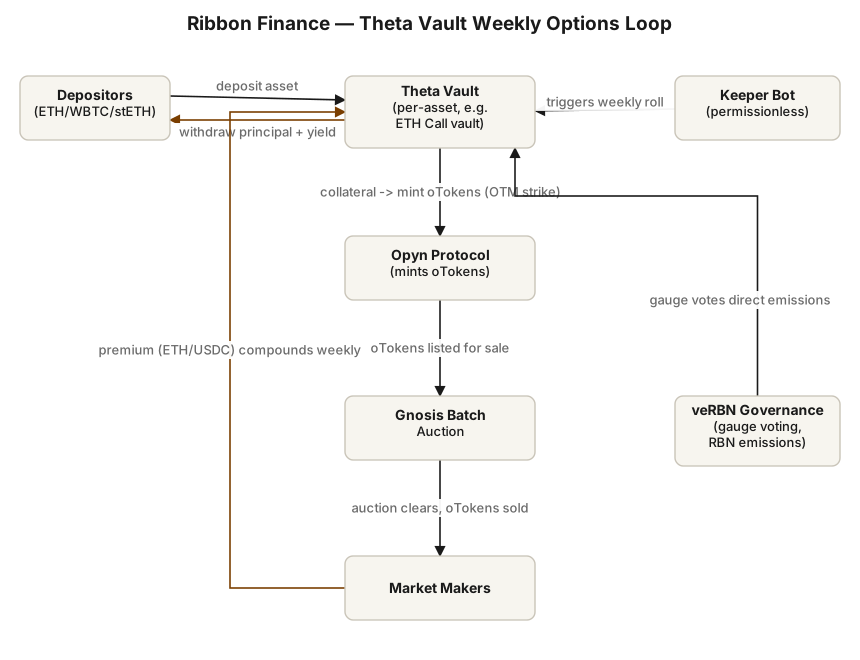 Open full-size diagram
Summary
Ribbon Finance, founded in late 2020 by ex-Coinbase engineers Julian Koh and Ken Chan, was the protocol that created the "DeFi Options Vault" (DOV) category. It launched on Ethereum in February 2021 with a strangle product, then in April 2021 shipped Theta Vaults — automated vaults that sell weekly out-of-the-money covered calls (and later cash-secured puts) on users' deposits and pay the option premium out as yield. The pitch was radical simplification: retail depositors get institutional-grade structured products (the crypto equivalent of TradFi yield notes) in one click, with all option minting, strike selection, auctioning, and premium compounding handled by smart contracts. TVL grew from under $20M in the first month to roughly $300M+ at peak ($320M by April 2022, per Nansen), Paradigm led an $8.75M round in March 2022, and Ribbon spawned an entire imitator category (Thetanuts, StakeDAO, Friktion, etc.). But sustained bear-market drawdowns, crowded volatility selling, and negative realized vault returns pushed the team to pivot: in April 2023 it launched Aevo, an OP Stack L2 order-book derivatives exchange, and in July 2023 RBN holders voted to fold the Ribbon brand and token entirely into Aevo (RBN→AEVO 1:1).
Design (Mechanism)
- Theta Vaults (core loop): Users deposit an asset (ETH, WBTC, stETH, AAVE, AVAX, SOL...). Each Friday the vault deposits collateral into Opyn and mints oTokens — ERC-20 European options with a one-week expiry and an algorithmically chosen strike (out-of-the-money, initially manually selected, later automated in V2 using a Black-Scholes-based strike selection with delta targets).
- Premium discovery via batch auction: The freshly minted oTokens are sold to market makers through Gnosis batch auctions, so the premium (the depositors' yield) is set competitively on-chain rather than by the team. Premiums flow back into the vault and compound weekly.
- Payoff profile: Depositors earn premium every week the option expires worthless; if the market moves through the strike (a sharp rally against a covered call, or a crash against a put vault), the vault pays out from principal. This is structurally short volatility — high win-rate, occasional large losses.
- V2 (September 2021): decentralized the weekly cycle (permissionless keeper-triggered rolls), introduced on-chain strike/parameter governance, and a fee switch (annualized management fee plus performance fee on premiums).
- Token & governance: RBN launched May 2021 with a retroactive airdrop to early users; "Ribbonomics" (2022) adopted Curve-style vote-escrowed veRBN with gauge voting directing RBN emissions across vaults.
- Later products: Ribbon Lend (unsecured lending to market makers) and Ribbon Earn (principal-protected structured products combining lending yield with exotic options), plus multichain vaults on Avalanche and Solana.
Outcome
Partial success. As a mechanism experiment, Ribbon worked: the vault machinery ran for years without a protocol hack, weekly auctions cleared competitively, and DOVs became a durable DeFi primitive that at peak (across the category) sold hundreds of millions of dollars of notional volatility. TVL peaked around $300M+ in late 2021/early 2022. But the product's economics degraded: the 2022 bear market plus crowded, schedule-telegraphed volatility selling compressed premiums and produced stretches of negative net returns for depositors, and TVL bled down. Notable incident: the October 2021 RBN airdrop was sybil-farmed by a Divergence Ventures analyst (~$2.5M / 702 ETH across dozens of wallets); after public outcry the funds were returned to the DAO — an airdrop-design failure, not a contract exploit. In July 2023 governance approved merging Ribbon into Aevo; RBN converted 1:1 to AEVO and the Ribbon brand was retired. The team and treasury survived and shipped a successor product, but the original structured-products experiment did not sustain itself as a standalone business.
Why it worked
- Genuine abstraction of a hard product: options are the most cognitively expensive instrument in finance; Ribbon compressed strike selection, settlement, and rolling into a single deposit — a real UX breakthrough.
- Composability: building on Opyn's oToken standard and Gnosis auctions let a small team ship a structured-products desk out of existing legos.
- Honest price discovery: auctioning premiums to competing market makers avoided the "house sets the price" trap and made yield legible on-chain.
- Right moment: launched into a 2021 market starving for "real yield" that wasn't token emissions — premiums were paid by option buyers, not inflation.
Where the design broke
- Short-vol payoff meets crypto tails: weekly covered calls cap upside in violent rallies and put vaults absorb crashes; 2021–2022 delivered both, so realized depositor returns often went negative despite high weekly "APYs."
- Crowding and reflexivity: as DOV TVL (Ribbon + clones) grew, everyone sold the same weekly expiries on a public schedule; market makers priced this in, implied vol got crushed into Friday auctions, and premiums shrank exactly as risk stayed constant.
- Yield marketing mismatch: annualizing weekly premiums as APY framed a risk premium as if it were interest, attracting depositors who did not understand they were underwriting tail risk.
- Airdrop sybil failure: minimal eligibility criteria let one VC-linked actor farm ~$2.5M of the community allocation, damaging trust in the distribution.
- Fee base too small in a bear: management/performance fees on a shrinking, negative-return TVL couldn't sustain the business, motivating the pivot to exchange fees via Aevo.
Lessons
- A high win-rate strategy is not a low-risk strategy. Selling options wins most weeks and occasionally loses big; annualizing weekly premium as "yield/APY" without surfacing drawdown scenarios obscures the tail risk from the median depositor.
- Public, synchronized flow gets priced against you. When a mechanism telegraphs the exact instrument, size, and time of its trade every week, counterparties adapt and the edge decays — DOVs effectively paid for their own vol crush. Randomize timing, tenor, and strikes, or accept shrinking premiums.
- Composability is a superpower for shipping and a dependency for risk. Ribbon's Opyn + Gnosis stack enabled a tiny team to run an options desk, but its risk surface was the union of every underlying protocol.
- Sybil resistance is mechanism design, not an afterthought. The Divergence incident showed that low-cost eligibility criteria convert community airdrops into VC farming targets.
- Pivoting via governance is a viable exit for a working-but-unprofitable mechanism. The RBN→AEVO merger preserved the team, treasury, and holders rather than letting the protocol zombify.
Redesign (EDITORIAL — hypothesis, not fact)
This section is editorial analysis — a hypothesis about how the mechanism might be redesigned, not a description of anything Ribbon actually did or planned. A modern DOV redesign should attack the two structural flaws: crowding and mis-sold risk. First, replace the fixed Friday auction with randomized, laddered issuance — many small auctions across staggered tenors and delta bands — so market makers cannot front-run a known weekly supply wall; premiums would better reflect true vol pricing. Second, make the risk legible at deposit time: require the UI and the contract metadata to show a backtested distribution (including the max-drawdown weeks of 2021–22), and report returns as realized PnL vs. holding the underlying, not annualized premium APY. Third, split each vault into tranches — a senior tranche that keeps a capped, insured share of premium and a junior tranche that absorbs assignment losses for levered premium — converting the hidden tail risk into an explicitly priced instrument. Finally, sybil-resistant distribution should weight time-and-capital-at-risk (vault-weeks held through drawdowns) rather than one-shot interaction counts, which would have neutralized the Divergence-style farm. The counterfactual claim: a DOV with unpredictable issuance and honest risk accounting would have retained a smaller but far stickier TVL through 2022 — small enough to keep earning a real vol risk premium, sticky enough to make the fee business survive without pivoting.
Sources
- Introduction to Ribbon Finance (official docs) — primary (docs)
- Ribbon docs — Contract Addresses — primary (docs)
- Theta Vaults Are Now Live (Ribbon official blog) — primary (docs)
- Introducing Ribbon V2 (Ribbon official blog) — primary (docs)
- Interview: Julian Koh — Ribbon Research — primary (retrospective)
- Ribbon Finance: The DeFi Structured Products Protocol (Nansen Research) (analysis)
- Airdrop Ethics: VC Firm Draws Ire Following $2.5M Ribbon Finance Exploit (CoinDesk) (news)
- Paradigm Invests $8.8M in DeFi's Ribbon Finance (CoinDesk) (news)
- Ribbon Finance governance approves Aevo brand merger (Blockworks) (governance)
- Ribbon Proposes to Merge into Aevo, Wind Down $RBN and Launch $AEVO (TokenInsight) (governance)
- Ribbon Protocol TVL (DefiLlama) (analysis)
- Ribbon Finance Series: DOV Strategies (verse2) (analysis)
Related experiments
Last verified: 2026-07-26 · Spot an error? Suggest a correction