Renzo
Liquid restaking protocol on EigenLayer whose ezETH token rode the 2024 restaking-points mania to ~$3.3B TVL, suffered a violent depeg after an airdrop announcement that allocated 5% of REZ supply to season-1 users and unlocked exchange farmers before depositors, and survived into a much smaller fee-driven business.
▶ Run interactive simulation animated mechanism with editable parameters
How it works onchain
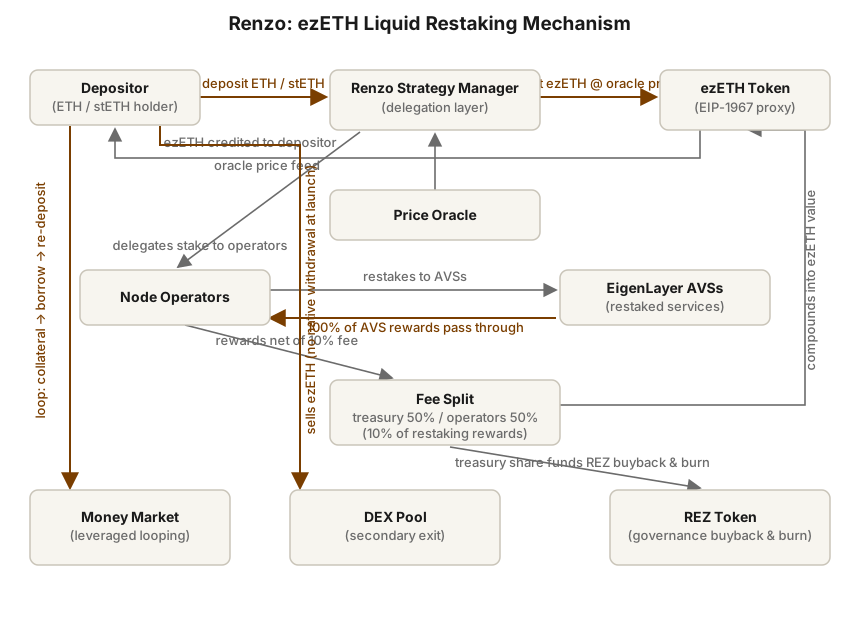 Open full-size diagram
Summary
Renzo is a liquid restaking protocol built as an interface to EigenLayer. Users deposit ETH or stETH and receive ezETH, a "liquid restaking token" (LRT) that represents a restaked EigenLayer position: the underlying stake secures Actively Validated Services (AVSs, later "Autonomous Verifiable Services") while the holder keeps a liquid, DeFi-composable claim. Renzo launched on Ethereum mainnet in late 2023 (deposits opened October 2023; full launch December 2023), raised a $3.2M seed led by Maven11 in January 2024, and rode the EigenLayer points meta to roughly $3.3B in TVL by April 2024 — one of the two or three largest LRTs. It is best known for two things: helping define the LRT category, and the April 24, 2024 ezETH depeg — a crash to as low as $688 on thin DEX liquidity (versus ETH ~$3,150) triggered by a badly communicated REZ airdrop/tokenomics announcement, causing $56–60M+ in leveraged-looper liquidations. The protocol survived, shipped withdrawals, expanded multi-chain and multi-asset (ezSOL, ezBTC, pzETH on Symbiotic), and by 2025–26 pivoted to fee-driven sustainability with a governance-approved REZ buyback-and-burn, but at a TVL ($111M in mid-2026, per its own site) roughly 97% below peak.
Design (Mechanism)
- Reward-bearing LRT. ezETH is a cToken-style appreciating token: rather than rebasing, one ezETH grows in redemption value against the underlying as staking + restaking rewards compound. Users deposit native ETH or stETH; Renzo mints ezETH against the oracle-priced value of underlying assets (ezETH token:
0xbf5495Efe5DB9ce00f80364C8B423567e58d2110, EIP-1967 transparent proxy). - Strategy manager on EigenLayer. Renzo acts as a delegation/strategy layer: deposited stake is run through node operators and delegated to EigenLayer AVSs, abstracting operator/AVS selection away from the user. Fees: 100% of EigenLayer rewards passed through; a 10% fee on restaking rewards split 50/50 between protocol treasury and node operators.
- Points campaign. Pre-token, Renzo distributed "ezPoints" (on top of EigenLayer points) to depositors, deliberately fueling leveraged "looping" strategies (deposit ezETH as collateral, borrow ETH, re-deposit) on money markets — the dominant LRT growth engine of early 2024.
- No native withdrawals at launch. For months, exit was only possible by selling ezETH on secondary DEX pools — a critical design gap. Withdrawals were later enabled (up to ~15 days delay depending on strategy).
- Token & governance. REZ (10B supply) launched via Binance Launchpool on April 30, 2024; airdrop initially 5% for season 1 (raised to 7% after backlash; 12% total earmarked for users). Governance later approved "Renzo Riduzione": buying back and burning 10% of REZ supply over six months using protocol revenue (first burn: ~1.14% of supply, Q3 2025 revenue).
- Expansion. Cross-chain ezETH (Arbitrum, Base, BNB, etc. via bridged tokens), pzETH on Symbiotic, ezSOL on Solana (Jito), ezBTC — a bet on "restaking-everything" beyond EigenLayer.
Outcome
Partial success. Renzo captured enormous share of the 2024 restaking wave (~$3.3B TVL, top-2 LRT behind Ether.fi) and reported ~$82M in cumulative fees earned. But the April 24, 2024 depeg — ezETH crashing 78%+ in under an hour on Uniswap after the not-to-scale pie chart tokenomics reveal, the 5% airdrop allocation, and Binance Launchpool farmers receiving tokens two days before ezETH holders — liquidated $56–60M+ of looped positions and permanently damaged trust. The peg restored within hours (arbitrageurs knew redemption value was intact) and Renzo raised the season-1 allocation to 7%, but as EigenLayer AVS yields disappointed and points meta died, TVL bled down ~97% to ~$111M by mid-2026. The protocol remains live, revenue-generating, and governance-active (buyback-and-burn), with its X presence now @renzoai — a smaller, ongoing business rather than the category winner.
Why it worked
- Right product, right moment: ezETH packaged EigenLayer exposure — points, restaking yield, liquidity — into one token exactly when the market wanted it, with stETH accepted as a deposit asset lowering switching costs.
- Compounding points flywheel: ezPoints + EigenLayer points + money-market looping created reflexive TVL growth measured in billions within months.
- Sound core accounting: the reward-bearing (non-rebasing) design and intact redemption value meant the depeg was a liquidity event, not insolvency — the peg mean-reverted.
Why it failed or underperformed
- Airdrop communication failure: a not-to-scale tokenomics pie chart, a 5% allocation perceived as stingy, and Launchpool farmers unlocked before loyal depositors converted the community-reward moment into a trust crisis.
- No withdrawals + leveraged loops = fragility: with redemption unavailable, secondary DEX pools were the only exit; when the points window closed, thin liquidity met one-way selling and cascading liquidations of looped positions.
- Underlying-yield disappointment: AVS payouts on EigenLayer never justified the risk stack (LST risk + restaking slashing risk + bridge risk + oracle risk), so once points ended, the capital left the whole LRT category — Renzo included.
Lessons
- Points-farmed TVL is rented, not owned; when the incentive ends, exit design (native withdrawals, deep liquidity) determines whether you get an orderly outflow or a depeg cascade.
- Airdrop communication is a mechanism: allocation size, unlock ordering across cohorts (exchange farmers vs. depositors), and even chart honesty directly price into the token users hold.
- A wrapper token's peg is only as strong as its worst exit path — if redemption is disabled, the DEX pool becomes the de facto oracle and the protocol's systemic-risk surface.
- Passing through 100% of headline rewards while monetizing a thin fee layer only works if the underlying yield (AVS payments) materializes; Renzo's revenue-funded buyback shows a viable but far smaller steady state.
Redesign (EDITORIAL — hypothesis, not fact)
This section is editorial hypothesis, not established fact. A redesigned Renzo would (1) ship native withdrawals before or at TGE, with a protocol-owned liquidity backstop sized to plausible points-end outflows; (2) publish exact airdrop percentages and cohort unlock schedules in machine-readable form, with depositors unlocked no later than exchange farmers — treating distribution ordering as part of the mechanism, not marketing; (3) cap or disincentivize looped leverage against ezETH (e.g., deposit caps per collateralization source) to reduce reflexive fragility; and (4) tie ezPoints to time-weighted, withdrawal-penalty-free commitments so TVL decays gradually rather than cliff-exiting. Longer term, an LRT whose fee comes only from realized AVS revenue (not TVL-based skim) would have been forced to confront the weak AVS-yield reality earlier and rightsized before, not after, a $3B round trip.
Sources
- ezETH — Renzo Protocol Docs — primary (docs)
- ezETH token contract (Etherscan) — primary (contract)
- REZ Buyback & Burn Program (Renzo governance forum) — primary (governance)
- Renzo Protocol official site — primary (docs)
- Renzo's ezETH depegs 18.3% following REZ tokenomics announcement — The Block (news)
- Renzo increases airdrop allocation slightly after community outrage and temporary ezETH depeg — The Block (news)
- Depeg of $3B restaking token ezETH causes over $60M in DeFi liquidations — Protos (news)
- Renzo's ezETH Depeg Amid Criticism of Airdrop Underlines Broader Risks in Restaking — Unchained (analysis)
- Renzo TVL, Fees & Revenue — DefiLlama (analysis)
- Renzo Protocol — IQ.wiki (analysis)
Related experiments
Last verified: 2026-07-27 · Spot an error? Suggest a correction